Keep our news free from ads and paywalls by making a donation to support our work!

Notes from Poland is run by a small editorial team and is published by an independent, non-profit foundation that is funded through donations from our readers. We cannot do what we do without your support.
Poland has joined a European Union project developing a secure satellite internet service that would provide an alternative to networks such as Elon Musk’s Starlink.
Warsaw has committed €656 million (2.8 billion zloty) to the IRIS² programme, with the money coming from Poland’s EU post-pandemic recovery funds.
In return for joining the project, Poland will gain access to the secure satellite communications network for government institutions, the armed forces and emergency services, while the growing Polish space industry will be eligible to compete for contracts linked to the development of the constellation
Today Poland🇵🇱joins the EU🇪🇺space programme #IRIS² w/additional €656 mln.
🇵🇱 is on a remarkable space journey to build a strong space economy & secure connectivity for the defence of Poland, the Eastern Flank & 🇪🇺.
IRIS² brings greater unity & strength for the entire Europe. pic.twitter.com/TwS59vpXtm
— Andrius Kubilius (@KubiliusA) July 21, 2026
“This is a big day for Poland, the eastern flank and the entire European Union,” declared the EU’s defence and space commissioner, Andrius Kubilius, at a signing ceremony in Warsaw on Tuesday. “By investing in space, Poland is investing in its security, its economy and its future.”
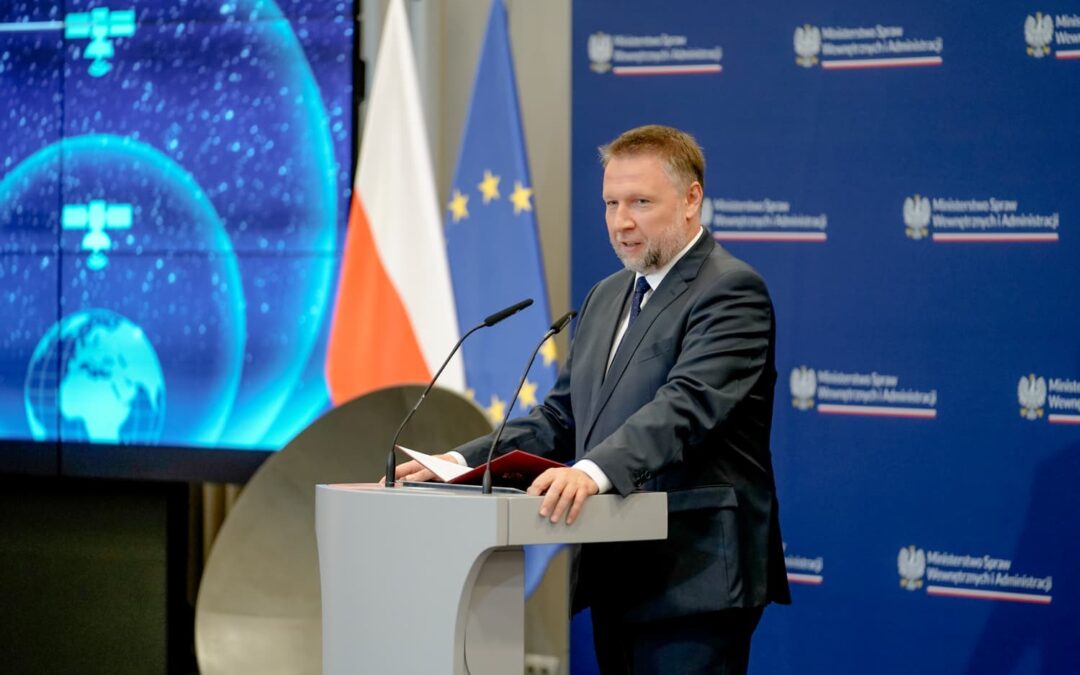
Speaking alongside him, Poland’s interior minister, Marcin Kierwiński, said that IRIS² would help “ensure our security and strategic independence” while “demonstrating that Poland aims to be a leader in the European space industry and remain at the centre of EU security efforts”.
“No single country is able to build such a [satellite] constellation so efficiently, which is why we are joining this major project – to be part of it and one of its managers,” he added.
The IRIS² programme aims to deploy a constellation of nearly 300 satellites in low and medium Earth orbit, providing encrypted, interference-resistant communications for governments, defence agencies, emergency services and selected commercial users across the EU.
First announced in 2022, the project is part of the EU’s efforts to reduce dependence on non-European satellite operators amid growing concerns over cybersecurity, hybrid threats and the resilience of critical infrastructure following Russia’s invasion of Ukraine.
“It is super important for Europe to have a sovereign capacity, and Starlink will never do that,” said Eva Berneke, CEO of Eutelsat, one of the companies involved in the project, quoted by Politico Europe.
The project is expected to cost €10.6 billion, including €6.5 billion in public funding and around €4 billion from private investors. IRIS² is expected to become operational in 2030.
🇪🇺 The IRIS program is Europe's replacement for Starlink. The constellation will consist of over 300 satellites to serve Europe alone. Security and sovereignty! Like Galileo, it could surpass its US counterpart. Fewer satellites, smarter coverage. Eventually more could be added pic.twitter.com/Uswmuotw7F
— Mariska den Eelden 🇪🇺🇳🇱 (@eeldenden) February 22, 2025
As part of its contribution to IRIS², Poland will finance six large satellites in medium Earth orbit (MEO) and six smaller satellites in low Earth orbit (LEO).
It will also build a ground gateway station in Warsaw to connect the satellites with GovNet, the country’s secure government fibre-optic communications network.
Earlier this year, the Polish government approved the use of money from its share of the EU’s post-pandemic reconstruction fund to cover its contribution to IRIS².
Sięgamy gwiazd!! Polska przystępuje do europejskiego programu budowy bezpiecznej łączności satelitarnej 🛰️📡! W ten sposób zaspokoimy wszystkie potrzeby łączności służb i administracji państwowej. IRIS² zapewni nam bezpieczeństwo i niezależność. Dziękuję @KubiliusA za współpracę pic.twitter.com/c8u2QH0Wyn
— Marcin Kierwiński (@MKierwinski) July 21, 2026
Once the system is up and running, Poland’s police, border guards and other emergency services would be able to use the network during natural disasters, power outages and other emergencies when terrestrial communications infrastructure is unavailable.
The system would also make it possible to provide temporary connectivity for civilians through emergency hotspots, says Poland’s interior ministry.
Polish companies will now also be able to compete for contracts covering satellite manufacturing, telecommunications equipment, software and ground infrastructure, expanding the country’s role in Europe’s space industry.
“It is estimated that each zloty invested in the project will generate a five-zloty return through new jobs, innovation and the development of domestic technologies,” the ministry said in a statement.
Warsaw has been chosen as the location for a new European Space Agency security centre, as Poland takes another step in its ambitions to become a bigger player in the space sector
The facility will be the @esa's first outside its 11 founding member states https://t.co/WnHIbrW3ze
— Notes from Poland 🇵🇱 (@notesfrompoland) July 13, 2026
Poland has placed great emphasis on developing its space industry in recent years, with the aim of becoming a major European player in the sector.
Last week, the European Space Agency (ESA) announced that it will open a new security centre in Warsaw. One of its areas of operation will be satellite communication, including the use of satellite imagery to monitor critical incidents such as natural disasters.
Prime Minister Donald Tusk also revealed that Poland and the ESA are working on the first Polish spacecraft, which would provide servicing, refuelling and other services for satellites
Last year, Poland launched its first national military satellite. A Polish firm, Creotech Instruments, signed Poland’s largest ever contract with the ESA, a €52 million deal to build and launch a constellation of Earth observation satellites.
Astronaut @astro_slawosz's recent trip to the International Space Station highlighted the Polish space industry's growing importance.
Once limited to making components for others, Poland is now building its own spacecraft and participating in missions https://t.co/TmQiD91IzZ
— Notes from Poland 🇵🇱 (@notesfrompoland) October 6, 2025
Notes from Poland is run by a small editorial team and published by an independent, non-profit foundation that is funded through donations from our readers. We cannot do what we do without your support.
Main image credit: MSWiA (under CC BY-NC-ND 3.0 PL)

Alicja Ptak is deputy editor-in-chief of Notes from Poland and a multimedia journalist. She has written for Clean Energy Wire and The Times, and she hosts her own podcast, The Warsaw Wire, on Poland’s economy and energy sector. She previously worked for Reuters.