Keep our news free from ads and paywalls by making a donation to support our work!

Notes from Poland is run by a small editorial team and is published by an independent, non-profit foundation that is funded through donations from our readers. We cannot do what we do without your support.
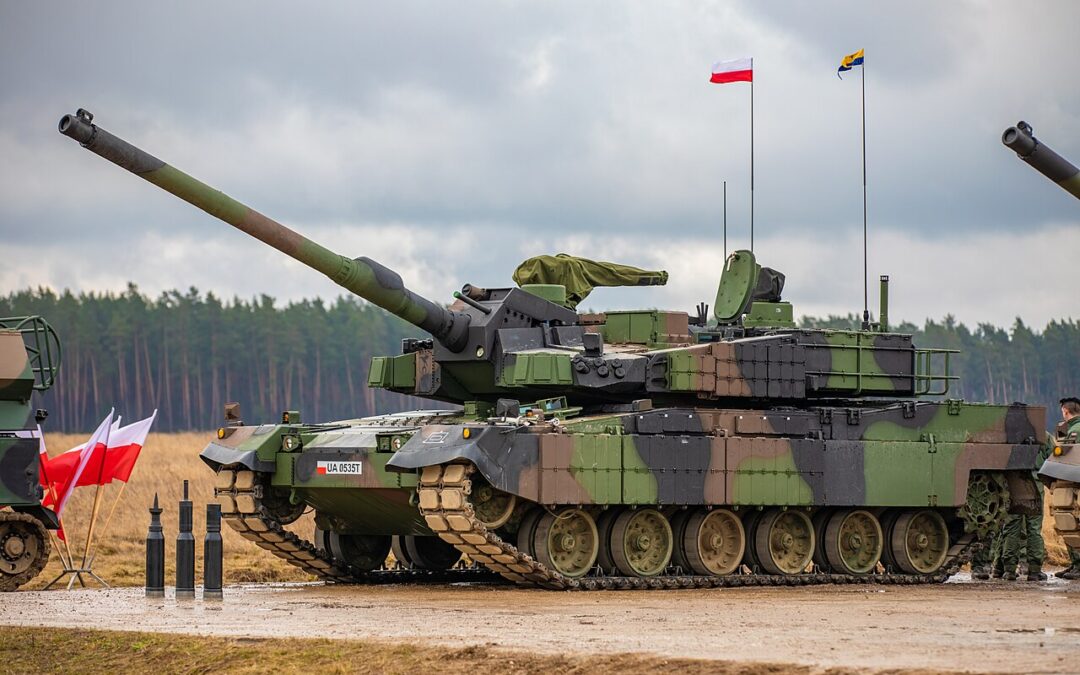
Polish state defence firm Bumar-Łabędy has signed an agreement with South Korea’s Hyundai Rotem setting out the terms of production in Poland of dozens of South Korean K2 tanks. It will be the first time in almost two decades that Poland will manufacture tanks domestically.
The agreement, signed on Monday, formally defines the division of work and payments under a wider 2025 contract in which Poland ordered 180 K2 tanks and 81 support vehicles, some of which were to be produced domestically.
Kolejny krok w programie K2PL
✍️W siedzibie @PGZ_pl podpisano dziś umowę podwykonawczą regulującą działania w zakresie montażu, serwisowania oraz polonizacji czołgów K2 do wersji #K2PL. Porozumienie zostało zawarte pomiędzy Zakładami Mechanicznymi #BumarŁabędy a Hyundai Rotem… pic.twitter.com/JbpJkwRo0Z
— Ministerstwo Aktywów Państwowych 🇵🇱 (@MAPGOVPL) April 27, 2026
Under the plan, Bumar-Łabędy will assemble 61 Polish-configured K2PL tanks and 72 support vehicles. The first K2PL tank is scheduled to roll off the Gliwice production line in 2028. That would be the first time a tank has been produced domestically since the last PT-91M Twardy was completed in 2009.
“Our collaboration with Bumar-Łabędy is the foundation of the K2PL program, enabling the transfer of advanced technologies and the development of modern production capabilities in Poland,” said Yong-bae Lee, president and CEO of Hyundai Rotem.
“Through this partnership, we are not only delivering state-of-the-art tanks but also building long-term industrial competencies…[and] strengthening Poland’s defence capabilities while developing a lasting Polish-Korean industrial partnership,” he added.
Hyundai Rotem is the prime contractor for the programme, while Bumar-Łabędy will act as subcontractor for production work, including assembly of the K2PL variant.
Three additional agreements were also signed on Monday, including with two other companies that are, like Bumar-Łabędy, part of state defence group PGZ. Wojskowe Zakłady Elektroniczne (WZE) and PCO will supply subsystems such as inertial navigation and driver camera systems.
Polish deputy state assets minister Konrad Gołota celebrated the fact that the deal was not only “restoring tank production in Poland”, but also represented a “generational leap for the Polish arms industry”, reports news website WNP.
Należące do @PGZ_pl Zakłady Mechaniczne Bumar-Łabędy z Gliwic i południowokoreański #HyundaiRotem podpisały umowę, która jest ostatnim aktem prawnym na drodze do przywrócenia montażu czołgów podstawowych w Polsce.https://t.co/ipt451vkdM
— WNP.PL (@wnppl) April 27, 2026
In 2022, Poland’s former government signed a framework agreement for the purchase of hundreds of K2 tanks, including plans for many of those to be produced in Poland itself. However, the first order, signed the same year, was for 180 tanks produced in South Korea. Those have all now been delivered.
In 2025, a second order was signed for a further 180 tanks, including 64 that will be in the Polish K2PL variant, 61 of which are to be produced in Poland, reports news website Wirtualna Polska.
Further phases of the programme are planned, with up to six implementation contracts in total. Poland is expected to acquire 1,000 K2 tanks, more than 500 of them in the K2PL version to be produced domestically, reports defence news website Defence24.pl.
Poland has signed a $6.7bn deal to buy a further 180 South Korean K2 tanks, including 61 that will be made in Poland itself.
Once delivery is complete by 2030, Poland will have more tanks than Germany, France, the UK and Italy combined https://t.co/Cw17lGKPSC
— Notes from Poland 🇵🇱 (@notesfrompoland) August 1, 2025
The agreements are part of a huge defence procurement spree launched by Poland in the wake of Russia’s full-scale invasion of Ukraine. By 2030, Poland is expected to operate around 1,100 tanks, which will be more than Germany, France, the UK and Italy combined.
Poland has also signed agreements with Korea to purchase hundreds of K239 Chunmoo rocket artillery systems, K9 self-propelled howitzers, and FA-50 combat aircraft. Some of those deals also include domestic Polish production.
In December, Poland’s WB Electronics and South Korea’s Hanwha Aerospace signed an agreement that will see Poland manufacture over 10,000 CGR-080 precision-guided missiles for the K239 Chunmoo, which will be used by both Poland and Norway.
Poland will manufacture the missiles for rocket artillery systems that Norway is buying from South Korea.
The Norwegian government says that Polish production "will strengthen security of supply for Norway and other European customers of the system" https://t.co/NIJj7owK45
— Notes from Poland 🇵🇱 (@notesfrompoland) January 29, 2026
Recently published data showed that Poland has been the largest arms importer in NATO over the last five years, with 47% of its equipment coming from South Korea and a further 44% from the United States.
However, the government has been seeking to boost domestic production, including through EU-backed financing and partnerships with foreign firms.
In February, US defence firm Northrop Grumman and Polish manufacturer Niewiadów-PGM announced plans to jointly produce more than 180,000 155-mm artillery shells annually in Poland. PGZ has also partnered with Britain’s BAE Systems on ammunition production.
Poland has been NATO's biggest importer of arms over the last five years, according to new data from @SIPRIorg.
Over 90% of Polish imports have come from South Korea and the United States https://t.co/jij0nfbhFc
— Notes from Poland 🇵🇱 (@notesfrompoland) March 9, 2026
In March, PGZ signed an agreement with Estonia’s Frankenburg Technologies to establish a facility in Poland producing up to 10,000 low-cost anti-drone missiles per year. The same month, a Polish-Ukrainian joint venture was announced to manufacture Ukraine’s Bohdana howitzer in Poland.
Menanwhile, Polish defence firm Mesko, which is also part of PGZ, announced record financial results in 2025 on the back of growing international demand for its Piorun air-defence systems.
Notes from Poland is run by a small editorial team and published by an independent, non-profit foundation that is funded through donations from our readers. We cannot do what we do without your support.
Main image credit: Staff Sgt. Matthew Foster / Wikimedia Commons (under public domain)

Alicja Ptak is deputy editor-in-chief of Notes from Poland and a multimedia journalist. She has written for Clean Energy Wire and The Times, and she hosts her own podcast, The Warsaw Wire, on Poland’s economy and energy sector. She previously worked for Reuters.