Keep our news free from ads and paywalls by making a donation to support our work!

Notes from Poland is run by a small editorial team and is published by an independent, non-profit foundation that is funded through donations from our readers. We cannot do what we do without your support.
The government’s majority in parliament has adopted a resolution pledging to take into account the wishes of the judicial community when selecting new members of the body responsible for nominating judges.
The move represents a “plan B” adopted by the government after opposition-aligned President Karol Nawrocki vetoed a bill that would have changed how members of the National Council of the Judiciary (KRS) are chosen.
Sejm przyjął uchwałę, która głosi, że Izba, wybierając sędziowski skład do KRS, uwzględni wyniki wyborów dokonanych przez sędziów #PAPInformacje pic.twitter.com/vC9iqAtosY
— PAP (@PAPinformacje) February 27, 2026
Until 2017, most of KRS’s members were elected by judges themselves. That year, however, the former national-conservative Law and Justice (PiS) government changed the system so that most members were chosen by politicians.
That political influence removed the KRS’s independence and thereby rendered it illegitimate, according to multiple Polish and European court rulings, as well as many expert bodies and Polish judges themselves.
The current government has pledged to restore the legitimacy of the KRS by again having most members elected by judges. However, a first attempt to do so was blocked in 2024 by then-President Andrzej Duda, a PiS ally, and then a revised bill was vetoed last week by Nawrocki.
Opposition-aligned President @NawrockiKn has vetoed a government bill intended to reform a judicial body at the heart of Poland’s rule-of-law crisis.
He argued that the measures would simply create even greater “legal chaos” https://t.co/I7FHRKIoP1
— Notes from Poland 🇵🇱 (@notesfrompoland) February 19, 2026
That means that 19 of the KRS’s 25 members must still be chosen by the Sejm, the more powerful lower house of parliament, under the rules introduced by PiS.
In addition, two members are elected by the Senate, one is appointed by the president, and three more – the Supreme Court chief justice, the justice minister, and the president of the Supreme Administrative Court – sit on the body based on the other position they hold.
With the four-year terms of current KRS members set to expire on 12 May, the speaker of the Sejm was required earlier this month to launch the process of selecting replacements under existing rules.
Today, the Sejm approved a resolution that is part of what the government calls a “plan B” that would allow judges to play a decisive role in picking KRS candidates, even though parliament would formally elect them under the current law.
The resolution says that the current KRS “is not a body independent of other authorities” because its judicial members are not representatives of the broader judicial community or of all types of courts.
It adds that, since “the effectiveness of the statutory changes adopted by the parliament was prevented by the refusal of the president to sign them, a special responsibility for restoring the constitutional standards of the KRS rests with the judicial community”.
The resolution also said that Sejm “will take into account in its decisions the results of elections held by Polish judges in a universal and transparent” manner.
The resolution was approved with 237 votes in favour, mostly from the ruling coalition, while 199 MPs, mainly from PiS and the far-right Confederation (Konfederacja), voted against it.
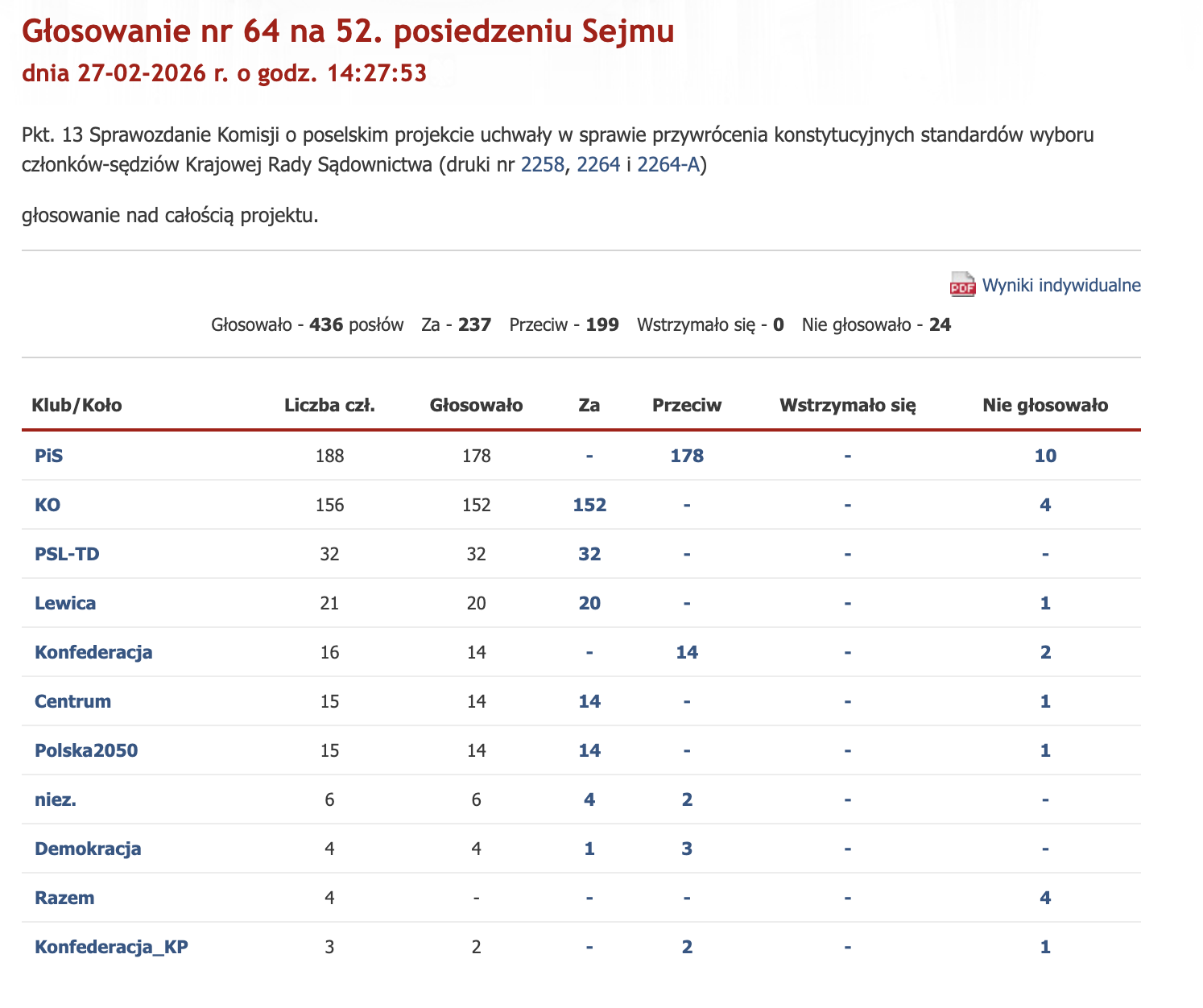
How MPs from various parliamentary caucuses voted on the resolution (za = for, przeciw = against, nie głosowało = did not vote). Source: Sejm
According to Dziennik Gazeta Prawna, a leading daily, the presidents of ten of Poland’s 11 appellate courts have said they are ready to help organise votes within the judiciary.
Under their proposal, judicial assemblies would vote on candidates, and the Sejm would appoint those who receive the strongest support.
“Although the election of the judicial members of the KRS would be made by politicians, the Sejm’s acceptance of the nominations of all judges would ensure that such a body would meet constitutional standards and guarantee independence from political authorities,” the court presidents said in a statement.
The speaker of parliament has launched the process of selecting new members of a key judicial body, despite the fact that it will take place under rules introduced by the former government that the current authorities regard as illegitimate https://t.co/6zw6ORLyMv
— Notes from Poland 🇵🇱 (@notesfrompoland) February 12, 2026
The ruling coalition argues that reforming the KRS is necessary to ensure legal certainty, as there are questions over the 3,000 or so judges appointed since the KRS was overhauled by PiS and the hundreds of thousands of rulings issued by them.
PiS has defended the existing model, saying that allowing judges to elect fellow judges risks creating closed networks and weak democratic accountability.
“Judges in the KRS must have strong democratic legitimacy. Legitimacy that comes from the nation, not from your narrow, hermetic group of judges,” PiS MP and former deputy justice minister Sebastian Kaleta, told the Sejm, quoted by Dziennik Gazeta Prawna.
He described the resolution as a “smokescreen” aimed at achieving “the complete political takeover of the KRS”.
Fifteen months since the change of government, Poland's rule-of-law crisis continues – indeed, many Poles think the situation has got worse.@J_Jaraczewski explains the roots of the crisis, what its impact has been, and how it might be resolved https://t.co/7KOCURV3dU
— Notes from Poland 🇵🇱 (@notesfrompoland) March 17, 2025
Notes from Poland is run by a small editorial team and published by an independent, non-profit foundation that is funded through donations from our readers. We cannot do what we do without your support.
Main image credit: Sejm RP/X

Alicja Ptak is deputy editor-in-chief of Notes from Poland and a multimedia journalist. She has written for Clean Energy Wire and The Times, and she hosts her own podcast, The Warsaw Wire, on Poland’s economy and energy sector. She previously worked for Reuters.