Keep our news free from ads and paywalls by making a donation to support our work!

Notes from Poland is run by a small editorial team and is published by an independent, non-profit foundation that is funded through donations from our readers. We cannot do what we do without your support.
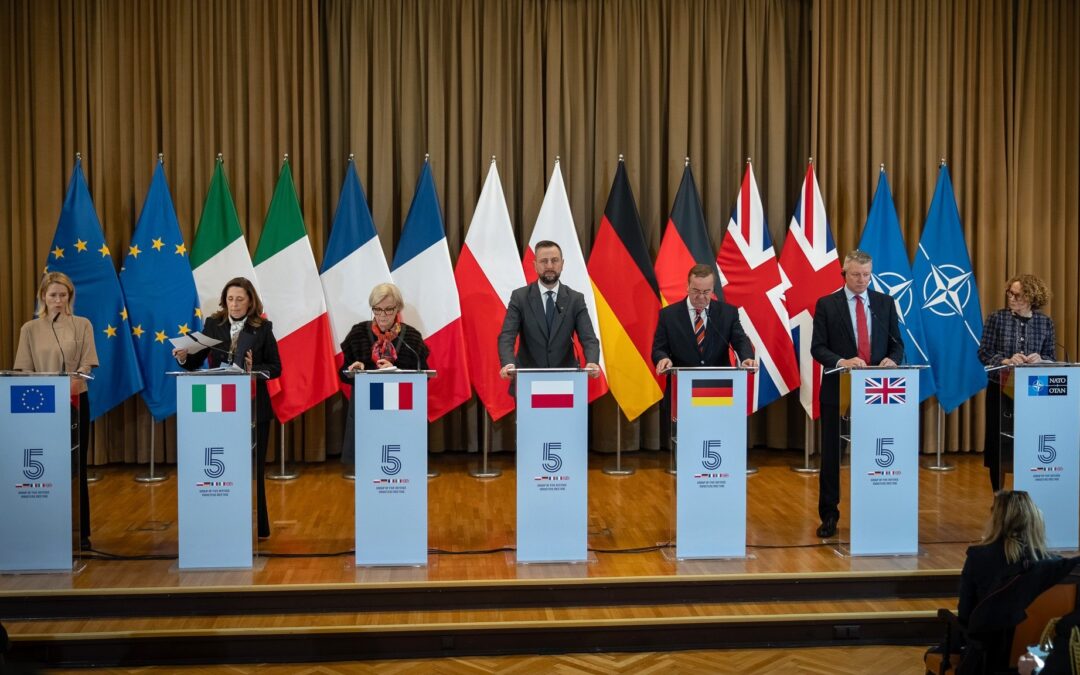
Poland, Germany, France, Italy and the UK have agreed to jointly develop and procure low-cost air defence systems, including drones and missiles, with the aim of boosting Europe’s ability to deal with growing aerial threats, especially from Russia.
The announcement was made during a summit on Friday in Kraków, southern Poland, of the so-called European Group of Five (E5). NATO deputy secretary general Radmila Šekerinska and the EU’s foreign policy chief, Kaja Kallas, also attended.
Podczas krakowskiego spotkania Grupy 5 Europejskich Ministrów Obrony #E5 potwierdziliśmy jedność Europy i wspólną odpowiedzialność za nasze bezpieczeństwo. Podpisaliśmy ważne zobowiązanie dotyczące wspólnego rozwoju zdolności rażenia z wykorzystaniem niskokosztowego uzbrojenia… pic.twitter.com/HUV41I1IKh
— Władysław Kosiniak-Kamysz (@KosiniakKamysz) February 20, 2026
In a joint statement, the quintet said they had agreed to launch the Low-Cost Effectors and Autonomous Platforms (LEAP) initiative. Effectors are weapons systems mounted on equipment such as drones, while autonomous platforms are the actual unmanned aerial vehicles themselves.
“In doing so, we aim to prevent potential aggression by Russia and ensure the capacity to respond to a broad range of threats,” said the group.
“Alongside cooperation on traditional weapons systems, this will improve our collective security within the alliance, help fulfil NATO capability requirements, and strengthen European cooperation with a view to greater burden-sharing among allies.”
The initiative is partly a response to growing incidents of air incursions and airspace violations by Russia and Belarus against NATO countries.
In September, Poland and its NATO allies shot down a number of Russian military drones that entered Polish airspace in what authorities called an “unprecedented violation”.
That response was initially heralded as a successful show of NATO’s resolve, but it quickly became clear that Poland and other countries on the eastern front lacked adequate anti-drone defence capabilities.
Expensive jets and their expensive missiles, costing over a million euros a piece, were used to destroy cheap Russian weapons. Only three out of 21 drones were neutralised, while Ukraine, by comparison, normally takes down over 90% of Russian swarms.
Poland has raised defence spending to the highest relative level in NATO, buying hundreds of tanks, aircraft, howitzers and other hardware.
But the recent Russian drone incursions have reignited a difficult question: is Poland preparing for the right war? https://t.co/Uya7dizUPi
— Notes from Poland 🇵🇱 (@notesfrompoland) October 25, 2025
“Technologies and combat techniques are changing rapidly – we must react quickly and appropriately,” said Polish defence minister Władysław Kosiniak-Kamysz.
“We need to make sure that we are matching the cost of the threats with the cost of defence,” commented the UK’s minister of state for defence readiness and industry, Luke Pollard, quoted by Politico Europe.
The UK government said in a separate statement that the first project under the LEAP initiative will be delivered by 2027. Pollard referred to the initiative as a “multi-million pound, multi-million euro commitment”, reports Reuters.
The E5 defence ministers also reiterated their commitment to boosting respective defence spending to 5% of GDP as agreed by NATO. Poland is already close to hitting that target, with its defence budget set to reach 4.8% of GDP this year, the largest relative figure in NATO.
Today I represented the United Kingdom at the E5 meeting in Poland of Europe’s five largest defence powers.
We announced a new joint low cost effector we will develop jointly to take out drones and air threats.
We also reinforced our collective support for Ukraine. pic.twitter.com/vvsruRhm0a
— Luke Pollard MP (@LukePollard) February 20, 2026
Last month, Poland signed an agreement with Norwegian partners to develop a new anti-drone system called SAN, which Warsaw claims will be the first of its kind in Europe and is intended to protect the country’s eastern borders.
Part of the funding for SAN comes from the EU’s Security Action for Europe (SAFE) programme, which is providing almost €44 billion (185 billion zloty) in loans for Poland to support its defence spending.
In their statement on Friday, the E5 defence ministers “welcomed the EU’s commitment to providing member states with increased fiscal flexibility for defence spending and to create lending instruments”.
However, the SAFE programme has been mired in domestic political controversy in Poland, where the right-wing opposition has urged conservative President Karol Nawrocki to try to block the funds, arguing they will place Warsaw under stronger influence from Brussels and potentially anger Washington.
Poland has signed an agreement for a new anti-drone system that it claims will be the first of its kind in Europe.
The network is intended to protect Poland’s eastern borders, where last year around 20 Russian drones crossed in an unprecedented incursion https://t.co/WhWhJxDwXA
— Notes from Poland 🇵🇱 (@notesfrompoland) January 30, 2026
Notes from Poland is run by a small editorial team and published by an independent, non-profit foundation that is funded through donations from our readers. We cannot do what we do without your support.
Main image credit: MON (under CC BY-NC-ND 4.0)

Olivier Sorgho is senior editor at Notes from Poland, covering politics, business and society. He previously worked for Reuters.