Keep our news free from ads and paywalls by making a donation to support our work!

Notes from Poland is run by a small editorial team and is published by an independent, non-profit foundation that is funded through donations from our readers. We cannot do what we do without your support.
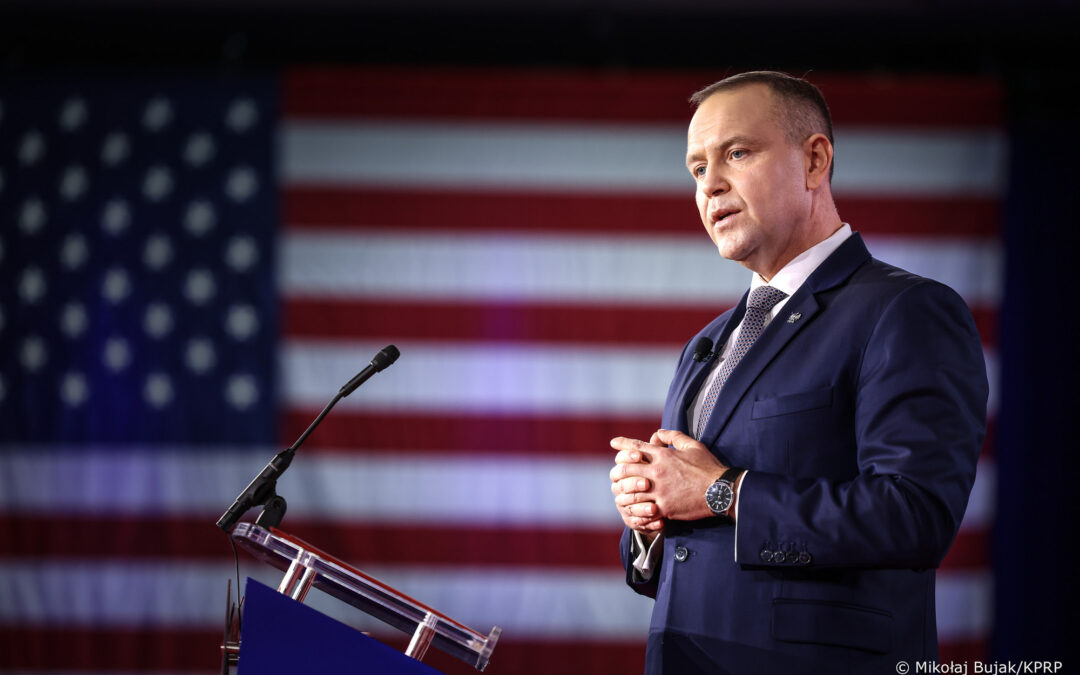
President Karol Nawrocki has proposed a law that would imprison for up to ten years officials who “persistently question” his powers or those of judicial institutions filled with appointees from the time of the former Law and Justice (PiS) government.
Meanwhile, judges who refuse to recognise the status of colleagues who were illegitimately appointed under PiS’s rule would be removed from the profession under the measures proposed by Nawrocki, who was elected as president last year with the support of PiS
The government, which regularly clashes with the president, has condemned his “autocratic” plans, saying they would “put judges under his boot” and force Poland to leave the European Union.
🔵 Projekt złożonej wczoraj w Sejmie prezydenckiej ustawy o przywróceniu prawa do sądu oraz rozpoznania sprawy bez nieuzasadnionej zwłoki ma na celu:
➡️ zapewnienie prawa do sądu i rozpoznania sprawy bez nieuzasadnionej zwłoki,
➡️ umocnienie niezależności i bezstronności sądów,… pic.twitter.com/dI1MBcrZj7— Zbigniew Bogucki🇵🇱 (@BoguckiZbigniew) February 20, 2026
On Thursday, Nawrocki announced that he was vetoing a government bill intended to reform the National Council of the Judiciary (KRS), the body responsible for nominating judges and which has been at the heart of Poland’s rule-of-law crisis since being overhauled by PiS in 2017.
Instead, Nawrocki submitted his own alternative bill to parliament that he said would help resolve the “ongoing disintegration of the justice system”.
Under the proposed law, it would be illegal for a “public official to persistently question, within the scope of their duties, the constitutional or statutory powers of the president of Poland, the Constitutional Tribunal, the National Council of the Judiciary, or the Tribunal of State, or acts or rulings issued by these bodies”.
Anyone who does so would be imprisoned for between six months and five years. If the perpetrator is found to have done so “in order to gain financial or personal benefit”, they would face an even tougher sentence of between one and ten years.
The bill also includes prison sentences of up to five years for officials who “persistently question the validity of the constitution or statutes regulating the system of courts and the procedure for appointing a judge, or refuse to apply them”, or who seek to assess the legality of the appointment of a judge.
However, the draft law adds that an official would not be guilty of any of the above offences if they were “acting within the scope of their constitutional or statutory powers”.
The proposed measures are aimed at ending Poland’s current “dual” legal system, where certain judges and their rulings are recognised by one side but not by the other.
The situation stems from PiS’s overhaul of the KRS in 2017. Previously, most of its members had been chosen by judges themselves; after PiS’s reform, most were chosen by politicians.
A number of Polish and European court rulings have found that PiS’s actions rendered the KRS illegitimate, because it was no longer independent. That in turn called into question the validity of the 3,000 or so judges appointed through the KRS since then, and the hundreds of thousands of rulings issued by them.
The current government, which replaced PiS in office in 2023, has sought to resolve the situation by restoring the KRS to its former status and annulling many of the judicial appointments made through it since 2017. However, those measures are opposed by Nawrocki, who has the power to veto them.
Opposition-aligned President @NawrockiKn has vetoed a government bill intended to reform a judicial body at the heart of Poland’s rule-of-law crisis.
He argued that the measures would simply create even greater “legal chaos” https://t.co/I7FHRKIoP1
— Notes from Poland 🇵🇱 (@notesfrompoland) February 19, 2026
The president’s new proposals would seek to criminalise and jail those who question the validity of post-2017 judges and institutions staffed by them. For example, around 60% of current judges on the Supreme Court were appointed through the KRS after it was overhauled by PiS.
Meanwhile, the current government also does not recognise the legitimacy of the Constitutional Tribunal because some of its judges (who are not nominated by the KRS) were appointed unlawfully by the PiS-era parliament and former PiS-aligned President Andrzej Duda.
Another element of Nawrocki’s bill would remove from the profession any judge who refused to sit on a bench with illegitimately appointed judges or challenges the rulings of such judges, as has often happened.
Given that it is Poland’s president who ultimately appoints judges to courts after they are recommended by the KRS or parliament, both Duda and Nawrocki have criticised dissenting judges and political opponents who have questioned the legal status of judicial appointments made by them.
Thirty judges on Poland's Supreme Court – almost a third of those working at the institution – have declared they will not adjudicate alongside colleagues appointed after the government's judicial overhaul, which they say rendered such nominations invalid https://t.co/jsFW62gWih
— Notes from Poland 🇵🇱 (@notesfrompoland) October 17, 2022
Nawrocki’s proposal was immediately condemned by justice minister Waldmar Żurek. He said that the bill was even more punitive than the disciplinary measures for dissenting judges introduced under PiS, which was nicknamed the “muzzle law”.
“This is not just a muzzle, it’s a leash for Polish judges,” said Żurek, who was himself a judge who faced disciplinary action under the PiS government.
“It’s intended to punish judges who apply EU rulings and rulings of legitimate Supreme Court judges,” he added, quoted by the Polish Press Agency (PAP). “This is unprecedented. It would take us back to the legal Middle Ages. If we tried to pass this bill, we’d have to leave the EU.”
Deputy justice minister Dariusz Mazur said that Nawrocki’s bill aimed to introduce “absolute, autocratic power over the justice system” and “put judges under his boot”.
Yesterday, President Karol Nawrocki announced a draft bill ostensibly aimed at restoring the right to a court hearing without undue delay. Fortunately, he lacks the power to enforce it, as the far-right parties supporting him do not hold a parliamentary majority.
What is truly…
— Dariusz Mazur (@_Dariusz_Mazur) February 20, 2026
On Friday, after the president’s bill was submitted to parliament, the speaker of the lower-house Sejm, Włodzimierz Czarzasty, condemned the proposal, which he said “violates judicial independence and the separation of powers”.
Given that the government has a majority in parliament, there is no chance the president’s bill will be passed during the current term, which runs until the next parliamentary election, due in autumn 2027.
However, the measures are a signal of intent of what Nawrocki could seek to do if a government formed from the current right-wing opposition parties wins power in that election.
When announcing the bill on Thursday, Nawrocki said that, if the government “rejects dialogue” on the issue, he would seek to call a national referendum on his proposals and “let the citizens decide”. However, the president can only call a referendum with the approval of parliament.
Fifteen months since the change of government, Poland's rule-of-law crisis continues – indeed, many Poles think the situation has got worse.@J_Jaraczewski explains the roots of the crisis, what its impact has been, and how it might be resolved https://t.co/7KOCURV3dU
— Notes from Poland 🇵🇱 (@notesfrompoland) March 17, 2025
Notes from Poland is run by a small editorial team and published by an independent, non-profit foundation that is funded through donations from our readers. We cannot do what we do without your support.
Main image credit: Mikołaj Bujak/KPRP

Daniel Tilles is editor-in-chief of Notes from Poland. He has written on Polish affairs for a wide range of publications, including Foreign Policy, POLITICO Europe, EUobserver and Dziennik Gazeta Prawna.