Keep our news free from ads and paywalls by making a donation to support our work!

Notes from Poland is run by a small editorial team and is published by an independent, non-profit foundation that is funded through donations from our readers. We cannot do what we do without your support.
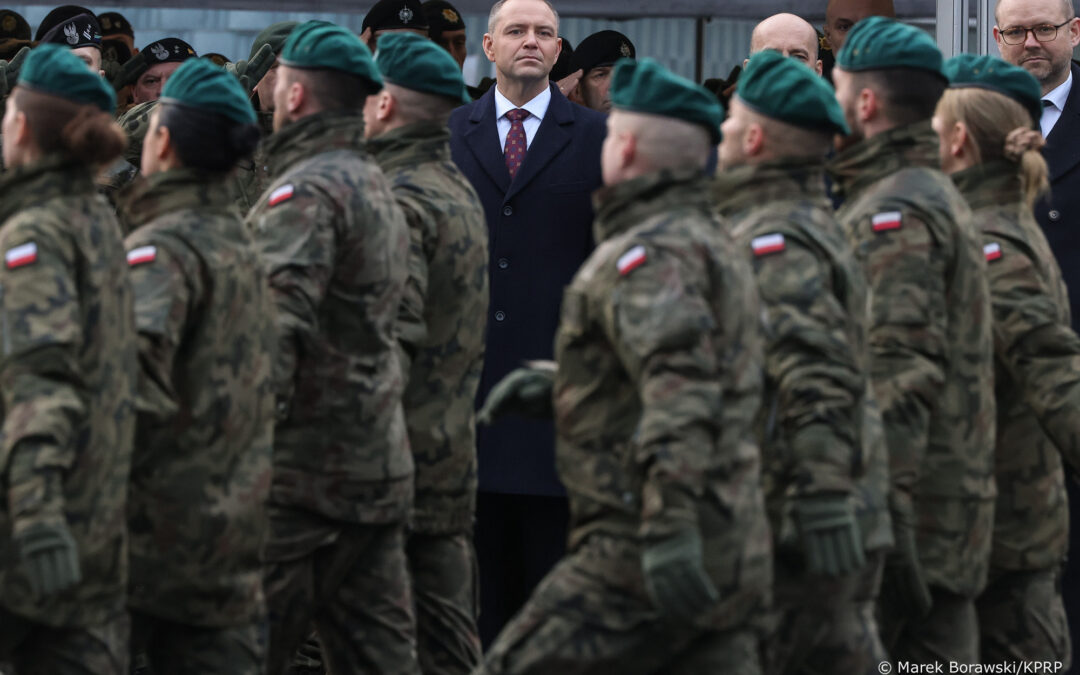
President Karol Nawrocki has called for Poland to seek a nuclear deterrent, saying that it is necessary in the face of an “aggressive, imperial Russia”.
Speaking on Sunday to Polsat News, Nawrocki was asked about German Chancellor Friedrich Merz’s comments at the ongoing Munich Security Conference, where he revealed that he has “begun confidential talks with the French President [Emmanuel Macron] on European nuclear deterrence”.
“I’m a huge advocate of Poland joining a nuclear project,” responded Nawrocki, saying that it would help “build Poland’s security”.
Prezydent @NawrockiKn:
„Jestem zdecydowanym zwolennikiem przystąpienia Polski do projektu nuklearnego. Droga do budowy 🇵🇱 potencjału nuklearnego, z pełnym poszanowaniem wszystkich międzynarodowych regulacji, to kierunek, którym powinniśmy podążać”
TAK
pic.twitter.com/LGRbAoyoJO— Adam Czarnecki (@czardam) February 15, 2026
Pressed as to whether this should mean so-called “nuclear sharing” with other allies or Poland developing its own programme, Nawrocki said only that “the path to Polish nuclear potential, while respecting all international regulations, is the path we should take”.
“We need to start acting in this direction so that we can begin work,” continued the president. “We are a country right on the border of an armed conflict [in Ukraine]. It is clear what the aggressive, imperial Russia’s attitude toward Poland is.”
Asked whether he was concerned about the Russian response to Poland seeking a nuclear deterrent, Nawrocki said that “Russia can react aggressively to anything” and that it is important for Poles “to feel safe”.
Relations between Warsaw and Moscow have been particularly tense in recent times. Operatives working on behalf of Russia have carried out a campaign of so-called “hybrid actions” in and against Poland, including sabotage, cyberattacks and disinformation.
Meanwhile, the Kremlin has regularly accused the Polish authorities of having a hostile, “Russophobic” attitude. An opinion poll published last month showed that 62% of Russians regard Poland as an “enemy”, the joint most (alongside Lithuania) of any country included in the study.
The idea of establishing some form of nuclear deterrent has resurfaced periodically in Poland since Russia’s full-scale invasion of Ukraine in 2022. That year, Nawrocki’s predecessor, Andrzej Duda, said that Poland was open to hosting nuclear weapons and had discussed the idea with the United States.
Poland has "declared our readiness" to host nuclear weapons from NATO allies, says President @AndrzejDuda.
In response, Russia says it is "analysing the situation" and will "take all necessary steps to ensure our security" https://t.co/MEIsWgOUuI
— Notes from Poland 🇵🇱 (@notesfrompoland) April 22, 2024
Two years later, Duda reiterated that Poland was willing to host nuclear weapons from its NATO allies and, in 2025, he said that he welcomed Macron’s idea of extending France’s “nuclear umbrella” to cover European allies.
However, at the same time, Prime Minister Donald Tusk said that it might be better for Poland to develop “our own nuclear arsenal” rather than rely on those of other countries.
The government, which regularly clashes with the opposition-aligned Nawrocki but has tried to present a united front on issues of national security, has not yet commented on the president’s latest remarks.
President @AndrzejDuda has welcomed @EmmanuelMacron's proposal to extend France's nuclear umbrella to cover European allies.
Prime Minister @donaldtusk, meanwhile, has gone even further, suggesting that Poland could develop its own nuclear arsenal https://t.co/n1i5yxp4Qu
— Notes from Poland 🇵🇱 (@notesfrompoland) March 10, 2025
Notes from Poland is run by a small editorial team and published by an independent, non-profit foundation that is funded through donations from our readers. We cannot do what we do without your support.
Main image credit: Marek Borawski/KPRP

Daniel Tilles is editor-in-chief of Notes from Poland. He has written on Polish affairs for a wide range of publications, including Foreign Policy, POLITICO Europe, EUobserver and Dziennik Gazeta Prawna.