Keep our news free from ads and paywalls by making a donation to support our work!

Notes from Poland is run by a small editorial team and is published by an independent, non-profit foundation that is funded through donations from our readers. We cannot do what we do without your support.
A Polish appeals court has upheld the five-and-a-half-year prison sentences given to two Russian men convicted of recruiting for the mercenary Wagner Group in Poland and working on behalf of Russian intelligence by distributing propaganda materials.
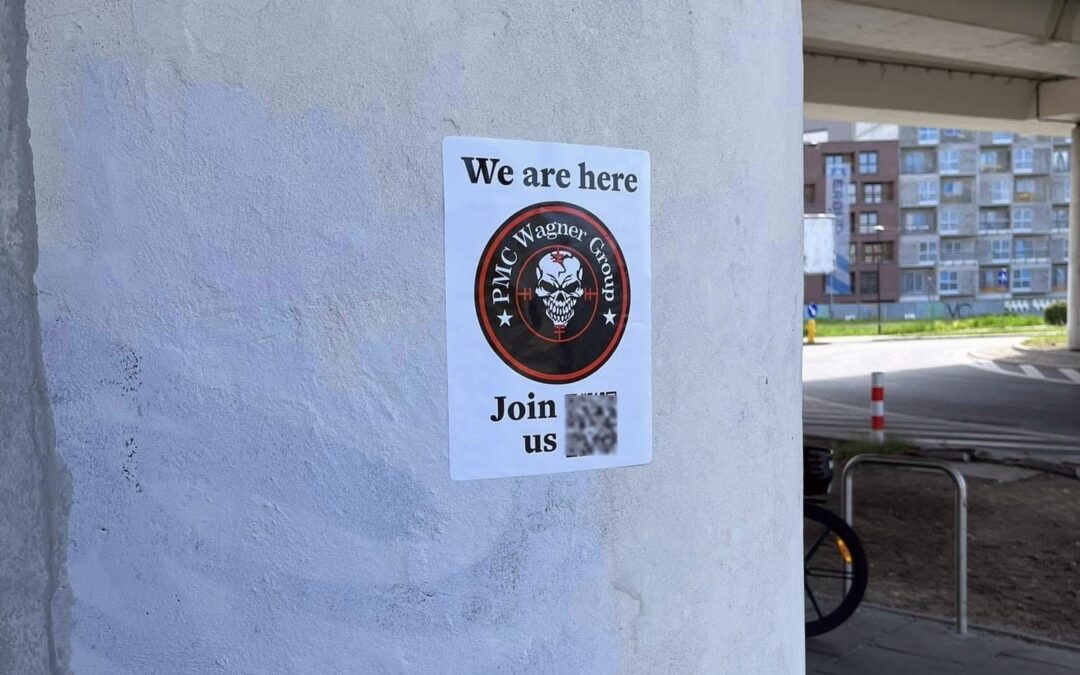
The men, who can only be named as Andrei G. and Alexei T. under Polish privacy law, were convicted last year of recruiting for a terrorist organisation after they placed hundreds of stickers in Warsaw and Kraków that directed potential recruits to Wagner contacts.
Sąd Apelacyjny w Krakowie utrzymał w mocy wyrok skazujący dwóch Rosjan za rozpowszechnianie w Polsce naklejek werbujących do Grupy Wagnera. Andriej G., i Aleksiej T., zostali skazani na 5,5 roku więzienia. Wyrok jest prawomocny.https://t.co/jNjHd2IaTo
— Fakty RMF FM (@RMF24pl) February 9, 2026
The pair were first detained in August 2023 by Poland’s Internal Security Agency (ABW) after the stickers, bearing the Wagner skull logo and the words “We are here. Join us”, appeared in public places in Poland’s two largest cities.
Prosecutors said at the time that the men were promised up to 500,000 roubles (€5,437) for the operation and planned to leave Poland afterwards.
The Wagner Group is a Russian private military company with close ties to the Kremlin and is known for its involvement in conflicts in Ukraine, Syria and parts of Africa.
Poland has long viewed the group as a security threat, particularly after its role in Russia’s invasion of Ukraine, reports of attempts to recruit operatives in Europe, and its activity in Belarus, including near the Polish border.
Wagner mercenaries who recently arrived in Belarus are holding training exercises this week with Belarusian special forces near the border with Poland.
Warsaw says it is monitoring the situation but that there is no need for “panic” https://t.co/4Ab1Vcdpd2
— Notes from Poland 🇵🇱 (@notesfrompoland) July 20, 2023
During the investigation, the defendants pleaded not guilty to recruitment and espionage, while acknowledging responsibility for distributing the stickers. Defence lawyers argued there was insufficient evidence of deliberate intelligence activity and sought acquittals.
In a first-instance ruling last February, Kraków’s district court found the materials served both recruitment and propaganda purposes as part of what prosecutors described as Russian’s “hybrid war” against Poland. It handed them each five-and-a-half-year prison terms.
Both the defence and prosecutors appealed the original ruling, with prosecutors seeking tougher eight-year sentences and the defence seeking acquittal.
In his oral justification for a ruling issed on Monday, appeal court judge Jacek Polański said the lower court had correctly assessed the evidence, reports news service InfoSecurity24.
“It was not just an appeal to join the Wagner Group, but there was also a QR code that took you to a website where you could find specific positions that you could apply for. It was not just agitation, but a specific indication of how to join the Wagner Group,” the judge emphasised.
He rejected defence claims that the group, which in June 2023 rebelled against the Kremlin, no longer existed at the time and he agreed with the lower court’s finding that the defendants were acting on behalf of Russian intelligence, saying their actions were consistent with efforts to destabilise Poland.
Although the ruling is now legally binding, both the defendants and prosecutors can still file a final so-called cassation appeal to the Supreme Court if they wish. Broadcaster Polsat reports that both sides will first read the court’s written explanation before deciding on further steps.
Polish prosecutors have filed five charges against a Russian man accused of running an espionage and sabotage network in Poland.
He is alleged to have coordinated a group of at least 30 operatives on behalf of Russia’s Federal Security Service https://t.co/BMpdFFLFQg
— Notes from Poland 🇵🇱 (@notesfrompoland) December 2, 2025
Prosecutor Tomasz Dudek called the outcome a success for law enforcement and also “a success for Polish society, which remained vigilant in this situation of war on the eastern border and immediately notified the authorities after discovering these criminal leaflets and stickers.”
“Thanks to this, it was possible to quickly identify and remove these leaflets and apprehend the perpetrators,” he added.
Since the start of Russia’s full-scale invasion of Ukraine, Poland has repeatedly accused Moscow of carrying out various “hybrid activities” on its territory consisting of sabotage, cyberattacks and disinformation. It has detained, charged and convicted dozens of agents accused of carrying out such actions.
Poland has issued an arrest warrant for a former Polish soldier accused of joining the Russian army and spreading disinformation on behalf of Russian intelligence, including through videos on TikTok, where he runs an account called "Pole in Donbas" https://t.co/HryZY2qy09
— Notes from Poland 🇵🇱 (@notesfrompoland) January 29, 2026
Notes from Poland is run by a small editorial team and published by an independent, non-profit foundation that is funded through donations from our readers. We cannot do what we do without your support.
Main image credit: Łukasz Wantuch/Facebook

Alicja Ptak is deputy editor-in-chief of Notes from Poland and a multimedia journalist. She has written for Clean Energy Wire and The Times, and she hosts her own podcast, The Warsaw Wire, on Poland’s economy and energy sector. She previously worked for Reuters.