Keep our news free from ads and paywalls by making a donation to support our work!

Notes from Poland is run by a small editorial team and is published by an independent, non-profit foundation that is funded through donations from our readers. We cannot do what we do without your support.
By Wojciech Konończuk (a version of this article was first published in German by the Pilecki Institute in Berlin here)
Poland has so far paid more for the maintenance of former Nazi-German camps on its territory than Germany has ever given to Polish victims of its wartime occupation.
In the longstanding and regularly recurring debates about difficult and unresolved issues between Poles and Germans, one important question has vanished from sight – responsibility for maintaining the sites of the extermination and concentration camps built by the Third Reich in occupied Poland.
In the eight largest alone – Auschwitz-Birkenau, Treblinka, Bełżec, Kulhof (Chełmno), Sobibór, Majdanek, Stutthof and Gross-Rosen – the Germans murdered around 3.2 million people, mostly European Jews. Ethnic Poles were the second-largest group of victims at the camps.
These hellish names have left their mark on the Polish lands and entered world history as symbols of an exceptional atrocity in human history.
After 1945, the onus of preserving and maintaining the sites of the former German camps, to retain proof of the German-Nazi crimes and a warning for future generations, fell on Poland. With certain small caveats (more on which below), the German state washed its hands of this duty, leaving it up to the Poles.
Germany “will never forget” – but it won’t pay either
During his visit to Warsaw in May 2025, immediately after becoming chancellor, Friedrich Merz said, “The great responsibility resulting from German guilt remains. We accept it. Germany will never forget the millions of victims of German occupation.”
Similar sentiments have been expressed many times by his predecessors. The problem is, though, that the words of German leaders have not been backed up by actions, and no real responsibility has been taken.
During Polish-German intergovernmental talks in Warsaw in July 2024, then Chancellor Olaf Scholz was set to announce payment of €200 million compensation to the still living victims of the Third Reich. But this public announcement did not come to pass, as Poland rejected the proposal.
The German chancellor has announced that his country will offer support to surviving Polish victims of WW2 and will help strengthen Poland’s eastern border.
However, in both cases he did not provide details of what these measures will involve in practice https://t.co/gKX6142Alo
— Notes from Poland 🇵🇱 (@notesfrompoland) July 2, 2024
It is difficult to see this one-off €200 million aid payment as anything other than a non-serious amount, bordering on offensive and violating a basic sense of justice.
To illustrate it with a few figures: since 1952, Germany has paid Jewish Holocaust victims or their descendants around $90 billion (€76.1 billion). In 2024 alone, Berlin sent them $1.4 billion. In late 2025, the Claims Conference, which negotiates with the German government on behalf of Holocaust survivors, announced that a record $1.08 billion of funding for domestic care for survivor home care had been negotiated from Germany for 2026.
Meanwhile, all German compensation to Polish victims of the occupation to date amounts to just €1.5 billion. It is difficult to disagree with Dieter Bingen, former head of the Deutsches Polen-Institut, who wrote that Germans treat Poles as “second-class victims”.
Germany argues that the issue of reparations is closed in a legal sense, and almost all lawyers agree. But it is not closed politically and morally, with the Polish side still calling for compensation.
Polish President @NawrockiKn has called on Germany to pay Poland war reparations during talks in Berlin with Chancellor @_FriedrichMerz.
In response, Germany has reiterated that it considers the issue to be legally closed and that no reparations are owed https://t.co/sX07qtCFRL
— Notes from Poland 🇵🇱 (@notesfrompoland) September 16, 2025
Yet this makes no impression on the Berlin government, which refuses to understand that Polish-German relations cannot be normal as – to quote a Polish parliamentary resolution from September 2022, supported by 418 MPs with just four opposed – “the injustice suffered by millions of Poles will cry out until it is fairly redressed”.
German camps, Polish duty
Germany has not paid Poland compensation for the wartime destruction, with Polish victims of the Third Reich receiving only symbolic compensation. Meanwhile, for 80 years, the Polish state has been footing the bill for funding the maintenance of former German extermination and concentration camps and the costs of museums and memorials at the sites.
As early as autumn 1944, the State Museum at Majdanek was established on the site of the former German Nazi concentration camp in Lublin, becoming the oldest museum in Europe commemorating the victims of World War II.
In 1947, on almost 200 hectares of the former Auschwitz camp, a museum was set up to “preserve for all time the area of the former Nazi concentration camp in Oświęcim along with all buildings and equipment found there”. Since that time, of course, Auschwitz has become a global symbol of war and its bestiality.
On the 80th anniversary of the liberation of Auschwitz, we look at the extraordinary story of Anna Odi, who has lived her entire life in the grounds of the former concentration camp as the daughter of survivors who helped establish the @AuschwitzMuseum https://t.co/d2enYJRjMk
— Notes from Poland 🇵🇱 (@notesfrompoland) January 27, 2025
This was followed by museum institutions intended to protect the areas of the former German camps in Stutthof (1962), Treblinka (1964) and Gross-Rosen (1983).
After 1989, further such museums opened in Chełmno (1990), a little-known place where around 200,000 people, the vast majority of them Jews, lost their lives; Sobibór (1993), with 180,000 victims; and Bełżec (2004), where as many as 600,000 Jews were murdered. The most recent is the KL Plaszow Memorial Museum in Kraków, established in 2021 in a former concentration camp and scheduled to open in 2026.
These eight museums occupy an area of more than 500 hectares, with their maintenance, operation and upkeep consuming enormous costs. According to data that I received from the museums operating at former German camps, their combined budget in 2023 amounted to 225 million zloty (€53.5 million).
Over 70% of this total comprises the budget of the Auschwitz-Birkenau State Museum. This institution is responsible for the largest area, with 150 buildings, 300 ruins, hundreds of thousands of artefacts, a vast archive and a research centre.
In 2024, it received 1.83 million visitors, and over the last decade has been visited by 16 million people from all over the world (Poles account for 24.2%, Germans 4.1% and Israelis 3%).
The Auschwitz Memorial’s perpetual fund
The Auschwitz-Birkenau Museum is in the best financial position of all such memorials in Poland, since half of its budget comes from its own income. In practice, this comes mainly from fees paid to guides (in principle, entry to all these museums is free of charge). In comparison, the other institutions’ revenue accounts for just 4-6% of their annual budgets.
In recent years, an important source of funding to the Auschwitz-Birkenau Museum has been the Auschwitz-Birkenau Foundation, set up in 2009 on the initiative of Władysław Bartoszewski, a former Auschwitz prisoner and Polish foreign minister. At the time, the Polish government sent letters to many countries asking them to support its perpetual fund, the interest from which was to fund future conservation work on the former Auschwitz camp.
That same year, the German government decided to send a total of €60 million in 2011-2016, adding a further €60 million in 2020-2021. The fund was also supported by other countries, including the United States ($17 million) and Poland (€10 million), as well as (mostly American) private donors.
The foundation’s perpetual fund currently totals around €180 million. As a result, in three years it has spent 72.4 million zloty on conservation work at Auschwitz, which is close to 17% of the memorial’s budget.
Conservation of camp artefacts is time-consuming and costly, and the needs are enormous. Suffice it to say that work commenced last year included the conservation of 8,000 children’s shoes.
Despite the Auschwitz-Birkenau Museum’s fairly good financial situation, a large proportion of its budget continues to come from the Polish ministry of culture and national heritage. In the last four years, the approximate figure has been 190 million zloty, around 30% of the total budget.
Funds provided by German foundations, meanwhile, are symbolic – in the last three years, amounting to just 0.3% of the budget.
No alternative to Polish funds
The remaining seven museums responsible for the sites of former German extermination camps are in a much worse financial situation. In 2023, their total budget was almost 60 million zloty, almost all of it from Polish culture ministry and local authority funds. These institutions did not receive either international or German funding. In recent years, only the Bełżec Museum and Memorial received 370,000 zloty.
In 2014-2023 alone, the total budget of the eight Polish institutions operating at former German extermination camps amounted to 1.16 billion zloty.
The Polish budget is also the only source of funding for new investments. In Treblinka, a new museum and educational building, to open in 2026, is being constructed at a cost of 45 million zloty. The mausoleum at Majdanek is being renovated, to the tune of almost 6 million zloty. Finally, the budget for the clean-up work at KL Plaszow and construction of the exhibition building totals 61.4 million zloty.
A simple calculation shows that these three projects alone will cost the Polish state over 100 million zloty in the coming years. Why has Germany not declared any support?
The budget of the largest museums in former German extermination camps in Polish territory
| Extermination camp | Number of victims | 2023 budget (million €) | Total budget 2014-2023 (million €) | Area of memorial site | Museum opening date |
| Auschwitz | 1.3m | 37 | 184.5 | 190 ha | 1947 |
| Treblinka | 800,000 | 1.1 | 5.5 | 20 ha | 1964 |
| Majdanek* | 78,000 | 5.1 | 36 | 90 ha | 1944 |
| Sobibór* | 180,000 | 31 ha | 1993 | ||
| Bełżec* | 450,000 | 7 ha | 2004 | ||
| Gross-Rossen | 40,000 | 1.4 | 10.5 | 44 ha | 1983 |
| Stutthof | 65,000 | 4.4 | 20 | 120 ha | 1962 |
| Chełmno | 200,000 | 1.05 | 9.9 | 4 ha | 1990 |
| 3.11m | 50.1 | 266.5 | 506 ha |
*The Sobibór and Bełżec memorials are branches of the Majdanek State Museum and have a joint budget.
Source: information obtained by the author from the museums’ management.
Funding “for all time”
Adding together all the money ever spent by Poland on maintaining former Nazi-German camps reveals that this amount is higher than the funds which Berlin has paid to Polish victims of the war (the aforementioned €1.5 billion).
Poland acts responsibly by quietly devoting vast amounts of public money to these memorial sites. But should the Polish state in future continue to bear the greatest burden for their upkeep?
There is no doubt that former concentration camps must be maintained and camp artefacts subjected to conservation. Someone must be responsible for the upkeep of the museums and education centres, paying for guides, research, etc. This will all require significant outlay in the coming years and decades.
The @AuschwitzMuseum has announced new restrictions on entry amid a surge in visitor numbers – which are close to record levels so far this year – and a rise in unscrupulous private firms bringing large numbers of people without pre-booked tickets https://t.co/HV4J2NXVsS
— Notes from Poland 🇵🇱 (@notesfrompoland) April 28, 2025
I am not aware of any proposals from Germany concerning systemic funding of these memorial sites. One might expect that the onus ought to be on the perpetrator, not the victim, to ensure the best possible preservation for future generations of places that should be a warning against repeating history; places that should conduct extensive international educational work, especially aimed at young people.
And yet Germany is showing a surprising complacency here, something that is difficult to view as anything other than a lack of responsibility.
At the same time, a myth of “collective innocence”, to use the German scholar Samuel Salzborn’s term, is increasingly visible in German society.
Studies show that German memory about the Nazi atrocities is worsening. According to the latest survey by the Claims Conference, 12% of Germans aged 18-29 have not heard of the Holocaust (compared to 2% in Poland, 3% in the United States and 5% in the United Kingdom) The same study found that 26% of young Germans cannot name a single Nazi camp or ghetto.
Perhaps if the annual German budget included a provision on funds earmarked for the maintenance and preservation of former Holocaust camp sites, this “blurring” of German memory would be more difficult.
Germans have significant gaps in their knowledge about WWII, a poll conducted on behalf of a Polish state research institute has found.
For example, 59% wrongly believe the primary victims of the Holocaust were German Jews rather than Polish ones https://t.co/agTnoRgsIu
— Notes from Poland 🇵🇱 (@notesfrompoland) September 2, 2024
The German state can easily improve its image. It can begin by guaranteeing “for all time” stable funding of these sites. At least in the form of a very significant increase to the Auschwitz-Birkenau perpetual fund, which could then be used to pay for conservation work at the sites of other former German camps set up in occupied Poland.
I have no doubt that a serious proposal from Berlin would be greeted with wholesale support from Polish politicians and society, who for too long have shouldered the burden of maintaining and preserving the sites of remembrance of mass German atrocities, while the descendants of those responsible preferred to forget.
Notes from Poland is run by a small editorial team and published by an independent, non-profit foundation that is funded through donations from our readers. We cannot do what we do without your support.
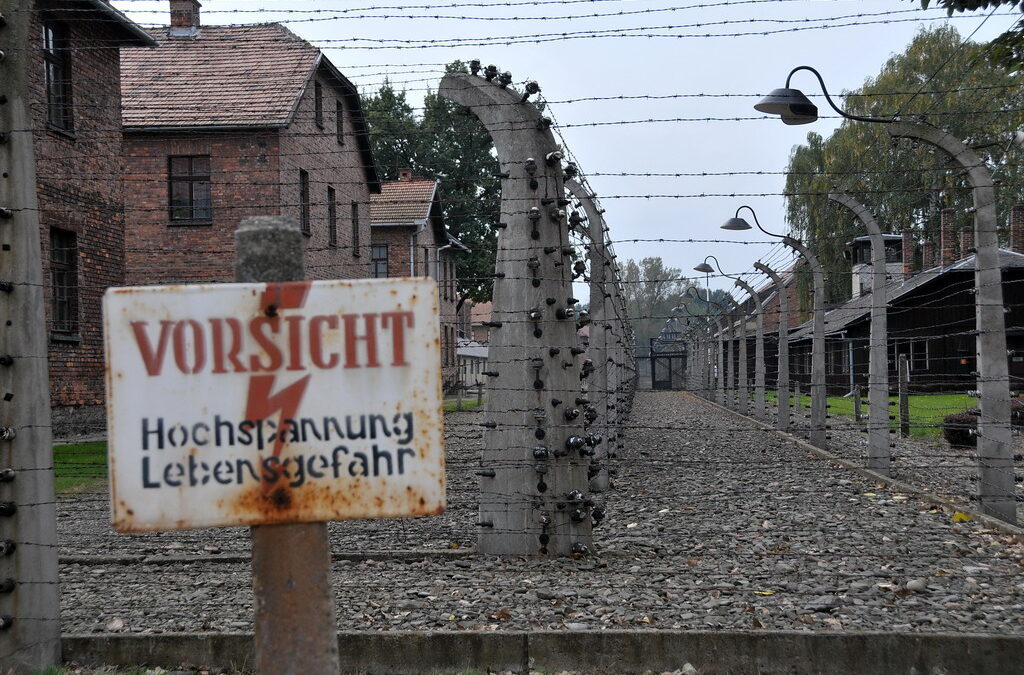
Main image credit: FaceMePLS/Wikimedia Commons (under CC BY 2.0)
Translated by Ben Koschalka