Keep our news free from ads and paywalls by making a donation to support our work!

Notes from Poland is run by a small editorial team and is published by an independent, non-profit foundation that is funded through donations from our readers. We cannot do what we do without your support.
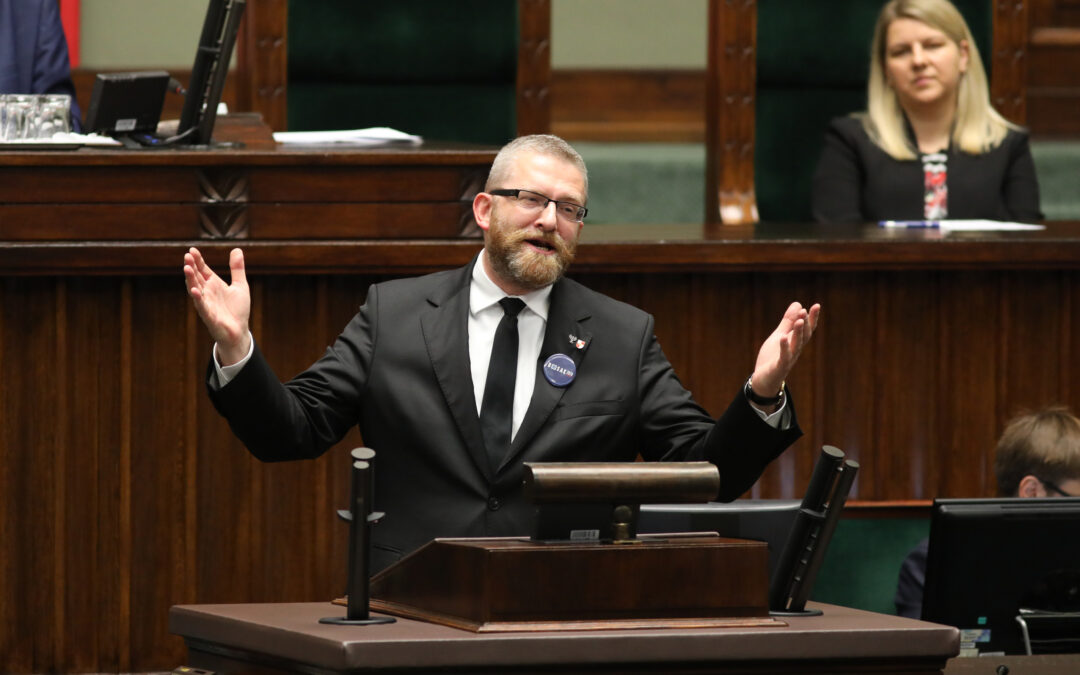
Far-right leader Grzegorz Braun, whose party has recently been rising in the polls, has announced that he wants a man on trial for alleged espionage on behalf of Russia to be one of his parliamentary election candidates.
At a recent meeting in the city of Szczecin, Braun appeared on stage alongside Mateusz Piskorski, a former member of parliament who is accused by Polish prosecutors of spying on behalf of Russia and China.
Oskarżony o szpiegostwo Piskorski wystartuje do Sejmu? Braun buduje listy wyborcze@Anna_Mierzynska #Braun #Piskorski #Rosja #szpiegostwo #okopress https://t.co/2GoZm4bDns pic.twitter.com/SrNI8AVDCr
— OKO.press (@oko_press) January 6, 2026
During the event, Braun declared that it was his “dream” for people like Piskorski to stand as parliamentary candidates for his Confederation of the Polish Crown (KKP) party at elections scheduled next year, reports news and analysis website OKO.press.
Braun acknowledged that Piskorski’s “court case is still ongoing”. But he said he would still be “proud to present such candidates for the next term of parliament”. Braun himself last month went on trial for a range of offences, including his 2023 attack on a Jewish religious celebration in parliament.
Braun, a member of the European Parliament, rose to prominence last year on the back of a presidential campaign centred around antisemitic, anti-Ukrainian and anti-LGBT rhetoric. He finished a surprised fourth in the election, with 6.3% of the vote, and his party is now averaging around 8% support in the polls.
But he has also faced accusations of sympathy towards Russia, and government spokesman Adam Szłapka said on Tuesday that naming Piskorski as a candidate shows that “Braun is no longer even trying to hide his connections with Russia”.
Braun już nawet nie próbuje ukrywać powiązań z Rosją.
Tym razem zapowiedział, że w najbliższych wyborach z list jego ugrupowania do Sejmu wystartuje człowiek który ma proces za szpiegostwo na rzecz Kremla.
Żadnych złudzeń.
— Adam Szłapka (@adamSzlapka) January 6, 2026
Piskorski, who between 2005 and 2007 was an MP representing the populist Self-Defence (Samoobrona) party, is known for his sympathetic views towards Russia. That is highly unusual in Poland, where animosity towards Russia is almost universal among the general public and political parties.
In 2014, Piskorski acted as the head of a group of “independent” observers allowed to oversee Russia’s referendum to annex Ukraine. Afterwards, Piskorski said that the referendum had been “conducted in accordance with the law” with “no violations of generally accepted standards”.
He also criticised those who just “repeat the arguments of one side of this conflict and use stereotypes like ‘bad Russians'”. He accused the West of being responsible for Vladimir Putin taking action against Ukraine, which he described as a “failed state”.
In 2015, when establishing a new party in Poland called Change (Zmiana), Piskorski told Kremlin news outlet Sputnik that its aim was to “rebuild relations with Russia” so the two countries would “once again become partners”. He also founded a think tank that has been accused of receiving Russian money.
In May 2016, Piskorski was detained by Poland’s Internal Security Agency (ABW) and charged with espionage on behalf of Russian and Chinese intelligence. Two years later, he was indicted to stand trial.
In April 2019, the trial began. But, almost seven years later, no verdict has been issued. Because the trial is classified, it is unknown what stage it is at or what evidence has been presented, notes OKO.press.
Meanwhile, in May 2019, after being held in pretrial detention for three years, Piskorski was released on a 200,000 zloty (€47,500) bail but banned from leaving the country. Since then, he has regularly appeared as a commentator on Russian and Belarusian state-linked media outlets.
Last year, another former member of Piskorski’s Change party, named only as Janusz N. under Polish privacy law, was indicted by Polish prosecutors on charges of espionage on behalf of Russia.
A man with alleged links to members of the Polish and EU parliaments will face trial in Poland accused of spying for Russia.
He reportedly organised trips for politicians, including to Ukraine, aimed at "building Russian spheres of influence in Europe" https://t.co/e404aoYyIf
— Notes from Poland 🇵🇱 (@notesfrompoland) February 6, 2024
Braun himself has long been accused of having sympathies towards and links to Russia. In 2019, Gazeta Wyborcza, a leading Polish daily, published photos of Braun in Moscow the previous year meeting with Leonid Sviridov, a Russian journalist expelled from Poland in 2015 on suspicion of espionage.
In September last year, after Russian drones violated Polish airspace, Braun claimed that the incident was faked as part of a conspiracy, involving Poland’s own government, to drag the country into the war in Ukraine.
In November, Braun and fellow KPP politicians wrote to Russian foreign minister Sergei Lavrov calling for a “normalisation in Polish-Russian relations”. OKO.press notes that, during his recent political activity, Braun has been “openly collaborating with pro-Russian figures”.
Until a year ago, Braun and his KPP were part of Confederation (Konfederacja), a far-right alliance that sits in Poland’s parliament. However, he was expelled after announcing a presidential run despite Confederation naming another of its leaders, Sławomir Mentzen, as its candidate.
Two far-right leaders claim the Russian drone incursions were faked by Poland’s own government as part of a conspiracy to drag the country into the war in Ukraine.
They have submitted a notification to prosecutors against foreign minister @sikorskiradek https://t.co/YixQCpQBd7
— Notes from Poland 🇵🇱 (@notesfrompoland) September 19, 2025
Notes from Poland is run by a small editorial team and published by an independent, non-profit foundation that is funded through donations from our readers. We cannot do what we do without your support.
Main image credit: SejmRP/Wikimedia Commons (under CC BY 2.0)

Daniel Tilles is editor-in-chief of Notes from Poland. He has written on Polish affairs for a wide range of publications, including Foreign Policy, POLITICO Europe, EUobserver and Dziennik Gazeta Prawna.