Keep our news free from ads and paywalls by making a donation to support our work!

Notes from Poland is run by a small editorial team and is published by an independent, non-profit foundation that is funded through donations from our readers. We cannot do what we do without your support.
The European Union’s Catholic bishops have “expressed concern” at last month’s ruling by the Court of Justice of the European Union (CJEU) ordering Poland to recognise same-sex marriages concluded in other member states.
The ruling “appears to push juriddprudence beyond EU competencies”, because family law is decided at the national level, says the Commission of the Bishops’ Conferences of the European Union (COMECE), which is composed of the Catholic episcopates of all member states.
This could “fuel anti-EU sentiments”, they warn.
⚖ On the @EUCourtPress judgment in the case #WojewodaMazowiecki (C-713/23), we stress that the decision appears to push jurisprudence beyond EU competences, "it may impact on questions lying at the core of national competences, fuel anti-EU sentiments". https://t.co/R9U18cXel3 pic.twitter.com/kkieXmGUAM
— The Catholic Church in the EU (@ComeceEu) December 9, 2025
On 25 November, the CJEU ruled on a case brought by two Polish men who had married in Germany but found their efforts to have their union recognised in Poland rejected by the registry office and courts because Poland’s constitution refers to marriage as being between a man and a woman.
The CJEU deemed that this infringed the freedom to move and reside within the EU as well as the right to respect for private and family life. It ordered Poland to change its system for recognising marriages conducted in other member states so that it does not discriminate against same-sex couples.
The European court emphasised, however, that its ruling “does not require the member state to provide for marriage between persons of the same sex in its national law”. It also said that the decision “does not undermine national identity or pose a threat to public policy”.
The EU court has ruled that Poland must recognise the marriage of a Polish same-sex couple who married in Germany, even though Polish law does not allow such marriages.
The ruling requires Poland to change its system for recognising such marriages https://t.co/upbcxVEdd8
— Notes from Poland 🇵🇱 (@notesfrompoland) November 25, 2025
But those arguments have been questioned by COMECE, which argues that the CJEU’s decision threatens to interfere with the right, enshrined in the Charter of Fundamental Rights of the EU, for national governments to regulate issues relating to marriages and families.
The EU ruling “impoverishes the meaning” of this guarantee “by underlining that in exercising this competence, each member state must comply with EU law,” wrote the bishops.
COMECE also said that the CJEU had given a “disappointingly limited role to the respect for member states’ ‘national identities’”. It argued that, “for some member states, the definition of marriage forms part of their national identity”.
Poland is one of the EU’s most religious member states, with around 70% of its population identifying as Catholic. The preamble to the country’s constitution refers to “our culture rooted in the Christian heritage of the nation”.
Polling by the Ipsos research agency this year found that only a minority of Poles, 31%, support the introduction of same-sex marriage. However, a majority, 62%, were in favour of allowing some form of legal recognition of same-sex relationships.
In their statement, COMECE expressed concern that the CJEU’s latest ruling “will have an impact on national family law legal systems and may foster pressure to amend them”.
It “effectively creates a convergence of matrimonial-law effects, even though the [European] Union does not have a mandate to harmonise family law”, say the bishops. They also worry that the ruling could “pave the way to future similar legal approaches regarding surrogacy”.
“These kinds of judgements give rise to anti-European sentiments in member states and can be easily instrumentalised,” they conclude.
State research agency @CBOS_Info has found its highest-ever level of support in Poland for the introduction of same-sex civil partnerships.
Over 62% are now in favour, up from 52% last year and just 25% in 2011, when the question was first asked https://t.co/Y9ydpbwsoU
— Notes from Poland 🇵🇱 (@notesfrompoland) November 14, 2025
The CJEU’s ruling requires Poland to introduce recognition of same-sex marriages conducted in other member states. If the country does not, it could face ongoing fines until it does so.
The Polish government has indicated that it will respect the ruling. However, Prime Minister Donald Tusk also declared that “the EU cannot impose anything on us on this issue” and “wherever matters must be decided by the nation state and national law, we will adhere to this principle”.
Even before the ruling, the government had presented a bill intended to allow unmarried partners, including same-sex couples, to sign an agreement granting them certain rights.
However, it has not yet been approved by parliament and, even if it is, faces a potential veto from conservative, opposition-aligned President Karol Nawrocki, who has said he will not support any measures that “undermine the unique and constitutionally protected status of marriage”.
Poland’s ruling coalition has presented a bill that would allow unmarried partners, including same-sex couples, to sign an agreement granting them certain rights.
The proposal is a compromise intended to be acceptable to both liberals and conservatives https://t.co/n7VqUnP6uq
— Notes from Poland 🇵🇱 (@notesfrompoland) October 17, 2025
Notes from Poland is run by a small editorial team and published by an independent, non-profit foundation that is funded through donations from our readers. We cannot do what we do without your support.
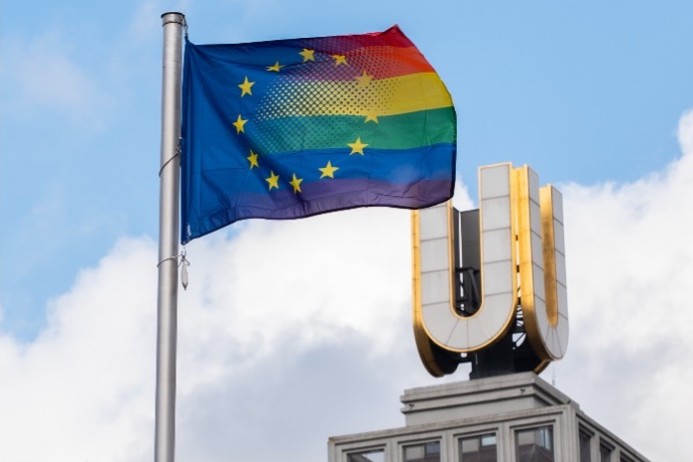
Main image credit: Pulse of Europe (under public domain)

Daniel Tilles is editor-in-chief of Notes from Poland. He has written on Polish affairs for a wide range of publications, including Foreign Policy, POLITICO Europe, EUobserver and Dziennik Gazeta Prawna.