Keep our news free from ads and paywalls by making a donation to support our work!

Notes from Poland is run by a small editorial team and is published by an independent, non-profit foundation that is funded through donations from our readers. We cannot do what we do without your support.
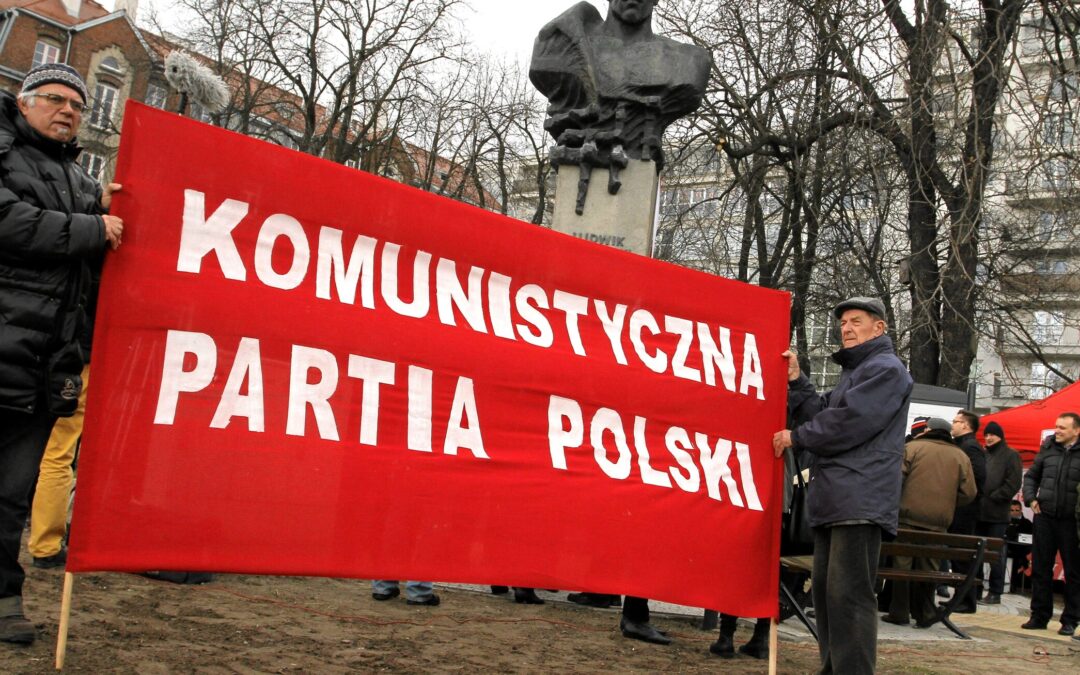
The Constitutional Tribunal (TK) has ruled that the Communist Party of Poland (KPP) violates the country’s constitution. That should lead to the KPP being outlawed, though the TK itself faces questions over its own legality, which complicates the situation.
“There is no place in the Polish legal system for a party that glorifies criminals and communist regimes responsible for the deaths of millions of human beings, including our compatriots, Polish citizens,” said Constitutional Tribunal (TK) judge Krystyna Pawłowicz in the justification for the ruling.
Komunistyczna Partia Polski zdelegalizowana. Jest wyrok Trybunału Konstytucyjnego
Kliknij w zdjęcie, by dowiedzieć się więcej 🔽 https://t.co/Mvi5OvJ4ZK
— Rzeczpospolita (@rzeczpospolita) December 3, 2025
The decision comes almost exactly five years after Poland’s former justice minister and prosecutor general, Zbigniew Ziobro, submitted a request to the TK to have the KPP outlawed. Last month, the current president, Karol Nawrocki, also filed his own such application.
The KPP was established in 2002 and claims to be the successor to the Communist Party that existed in Poland before World War Two, rather than the Soviet-backed Polish United Workers’ Party (PZPR) that ruled Poland after the war until 1989. The KPP has no elected representative and very little public visibility.
However, in his notification to the TK, Ziobro argued that the KPP “has identical goals to other communist parties in the 20th century”, including introducing a system “modelled on Soviet Russia” with “totalitarian methods and practices”.
Nawrocki likewise wrote that the KPP’s aims and activities are “contrary to the legal order of Poland”, and that “communist ideology is directed against fundamental human values and the traditions of European and Christian civilisation”.
On Wednesday, after hearings to consider Ziobro and Nawrocki’s applications, the TK found that “the goals and activities of the Communist Party of Poland are inconsistent with the provisions of the constitution”, specifically articles 11 and 13, said Pawłowicz.
Article 11 states that political parties must “be founded on the principle of… the equality of Polish citizens” and shall seek to “influence the formulation of the policy of the state by democratic means”.
Article 13, meanwhile, stipulates that political parties “whose programmes are based upon totalitarian methods and the modes of activity of Nazism, fascism and communism…[or] the application of violence for the purpose of obtaining power or to influence the state policy…shall be prohibited”.
President Nawrocki has submitted a request to the constitutional court for the Communist Party of Poland to be outlawed.
"There is no place in the Polish legal order for a party that glorifies criminals and regimes responsible for the deaths of millions" https://t.co/GLCSGVBndL
— Notes from Poland 🇵🇱 (@notesfrompoland) November 14, 2025
The KPP’s programme calls for “preparing working people for a joint and conscious struggle to eliminate exploitation by building a classless, democratic society within the framework of a socialist system”.
The Rzeczpospolita daily notes that, in 2015, the KPP removed the call for communist revolution from its platform in order to avoid potential legal problems.
However, in its ruling today, the TK said it had assessed not only the KPP’s programme adopted in 2015 but also the statute it adopted on its founding in 2002, as well as various other publications, statements and actions.
Speaking before the TK, the chairwoman of the KPP’s national executive committee, Beata Karoń, argued that, while her party has “a certain vision of what it wants[,]…if what we propose is so unattractive, we simply won’t gain support in elections”, reports the Polish Press Agency (PAP).
A building that served as a Soviet headquarters – and in which prisoners were detained, tortured and executed – has been bought by the Polish government and will be turned into a museum commemorating communist crimes https://t.co/wKGxLowLS9
— Notes from Poland 🇵🇱 (@notesfrompoland) July 8, 2021
The TK’s decision should lead to the delegalisation of the KPP, as Poland’s law on political parties states that, “if the Constitutional Tribunal issues a ruling on the unconstitutionality of the goals or activities of a political party, a court shall immediately issue a decision to remove the political party from the register”.
Pawłowicz said today that the tribunal would immediately forward its ruling to Warsaw’s district court, which maintains the register of political parties in Poland.
However, the TK itself is embroiled in a dispute over its own legality, with the current government refusing to recognise its rulings due to the presence of judges illegitimately appointed under the former Law and Justice (PiS) administration.
Another of the TK’s judges, former PiS MP Stanisław Piotrowicz, was himself a member of the Polish United Workers’ Party who served as a state prosecutor when Poland was under communist rule, including during martial law in the 1980s. Piotrowicz was among the judges who issued today’s ruling.
Notes from Poland is run by a small editorial team and published by an independent, non-profit foundation that is funded through donations from our readers. We cannot do what we do without your support.
Main image credit: Slawomir Kaminski / Agencja Wyborcza.pl

Daniel Tilles is editor-in-chief of Notes from Poland. He has written on Polish affairs for a wide range of publications, including Foreign Policy, POLITICO Europe, EUobserver and Dziennik Gazeta Prawna.