
Keep our news free from ads and paywalls by making a donation to support our work!

Notes from Poland is run by a small editorial team and is published by an independent, non-profit foundation that is funded through donations from our readers. We cannot do what we do without your support.
Despite a shrinking and ageing population, the number of workers in Poland has reached its highest ever level, as more people remain in employment beyond retirement age and previously economically inactive adults, especially women, enter the labour market.
The number of employed people rose to 17.361 million in the third quarter of 2025, around 84,000 higher than a year earlier, reports Statistics Poland (GUS), a state agency. The figure was a record, exceeding the previous high set in the first quarter of 2023 by 29,000.
Polski rynek pracy bije rekordy – mamy najwięcej osób pracujących w historii [HIRSCH O GOSPODARCE] https://t.co/D00LoMJDjY
— Mirosław Szulczyński (@izka1702) November 27, 2025
The labour force participation rate, which includes those currently in work and job seekers, now stands at 84.8% for those of working age (18 to retirement age) and 59.0% for people aged 15 to 89. Those figures are up from 78.7% and 57.7%, respectively, in the first quarter of 2021.
Working-age men (84.5%) are more likely to be in the labour force than women (79.9%). However, women were the main force behind the employment growth, with 69,000 more now in work than a year ago, compared to 15,000 more men.
Over half of the rise in employment was driven by people who had previously been outside the labour force, such as homemakers and students.
In 2024, Poland’s government introduced a package of measures intended to provide financial support to help parents of young children return to work. In the first year of operation, parents of nearly 770,000 children took advantage of the benefits.
The number of post-working-age workers has also increased, indicating that an increasing number of people are choosing to continue working after reaching retirement age (which is 65 for men and 60 for women).
The year-on-year increase in this case was about 39,000. As a result, their total has exceeded 800,000 for the first time in Poland.
Economics commentator Rafał Hirsch, writing for the WNP news website, notes that, if current trends persist, the number of workers above retirement age could soon overtake those aged 20-24. The gap between the groups has narrowed to just 68,000 from 196,000 in the first quarter of 2021.
Alongside the rise in employment, the number of hours people are working continued a gradual decline: average weekly hours are now 39.9, down marginally from 40 a year ago and 41.2 four years ago. Poles work some of the longest hours in the European Union.
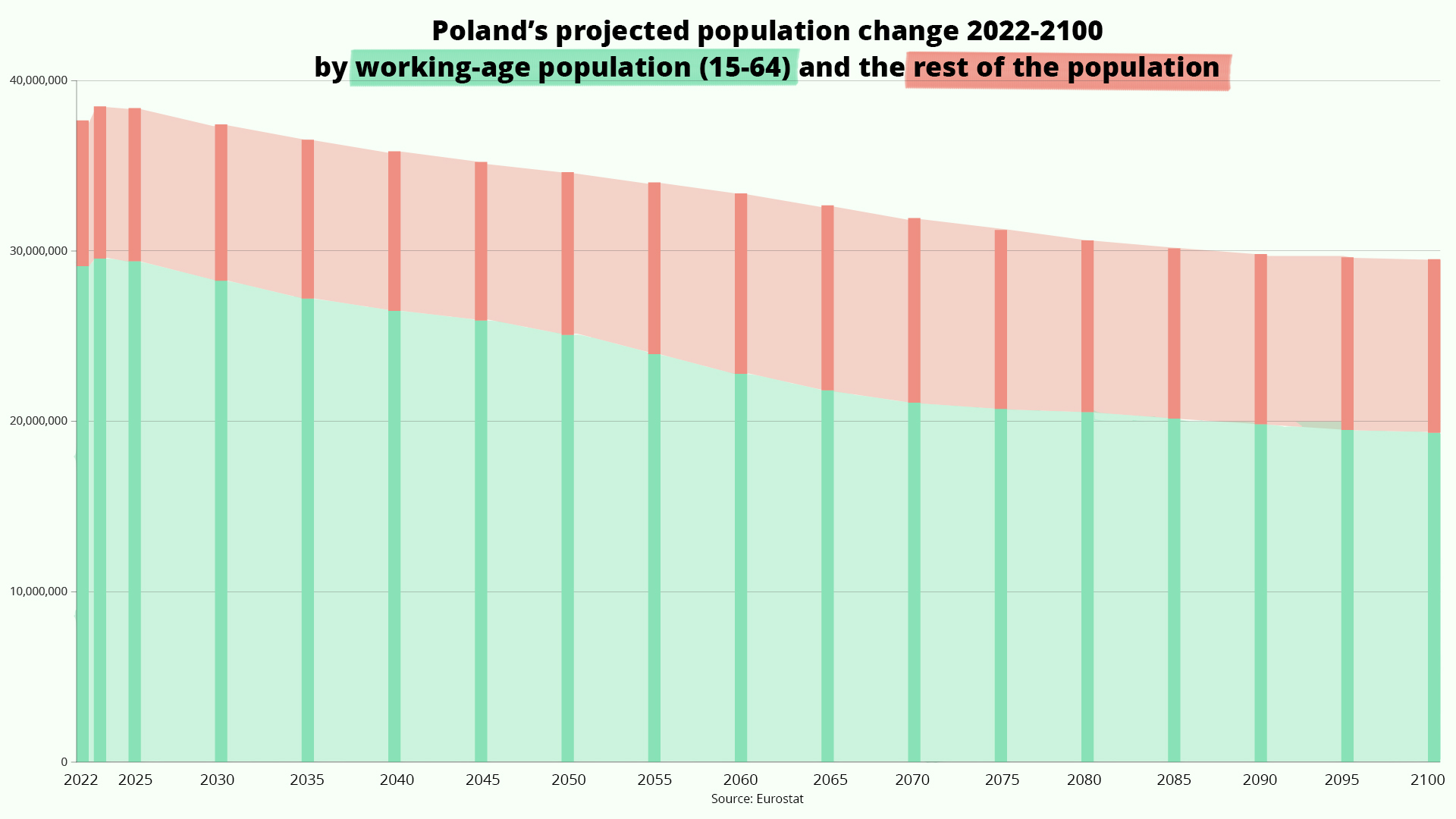
Poland's population is set to shrink 23% by 2100, the seventh largest decline in the EU, new @EU_Eurostat forecasts show.
The ratio of the elderly to the working-age population is set to rise from 30% to 60% over that period https://t.co/NhL99Noizb
— Notes from Poland 🇵🇱 (@notesfrompoland) April 20, 2023
The rise in employment has come despite Poland’s well-documented demographic problems.
The country’s fertility rate – the number of children expected to be born to a woman in her lifetime – fell to a new low of 1.1 last year, one of the lowest levels in the world. More people have died than been born in Poland for the last 12 years running.
As a result, Poland’s population has been shrinking, falling to 36.5 million in 2024 from a peak of 38.5 million in 2012. Recent GUS estimates suggest it could drop to just 29.4 million by 2060.
Society is also ageing, with Eurostat forecasting that the ratio of the elderly to the working-age population will double by 2060.
Notes from Poland is run by a small editorial team and published by an independent, non-profit foundation that is funded through donations from our readers. We cannot do what we do without your support.
Main image credit: Vlada Karpovich/Pexels

Alicja Ptak is deputy editor-in-chief of Notes from Poland and a multimedia journalist. She has written for Clean Energy Wire and The Times, and she hosts her own podcast, The Warsaw Wire, on Poland’s economy and energy sector. She previously worked for Reuters.