Keep our news free from ads and paywalls by making a donation to support our work!

Notes from Poland is run by a small editorial team and is published by an independent, non-profit foundation that is funded through donations from our readers. We cannot do what we do without your support.
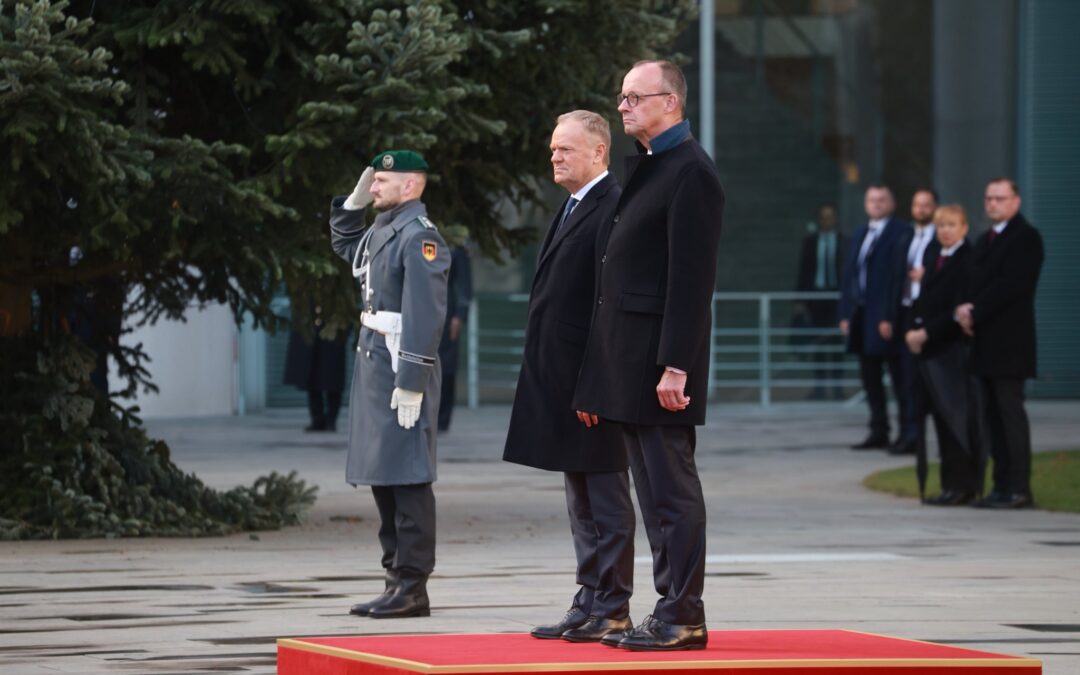
Prime Minister Donald Tusk has hailed Poland’s “exceptionally good” relations with Germany, especially on security issues and Russia’s war in Ukraine, after a meeting with Chancellor Friedrich Merz.
However, he urged Berlin to “hurry up” on implementing a pledge, made last year, to provide support to surviving Polish victims of the Nazi-German occupation. If it does not, Poland may simply start paying them from its own funds, said Tusk.
Merz, meanwhile, revealed that Poland and Germany are preparing to sign a defence agreement next year. However, he also reiterated Berlin’s longstanding position that it will not pay war reparations.
Polska jest naszym nieodzownym partnerem na rzecz bezpiecznej, wolnej i zamożnej Europy. Spotykamy się w czasach, gdy jedność Europy znajduje się pod presją. Nasza deklaracja kładzie fundament pod przyszłą współpracę. Dziękuję za wizytę, @DonaldTusk. pic.twitter.com/FD2LQdIRjV
— Bundeskanzler Friedrich Merz (@bundeskanzler) December 1, 2025
The German and Polish governments held bilateral consultations in Berlin today. Speaking alongside Tusk afterwards, Merz declared that “Germany and Poland are indispensable partners” and that “we Germans need a strong Poland as an equal partner”.
This is particularly important “in the face of the threat posed by a revisionist Russia”, he added, saying that “the Second World War and the German atrocities committed against the Polish nation” offer a “lesson from history”.
The chancellor noted that Germany recently bolstered its contribution to NATO’s air policing of Poland in response to September’s unprecedented violation of Polish airspace by Russian drones. The two countries have also increased joint military exercises.
But, to “make our cooperation in this area deeper and more systematic…we have also tasked our ministers with drafting a defence policy agreement, which we intend to finalise in 2026”, said Merz.
The chancellor also emphasised that Poland and Germany are united in “standing by Kyiv against Russian aggression”, including seeking to find a fair peace agreement and pushing for EU measures to use frozen Russian assets to help Ukraine.
Meanwhile, in a nod to the past, Merz noted that the German authorities are pushing ahead with a planned memorial to Polish victims of World War Two in Berlin, and are “accelerating the restitution of Polish cultural property” looted during the war.
Just before the two leaders spoke to the media, it was announced that Germany is returning 73 medieval documents to Poland that were looted during World War Two.
Germany has agreed to return to Poland a collection of 73 medieval documents that were looted during WWII.
The culture minister has hailed it as "the most important and valuable return of stolen cultural heritage in modern Polish history" https://t.co/GxHQ8A0jyr
— Notes from Poland 🇵🇱 (@notesfrompoland) December 1, 2025
Speaking next, Tusk likewise hailed the “complete Polish-German cooperation when it comes to defending Europe’s eastern border”.
He also noted that “Germany and Poland speak with one voice about the need to make Europe 100% independent of energy supplies from Russia”, something that “a few years ago would have been unimaginable”.
But Tusk acknowledged that there remain “difficult issues” between the two countries, in particular relating to World War Two history and the question of reparations.
Asked about this by a journalist, Merz reiterated that the German government’s opinion on that subject is well known and longstanding: “From a German perspective, the question of reparations has been definitely answered legally and politically for many years.”
Germany's ambassador has told a member of the Polish opposition that their demands for Berlin to pay war reparations “create divisions that help only Putin”.
His comments sparked criticism, including from President Nawrocki's chief foreign-policy aide https://t.co/z76wvBPbbH
— Notes from Poland 🇵🇱 (@notesfrompoland) November 16, 2025
However, Merz added that Berlin wants to “find a good, joint solution that will have a positive impact on the future of both our countries”.
When asked why Germany has so far failed to follow through on a pledge made by former Chancellor Olaf Scholz last year to offer support to surviving Polish victims of the war, Merz said that discussions are still ongoing.
Tusk responded by noting that time is running out to agree on such support: last year, when Scholz made his pledge, there were an estimated 60,000 remaining victims; now, there are only 50,000.
“If you want to make such a gesture, hurry up,” said the Polish prime minister. He added that, if no decision is reached soon, Poland will next year consider providing such support from its own funds.
The German chancellor has announced that his country will offer support to surviving Polish victims of WW2 and will help strengthen Poland’s eastern border.
However, in both cases he did not provide details of what these measures will involve in practice https://t.co/gKX6142Alo
— Notes from Poland 🇵🇱 (@notesfrompoland) July 2, 2024
Poland suffered enormously under Nazi-German occupation. Around six million of its citizens were killed, representing 17% of the prewar population – a higher relative loss than any other country suffered during the war.
Many other Poles were imprisoned in concentration camps. Meanwhile, Polish cities, including Warsaw, were left in ruins and hundreds of thousands of items of cultural, artistic and intellectual significance were destroyed or looted.
In 2022, Poland’s former Law and Justice (PiS) government submitted a demand for $1.3 trillion in war reparations from Germany. Berlin, however, rejected the request.
Tusk’s government, which replaced PiS in 2023, has not actively pursued the reparations claim but has suggested that Germany find other ways to “compensate” Poland for historical wrongs.
Notes from Poland is run by a small editorial team and published by an independent, non-profit foundation that is funded through donations from our readers. We cannot do what we do without your support.
Main image credit: PremierRP/X

Daniel Tilles is editor-in-chief of Notes from Poland. He has written on Polish affairs for a wide range of publications, including Foreign Policy, POLITICO Europe, EUobserver and Dziennik Gazeta Prawna.