Keep our news free from ads and paywalls by making a donation to support our work!

Notes from Poland is run by a small editorial team and is published by an independent, non-profit foundation that is funded through donations from our readers. We cannot do what we do without your support.
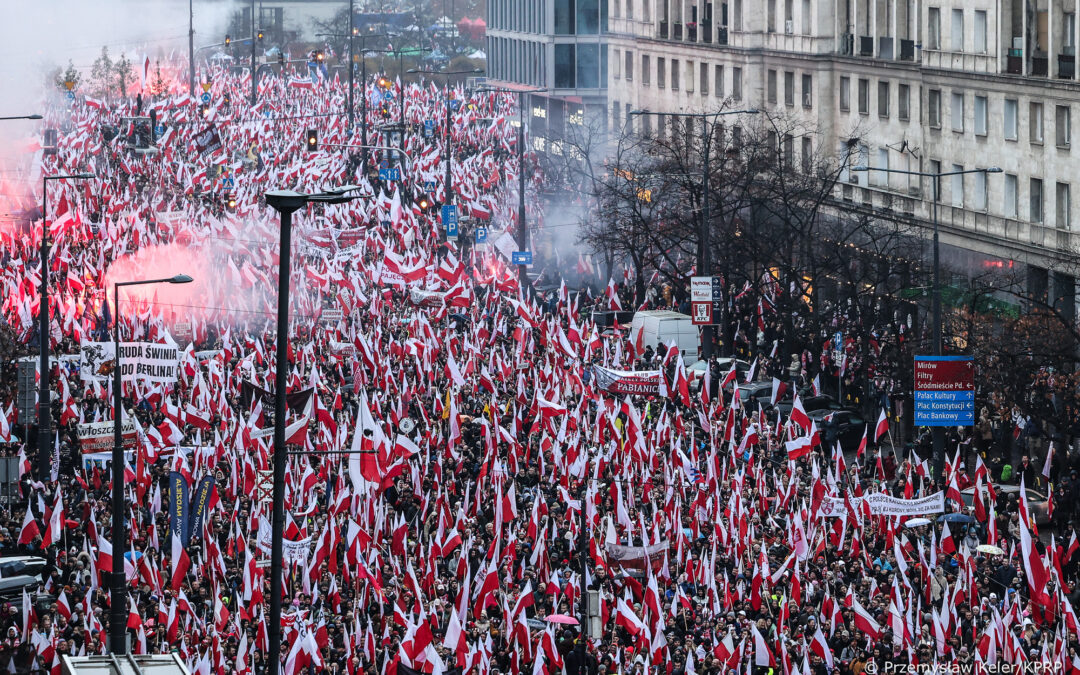
The annual march organised in Warsaw by nationalist groups to celebrate Polish Independence Day has passed peacefully through the city.
Among the participants – whose number is estimated at around 150,000 – was recently elected right-wing President Karol Nawrocki, whose conservative predecessor, Andrzej Duda, had avoided attending the event.
However, members of Poland’s more liberal government stayed away from the march. Prime Minister Donald Tusk, attending a separate Independence Day celebration in his hometown of Gdańsk, declared that “no one has a monopoly on patriotism” and called “diversity a source of our strength”.
Rondo Dmowskiego – Marsz Niepodległości 2025 🔥💪🇵🇱#11listopada #ŚwiętoNiepodległości #OdzyskanieNiepodległości #Polska #MarszNiepodległości #MarszNiepodległości2025 pic.twitter.com/oVlgbv7GGT
— Tygodnik Solidarność – tysol.pl (@Tysolpl) November 11, 2025
In the early afternoon, participants in the Independence March gathered at Warsaw’s Roman Dmowski Roundabout, the traditional starting point. Many waved white-and-red national flags and some set off red flares, despite a reminder from the local authorities that such pyrotechnics are illegal.
Among the banners carried by the marchers was one declaring: “Stop Immigration, Time for Deportation.”
Another, displayed by All-Polish Youth (Młodzież Wszechpolska), one of the far-right organisations that founded the march 15 years ago, declared: “Poland for the Poles – Europe for the Europeans.” Members of the group also set fire to a European Union flag.
Polska dla Polaków❗
Europe for Europeans❗ pic.twitter.com/cOO7bBlqcd— Młodzież Wszechpolska (@MWszechpolska) November 11, 2025
Before the march set off, speakers from the far-right National Movement (RN), which is the main organiser of the event, spoke to the crowd.
“We will not allow our lands to be settled by foreign nations without a fight,” declared Krzysztof Bosak, leader of RN and also a deputy speaker of parliament, where he and his movement sit as part of the far-right Confederation (Konfederacja) grouping.
“It is Poles who should decide who we accept and who we stop at the borders,” he continued. “We will not agree to having foreign civilisational principles and customs imposed on us…It is our duty to defend independence in every dimension.”
Dziś oczy Europy są zwrócone na Polskę.
Coraz więcej ludzi przyjeżdża tu, by odetchnąć pełną piersią i poczuć atmosferę wolności, dumy narodowej i patriotyzmu.
U nas nikt nie musi wstydzić się biało-czerwonych barw ani obawiać się ich pokazywać. W innych krajach za to można… pic.twitter.com/3iZRI12ymp— Krzysztof Bosak 🇵🇱 (@krzysztofbosak) November 11, 2025
The march then passed through the city along its traditional route towards the finishing point at the National Stadium. Whereas in the past some years have seen clashes between marchers and the police, this year no serious disorder was reported.
Warsaw city hall, which is controlled by Tusk’s centrist Civic Coalition (KO) party, estimated attendance at the march to have been around 100,000. The organisers of the event, however, put the figure at 250,000, according to broadcaster Polskie Radio.
Onet, a leading news website, calculated, based on aerial footage of the size of the march, that attendance was between 120,000 and 160,000.
Among the marchers was Nawrocki, who took office as president in August. He shared images of himself waving a Polish flag and greeting other participants.
Earlier in the day, at official state celebrations of Independence Day, Nawrocki gave a speech, presumably aimed at Tusk’s government, in which he warned that “some Polish politicians are ready to give up Polish freedom, independence and sovereignty piece by piece to foreign institutions, tribunals and EU agencies”.
He pledged to never allow Poland to become “a parrot, passively repeating what comes from the West” and to always put “Poland first and Poles first”.
Prezydent Polski🇵🇱 nigdy nie pozwoli na to, abyśmy stali się papugą narodów powtarzających to, co przychodzi z zachodu‼️
Po pierwsze Polska, po pierwsze Polacy! – to nasze zobowiązanie.@prezydentpl pic.twitter.com/NaUbvKceHN
— Zbigniew Bogucki🇵🇱 (@BoguckiZbigniew) November 11, 2025
Nawrocki was elected this year with the support of the national-conservative opposition Law and Justice (PiS) party, which has long had a mixed relationship with the Independence March.
Former President Duda, who was also aligned with PiS, did not attend the march with the exception of 2018, when a special, larger event was co-organised with the PiS government of the time to celebrate the centenary of Poland regaining independence.
However, as the Independence March has attracted ever more mainstream conservatives, in addition to the nationalists with which it was originally associated, PiS’s position towards the event has softened.
Last year, PiS leader Jarosław Kaczyński attended for the first time and today he was again among the marchers.
🇵🇱 Wraz z polskimi patriotami idziemy w Marszu świętując 107. rocznicę odzyskania niepodległości przez Polskę! #11listopada pic.twitter.com/koSYxkuUs8
— Prawo i Sprawiedliwość (@pisorgpl) November 11, 2025
Figures from the current governing coalition, which ranges from left to centre right, stayed away from the event, however. Some of them also criticised Nawrocki for his speech, saying that he was politicising a day that should see a display of national unity.
“In Gdańsk it was all about unity and joy,” wrote Tusk, sharing a photo from a parade in the city. But that message “didn’t reach everyone”, he added, in a presumed reference to Nawrocki.
“No one has a monopoly on patriotism,” declared the prime minister during a speech at the Gdańsk event. “Diversity is and can be a source of our strength in the future, but these differences and disputes must not breed hatred, contempt or violence.”
W Gdańsku było o jedności i radości.❤️🇵🇱Nie wszędzie dotarło. pic.twitter.com/JTj41K4TY4
— Donald Tusk (@donaldtusk) November 11, 2025
Notes from Poland is run by a small editorial team and published by an independent, non-profit foundation that is funded through donations from our readers. We cannot do what we do without your support.
Main image credit: Przemysław Keler/KPRP

Daniel Tilles is editor-in-chief of Notes from Poland. He has written on Polish affairs for a wide range of publications, including Foreign Policy, POLITICO Europe, EUobserver and Dziennik Gazeta Prawna.