Keep our content free from ads and paywalls by making a donation to support our work!

Notes from Poland is run by a small editorial team and is published by an independent, non-profit foundation that is funded through donations from our readers. We cannot do what we do without your support.
Prime Minister Donald Tusk has announced that his centrist Civic Coalition (KO), the main group in Poland’s government, will hold primaries to choose a candidate for next year’s presidential election.
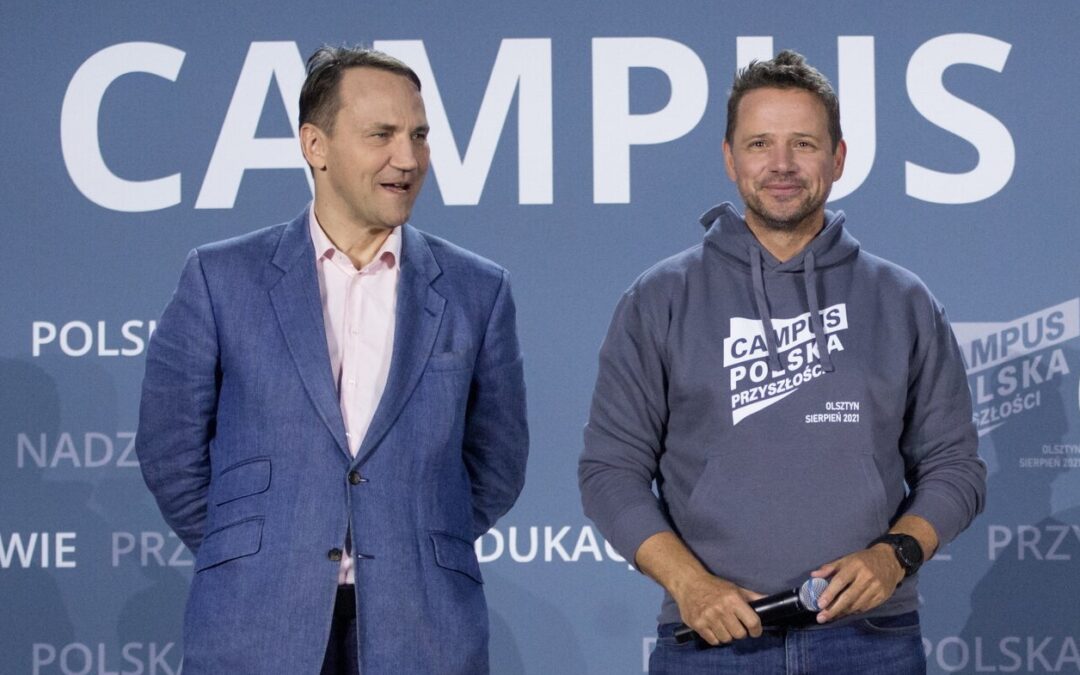
Party members will be able to choose between two options: Warsaw mayor Rafał Trzaskowski (pictured above right), who narrowly lost the 2020 presidential election to incumbent Andrzej Duda; or Radosław Sikorski (pictured above left), the foreign minister.
💬 Premier @donaldtusk: Z czystym sumieniem mogę powiedzieć, że do boju w prawyborach na kandydata Koalicji Obywatelskiej na Prezydenta Polski staje dwóch świetnych kandydatów – Radek Sikorski i Rafał Trzaskowski.
— PlatformaObywatelska (@Platforma_org) November 9, 2024
Duda is currently serving his second and final term in office, meaning a successor needs to be elected when he steps down next year.
The outcome will be extremely significant because the president has veto powers, something that Duda – an ally of the national-conservative opposition Law and Justice (PiS) party – has used to block the policies of the Tusk government since it took office last December.
In recent weeks, speculation has intensified as to whether KO would choose Trzaskowski or Sikorski as their candidate. Some had previously suggested Tusk himself could stand, but last month he ruled himself out and announced that a candidate would be named on 7 December.
At a press conference today, the prime minister made the surprise announcement that a primary would be held in the coming weeks to select that candidate, with Trzaskowski and Sikorski the only two options.
He revealed that Trzaskowski himself had proposed the idea of primaries, with the Warsaw mayor later confirming this at a press conference of his own. Tusk said that he himself also supported the idea of “the widest possible group” being able to pick the candidate.
The prime minister confirmed that all members of KO – which is dominated by his Civic Platform (PO) party but also includes Modern (Nowoczesna), The Greens (Zieloni) and Polish Initiative (iPL) – would be able to vote in the primaries.
💬 Premier @donaldtusk 👇 pic.twitter.com/coqq5byqYx
— PlatformaObywatelska (@Platforma_org) November 9, 2024
He added that both candidates are “excellent” and that each has “said that they will respect not only the result of the primaries, but also support the winner in the presidential elections”.
Tusk also noted that voting would take place this month, with the winning candidate presenting his programme on 7 December. There would not be a large-scale campaign because both candidates are already very well known, he added.
“There is one opponent: PiS,” said Trzaskowski, quoted by the Rzeczpospolita daily, adding that he “only has positive things to say about Radosław Sikorski”.
Melduję pełną gotowość na #11listopada. Świętujmy niepodległość wspólnie!
I pełną determinację do walki o lepszą przyszłość Polski. A kluczowe dla niej wybory już za kilka miesięcy. Potrzebujemy silnego kandydata z silnym mandatem poparcia. Jestem gotów 🇵🇱 pic.twitter.com/qOrhIgIXUx
— Rafał Trzaskowski (@trzaskowski_) November 9, 2024
“These [presidential] elections are of fundamental importance when it comes to the development of democracy in Poland,” he continued. By holding primaries, “we want to prove that we are a fully democratic party, to give a voice to our members, so that the mandate obtained is as strong as possible”.
Wirtualna Polska, a leading news website, reports based on unnamed party sources that Trzaskowski “knows he will win” the primaries, the purpose of which is simply to confirm his status as KO’s favoured candidate. They added that Sikorski was taken by surprise by the idea.
In a social media post, Sikorski appealed for support in the primaries. “The presidential elections will be about Poland’s security. The primaries should produce a candidate who will be effective in these uncertain times,” wrote Sikorski, who, in various Polish governments, has served twice as foreign minister and once as defence minister.
Wybory prezydenckie będą o bezpieczeństwie Polski.
Prawybory powinny wyłonić kandydata, który będzie skuteczny w tych niepewnych czasach.
Proszę o wsparcie. pic.twitter.com/EZGFUDELsu— Radosław Sikorski 🇵🇱🇪🇺 (@sikorskiradek) November 9, 2024
At his press conference today, Tusk said that he was proud that his group was the only one that has decided to hold primaries to choose its candidate. PiS had considered holding primaries but decided against it last month. It has not yet announced when its candidate will be unveiled.
So far the only candidate that has been publicly announced for the presidential elections is Sławomir Mentzen, one of the leaders of the far-right Confederation (Konfederacja), another opposition party.
The other main groups that could put forward a candidate are KO’s partners in the ruling coalition: the centrist Poland 2050 (Polska 2050), whose leader Szymon Hołownia came third in the 2020 presidential elections and may stand again; the centre-right Polish People’s Party (PSL); and The Left (Lewica).
The opposition PiS party has announced that it will not hold primary elections to choose its candidate for next year's presidential elections.
There had been talk in recent weeks that it would organise primaries instead of directly picking one candidate https://t.co/oiOj6dhs0y
— Notes from Poland 🇵🇱 (@notesfrompoland) October 25, 2024
PO also held a primary to choose its candidate in 2020, settling on Małgorzata Kidawa-Błońska. However, after the elections were delayed amid the pandemic, and with Kidawa-Błońska polling very badly, she stepped aside and PO chose Trzaskowski to replace her.
Trzaskowski finished second in the first round of the elections, with 30.3%, behind Duda on 43.7%. The failure of any candidate to reach 50% meant a second-round run-off was held. Duda emerged triumphant, winning 51% of the vote to Trzaskowski’s 49%.
Since taking office, Tusk’s government has failed to implement most of its promised agenda, but has often blamed that on the fact that Duda is unwilling to sign its proposed legislation into law.
Notes from Poland is run by a small editorial team and published by an independent, non-profit foundation that is funded through donations from our readers. We cannot do what we do without your support.
Main image credit: Adam Stepien / Agencja Wyborcza.pl