Keep our news free from ads and paywalls by making a donation to support our work!

Notes from Poland is run by a small editorial team and is published by an independent, non-profit foundation that is funded through donations from our readers. We cannot do what we do without your support.
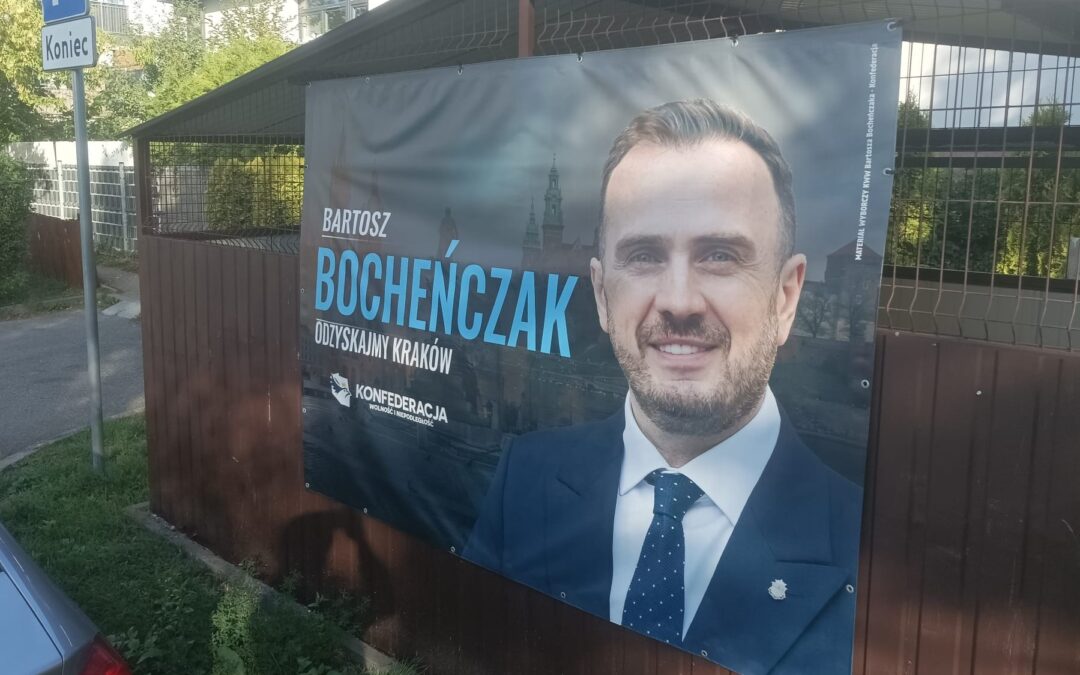
The candidate of the far-right Confederation (Konfederacja), one of Poland’s main political groups, has been disqualified from Kraków’s mayoral election after over 2,000 of the signatures from local residents collected in support of his candidacy were found to be invalid.
One of Confederation’s leaders, Sławomir Mentzen, admitted that the situation was an “embarrassment” and “catastrophe”. He responded by dismissing the candidate, Bartosz Bocheńczak, as head of his party’s local structures in Kraków and launching an investigation into how the blunder occurred.
Podobnie jak i wielu naszych działaczy, wolontariuszy, sympatyków i wyborców, czuję się bardzo zawiedziony brakiem rejestracji kandydatury Bartosza Bocheńczaka w Krakowie.
Przyczyną braku rejestracji było to, że spośród około 5000 zebranych podpisów, ponad 2000 były błędnych.…
— Sławomir Mentzen (@SlawomirMentzen) September 7, 2026
Kraków, Poland’s second-largest city, is holding a mayoral election this year after the previous incumbent, Aleksander Miszalski, was removed mid-term in a rare recall referendum earlier this year.
Over a dozen potential candidates announced plans to stand. But, in order to be registered, they had to collect at least 3,000 signatures from residents of the city supporting their candidacy, then submit them to the municipal electoral commission by 3 September.
Twelve candidates made such submissions, after which the commission began assessing all signatures to ensure that each candidate had at least 3,000 that were valid.
On Monday, reports began to emerge that, although Bocheńczak had submitted just over 4,600 signatures, the commission had found that fewer than 3,000 of them were valid. That evening, the candidate himself confirmed the news.
Mentzen, who is leader of the far-right libertarian New Hope (Nowa Nadzieja) party that makes up one half of Confederation, revealed that over 2,000 signatories had listed their address as their place of residence rather than where they are officially registered as living.
In Poland, it is common for people to live somewhere different from where they are officially registered. That is particularly the case for young people, who are often registered at their parents’ address while residing elsewhere. Confederation is particularly popular among young people, and Kraków has a large student population.
Moja kandydatura na Prezydenta Krakowa nie została zarejestrowana.
Zabrakło ważnych podpisów.Nie będę snuł teorii spiskowych, szukał winnych ani przerzucał odpowiedzialności na kogokolwiek. Uważałem, że złożenie niemal 5000 podpisów zapewni nam wystarczający margines…
— Bartosz Bocheńczak (@BBochenczak) September 7, 2026
Mentzen said that the regulations regarding collecting signatures for candidates are “absurd”, yet admitted that Bocheńczak’s campaign should have done a better job of complying with the rules.
There must now be “consequences from this embarrassment”, said Mentzen, who announced that Bocheńczak had been dismissed as New Hope’s local leader in Kraków and that a party commission would “determine responsibility for this disaster”.
Confederation also faced scrutiny last year when the National Electoral Commission (PKW) rejected its financial report for the 2024 European elections after it found irregularities. The party also failed to submit the required documents on time. As a result, it lost access to state subsidies.
The Supreme Court has rejected an appeal by the far-right Confederation against the electoral commission's decision to reject its financial report for last year's European elections due to irregularities.
The group will now lose access to state subsidies https://t.co/hNGu2Zvzii
— Notes from Poland 🇵🇱 (@notesfrompoland) November 14, 2025
Bocheńczak is not the only candidate who has struggled with collecting signatures. Last week, just days before the deadline, it emerged that over 3,000 signatures collected in support of the favourite in the elections, Łukasz Gibała, an independent, were invalid because the word “Kraków” was missing from the form.
Gibała – a perennial candidate in mayoral elections who finished runner-up to Miszalski in 2024 – quickly scrambled to collect more signatures, and his team managed to gather an additional 9,000 in three days.
On Monday this week, it also emerged that three other independent candidates, Marian Banaś, Stanisław Kułach and Marta Ratuszyńska, had failed to gather enough signatures. All three have taken up their right to appeal against the commission’s decision to reject their candidacies.
Dziś złożymy dodatkowe podpisy do komisji wyborczej – ponad 9 tysięcy (oprócz wcześniejszych 5,5 tys.).
Skala Waszego zaangażowania i pomocy była bezprecedensowa – w 3 dni zebraliśmy więcej podpisów niż którykolwiek z naszych rywali przez 3 tygodnie 💪
Bardzo Wam dziękuję i…
— Łukasz Gibała (@LukaszGibala) September 3, 2026
Six candidates have so far been accepted, including Gibała; Monika Piątkowska, who is supported by the centrist Civil Coalition (KO) and Polish People’s Party (PSL); Michał Drewnicki of the national-conservative Law and Justice (PiS); Aleksandra Owca of the left-wing Together (Razem); and Michał Klimek of the radical-right Confederation of the Polish Crown (KKP).
Two candidates, Daria Gosek-Popiołek of The Left (Lewica) and Sławomir Pietrzyk of Social Democracy of Poland (Socjaldemokracja Polska), are still awaiting confirmation from the electoral commission that they submitted enough valid signatures. A decision is due to be announced today.
The first round of the election will take place on Sunday 27 September. If any candidate receives over 50% of the vote, they will become mayor. If not, a run-off between the top two candidates will take place on 11 October.
There has been little polling on support for candidates, but one survey by the Opinia24 agency for Polityka Insight two weeks ago showed Gibała with 25.2%, ahead of Piątkowska (15.3%) and Gosek-Popiołek (8.7%). Bocheńczak was in sixth with just 3.2%.
Notes from Poland is run by a small editorial team and published by an independent, non-profit foundation that is funded through donations from our readers. We cannot do what we do without your support.
Main image credit: Ben Koschalka/Notes from Poland

Daniel Tilles is editor-in-chief of Notes from Poland. He has written on Polish affairs for a wide range of publications, including Foreign Policy, POLITICO Europe, EUobserver and Dziennik Gazeta Prawna.