Keep our news free from ads and paywalls by making a donation to support our work!

Notes from Poland is run by a small editorial team and is published by an independent, non-profit foundation that is funded through donations from our readers. We cannot do what we do without your support.
In the wake of Saturday’s deadly terrorist attack in Kraków, a deputy defence minister has called for debate on limiting the number and types of weapons people can own. Meanwhile, a deputy interior minister says the tragedy provides an “incentive” to revisit proposals to better register certain guns.
Poland has among the lowest levels of gun ownership in Europe, though the number of firearms licences being issued has risen in recent years and some politicians have called for expanded access to guns.
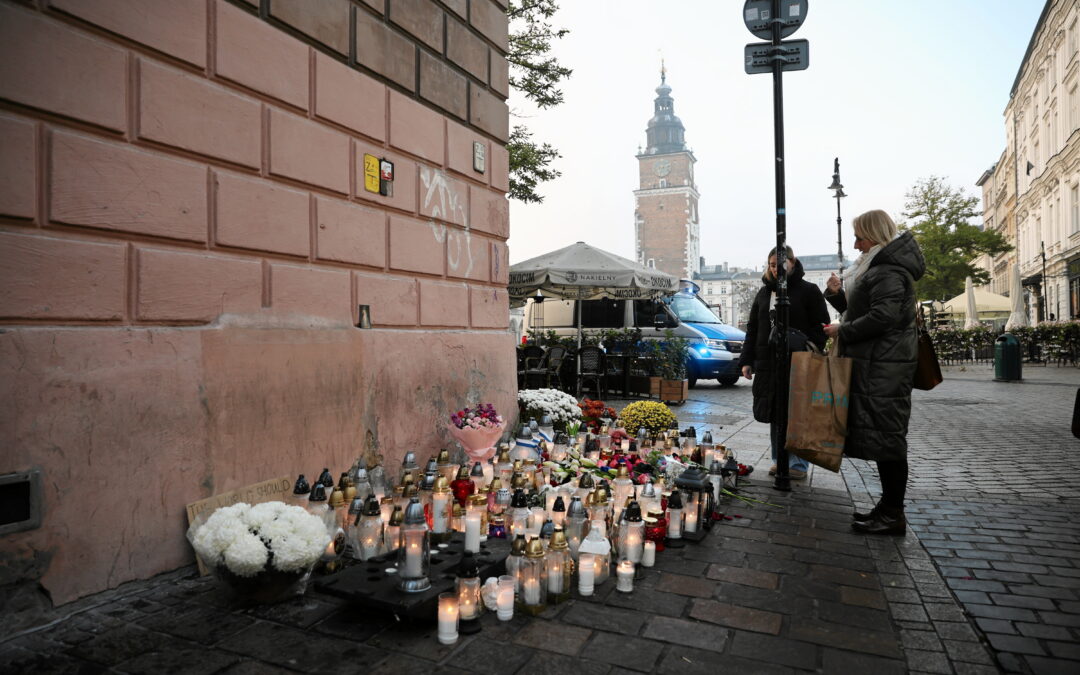
On Saturday, 24-year-old Michał Oksiński drove through the historic city centre of Kraków, which was packed with tourists and locals, firing at random from his car.
He killed six people and injured over a dozen more. Later in the day, the bodies of the perpetrator’s parents and sister were found in his home, where they had been shot dead.
Oksiński’s rampage was brought to an end in a shootout with two police officers, which left all three with serious injuries. On Monday morning, the police announced that Oksiński had died in hospital. One of the police officers remains in what is described as “serious but stable” condition.
The man who carried out Saturday’s deadly terrorist attack in the Polish city of Kraków has died in hospital from the injuries he sustained during a shootout with police.
One of the two officers who stopped him remains in serious but stable condition https://t.co/rT1YBXhkp7
— Notes from Poland 🇵🇱 (@notesfrompoland) November 9, 2026
The incident has caused shock in Poland, a country that has never previously experienced this type of mass public shooting.
Speaking to Polsat News on Sunday, deputy defence minister Magdalena Sobkowiak-Czarnecka said that the tragedy “is the best illustration that it makes no sense to talk about expanding access to firearms”.
She added that “it’s already relatively easy” to obtain a gun licence, which can be granted to anyone aged 21 or over who has passed the relevant tests and declared that the firearm is for sporting purposes. Both Oksiński and his father had such licences and legally owned 11 firearms.
“I would like to start a discussion about whether access to such a large number of weapons should actually be so easy,” said Sobkowiak-Czarnecka. “This is also a question of whether someone who uses weapons for sporting purposes should have so many different types of weapons stored at home.”
Also speaking to Polsat on Sunday, Czesław Mroczek, a deputy interior minister, said that “weapons are certainly a challenge for us”. He noted that “in Poland we have had many cases of killings using black powder weapons, for which there is not even a register, let alone a permit procedure”.
Such weapons use traditional black powder rather than modern smokeless powder and include firearms manufactured before 1885 and their modern replicas.
According to a recent study by researchers from the Jagiellonian University in Kraków, they make up a considerable proportion of firearm-related fatalities in the country.
While noting that the matter is not directly related to the Kraków attacks, Mroczek said that plans to include these weapons in a register had already been drawn up and “this event [in Kraków] is an incentive for us to reexamine the matter”.
🇵🇱 Poland's interior ministry says black-powder guns, currently exempt from registration, will be entered into the register. The Krakow attack is described as an impulse to review the whole permit system.https://t.co/Nh7dr46MJ7
— Олег Рощин (@oleg_roshchin) November 9, 2026
On Monday morning, the spokesman for the National Prosecutor’s Office, Przemysław Nowak, held a press conference at which he provided further details on their findings so far.
He revealed that Oksiński had been found with two AR-15 rifles and two handguns on his person and in his car, as well as around 500 rounds of ammunition. He had earlier fired “several dozen, possibly several hundred, shots”.
A further seven guns had been found at Oksiński’s home. The total of 11 firearms matched the number of weapons there were permits for, noted Nowak, quoted by news website Wirtualna Polska.
“The entire matter related to the weapons and the firearms permits will be reviewed,” added the spokesman. “We know that, since March of this year, he [Oksiński] has held firearms permits for one rifle and one pistol.”
Prosecutors have launched a terror investigation into Saturday’s shooting in Kraków, which left six dead. Three more bodies were later found in the suspect's home.
Further details have also emerged about the heroic actions of police and medical personnel https://t.co/icBJWLRK7c
— Notes from Poland 🇵🇱 (@notesfrompoland) November 8, 2026
Although gun ownership in Poland is relatively low, it has been rising steadily in recent years, particularly since Russia’s full-scale invasion of Ukraine, with the total number of registered firearms owned by Poles surpassing 1 million, up from around 380,000 in 2014.
Last year, a record 50,709 new gun licences were issued in the country in 2025, up 10.6% compared to a year earlier.
Under Polish law, civilians can apply for licences for sporting, hunting, collecting and personal protection purposes. To obtain one, applicants must undergo medical examinations, pass a test, and join a relevant association, such as the Polish Sports Shooting Association, the Polish Hunting Association, or a collectors’ group.
Licences for sports and collection purposes are the most popular types of permits, together making up 76% of last year’s permits. But the number of licences issued for “personal protection” has grown from just 81 in 2021 to 7,254 last year.
A record 50,709 gun licences were issued in Poland last year and the total number of registered firearms has now surpassed 1 million.
Gun ownership in Poland has risen particularly rapidly since Russia's invasion of Ukraine in 2022 https://t.co/axt2YS044Z
— Notes from Poland 🇵🇱 (@notesfrompoland) February 11, 2026
Access to firearms widened in 2023 under the former government, when parliament passed a law removing “unnecessary administrative and legal barriers.” That allowed members of uniformed services to apply for personal protection permits, a change lawmakers said was intended to “strengthen Poland’s defence potential”.
However, some politicians, especially on the right, have pushed for ownership rules to be further loosened. In September, speaking at the opening of a shooting range, President Karol Nawrocki, who is aligned with the right-wing opposition, called for “public discussion about responsible access to weapons”.
“Even in the European Union, Poland remains at the bottom of the list in terms of access to firearms,” he said, quoted by Polsat. “Only about 1% of Polish citizens have access to weapons and are skilled at using them. Fortunately, I’m in that 1%.”
Notes from Poland is run by a small editorial team and published by an independent, non-profit foundation that is funded through donations from our readers. We cannot do what we do without your support.
Main image credit: Jakub Wlodek / Agencja Wyborcza.pl
Ben Koschalka is a translator, lecturer, and senior editor at Notes from Poland. Originally from Britain, he has lived in Kraków since 2005.