Keep our news free from ads and paywalls by making a donation to support our work!

Notes from Poland is run by a small editorial team and is published by an independent, non-profit foundation that is funded through donations from our readers. We cannot do what we do without your support.
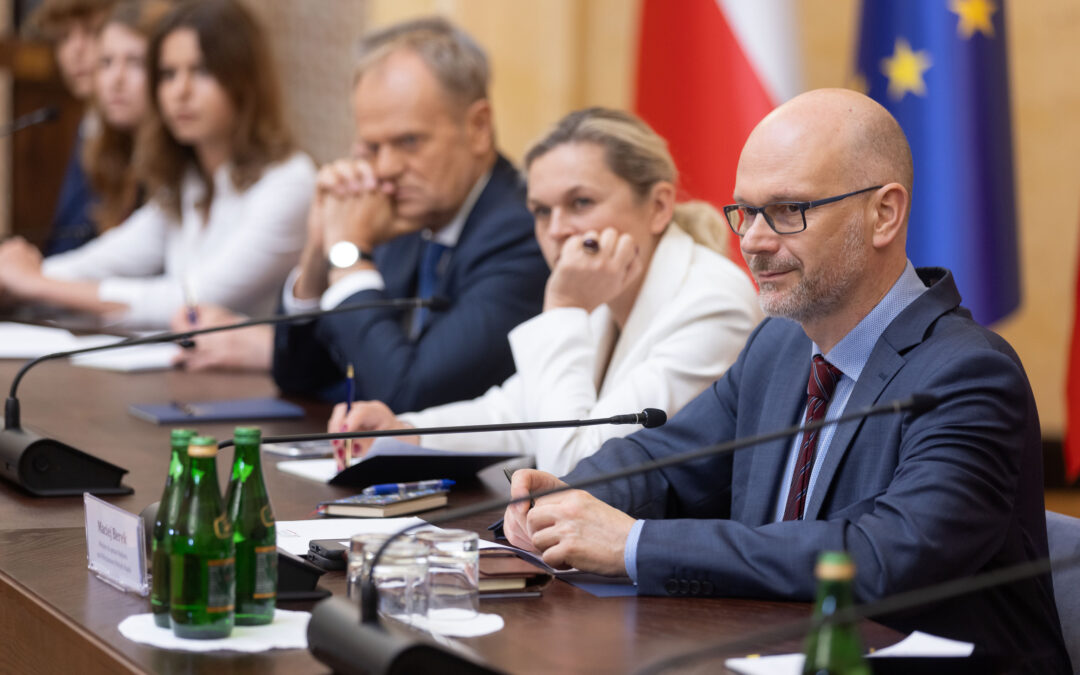
Prime Minister Donald Tusk has succeeded in having Maciej Berek, whom he recently described as his “right-hand man”, elected by parliament as a Constitutional Tribunal (TK) judge, staving off a rebellion from some members of his own coalition.
Critics argued that the nomination violated the government’s pledge to “depoliticise” the TK, including by banning recently active politicians from sitting on it. Berek served as a government minister from 2023, when Tusk came to power, until last month, when he stepped down in order to run for the TK.
However, it is far from clear what will happen next. Opposition-aligned President Karol Nawrocki has this year refused to swear in four TK judges chosen by parliament, and he has made clear that he also opposes Berek’s candidacy.
✅Sejm dokonał wyboru Macieja Berka na stanowisko sędziego Trybunału Konstytucyjnego. pic.twitter.com/ek0ak9C33v
— Sejm RP🇵🇱 (@KancelariaSejmu) September 4, 2026
In mid-August, Berek announced that he was leaving the government, where he had served as minister in charge of overseeing the implementation of policy. Shortly afterwards, Tusk confirmed that Berek would be nominated to fill an upcoming vacancy on the TK.
The prime minister argued that, during his time in government, Berek had undertaken a technocratic role that was “apolitical and nonpartisan”. He said that Berek’s extensive experience in constitutional law and the legislative process made him an ideal candidate.
However, some MPs from Tusk’s junior coalition partners publicly opposed the nomination. They noted that the government’s parliamentary majority had, in 2024, approved a law banning anyone who had served as a politician in the last four years from becoming a TK judge.
The law never went into force as it was effectively blocked by a combination of then-President Andrzej Duda and the TK itself, which were both aligned with the national-conservative Law and Justice (PiS), Poland’s ruling party from 2015 to 2023 and now the largest opposition group.
Polish NGOs have urged Tusk's "right-hand man" to withdraw his Constitutional Tribunal candidacy, warning his political ties could undermine efforts to restore the court’s independence.
The nomination has also exposed tensions within the ruling coalitionhttps://t.co/jQn0MyuS7G
— Notes from Poland 🇵🇱 (@notesfrompoland) August 21, 2026
Ahead of today’s vote in the Sejm, the more powerful lower house of parliament, it remained unclear if Berek’s candidacy would be approved. In the end, he obtained the necessary majority, receiving the support of 226 MPs among the 437 who voted in the 460-seat chamber.
Within the ruling coalition, only four MPs voted against Berek’s candidacy, including one from Tusk’s own centrist Civic Coalition (KO), Klaudia Jachira. Another opponent was Włodzimierz Czarzasty, who is the leader of The Left (Lewica), one of Tusk’s junior coalition partners, and the speaker of the Sejm.
Eleven MPs from the ruling coalition did not take part in the vote. The entire right-wing and far-right opposition voted against Berek’s candidacy.
Berek is now meant to join the TK after the next vacancy on its 15-person bench opens up on 18 September, when the nine-year term of an existing judge, Justyn Piskorski, ends.
However, under Polish law, a new TK judge must first swear an oath “before the president”. Nawrocki has used this requirement to refuse to swear in four of the judges chosen by the ruling majority in the Sejm this year. He has, however, sworn in three others.
Nawrocki argued that there were legal doubts over the appointment of the quartet whose oaths he refused to receive. However, the government says that the president does not have the right to assess their candidacies and that the swearing-in is merely a formality.
The crisis around Poland’s Constitutional Tribunal (TK) has deepened further after the tribunal ruled that the president is not obliged to swear in new TK judges appointed by parliament.
President Nawrocki last month refused to swear in four new judges https://t.co/ycnweW9pSR
— Notes from Poland 🇵🇱 (@notesfrompoland) May 13, 2026
The four judges instead organised their own swearing-in ceremony in the Sejm before a notary, after which they forwarded their oaths to the president and attempted to take their seats on the TK.
However, the tribunal’s chief justice, Bogdan Święczkowski, refused to allow them to serve, citing their failure to swear an oath before the president. Święczkowski previously served as a deputy justice minister in the former PiS government and is still seen as loyal to the party.
In May, the European Court of Human Rights issued an interim order requiring that the four judges be allowed to take up their positions. However, Święczkowski has ignored it, arguing that the ECHR does not have the authority to make such a decision.
The European Court of Human Rights has ordered Poland’s Constitutional Tribunal (TK) to accept four judges whom opposition-aligned President Nawrocki refused to swear in.
The decision was welcomed by the government but rejected by the TK itself https://t.co/9NxInPdYk9
— Notes from Poland 🇵🇱 (@notesfrompoland) May 6, 2026
It appears likely that Nawrocki will refuse to swear in Berek. “I think the last thing the TK needs is another politician, especially a politician who is a close collaborator of Prime Minister Donald Tusk,” said Nawrocki on Thursday.
On Friday morning, ahead of the Sejm vote, the president’s chief of staff, Zbigniew Bogucki, addressed the chamber to outline the president’s opposition to Berek’s candidacy.
He said that, as well as Berek’s political association with the government, there are doubts over whether he even meets the formal requirements to sit on the tribunal, in particular the need to have practised the law for at least 10 years. Berek says he does meet that requirement.
Szef KPRP @BoguckiZbigniew w Sejmie ⬇️ pic.twitter.com/rhDHxqfRfB
— Kancelaria Prezydenta RP (@prezydentpl) September 4, 2026
Adding to the confusion is the fact that Tusk’s government does not regard the current TK as legitimate because of the presence of judges, including Piskorski, who were unlawfully appointed when PiS and Duda were in office. It ignores all TK rulings.
Tusk has emphasised that one of the reasons he wants to appoint Berek to the TK is to help “fix” the tribunal. Berek’s nomination means that there are now eight TK judges chosen by the ruling coalition, giving them a majority on the court.
However, with Nawrocki and Święczkowski refusing to accept four of them, and likely to reject Berek too, some kind of drastic action would be required to allow them to begin to serve.
The proportion of Poles who negatively assess the justice system has increased under the current government, despite its promises to restore the rule of law.
State pollster @CBOS_Info found 61% now hold a negative view, up from 55% in 2022 and 51% in 2017 https://t.co/P3fbTTbS5C
— Notes from Poland 🇵🇱 (@notesfrompoland) August 12, 2026
Notes from Poland is run by a small editorial team and published by an independent, non-profit foundation that is funded through donations from our readers. We cannot do what we do without your support.
Main image credit: KPRM/Flickr (under CC BY-NC-ND 4.0)

Daniel Tilles is editor-in-chief of Notes from Poland. He has written on Polish affairs for a wide range of publications, including Foreign Policy, POLITICO Europe, EUobserver and Dziennik Gazeta Prawna.