Keep our news free from ads and paywalls by making a donation to support our work!

Notes from Poland is run by a small editorial team and is published by an independent, non-profit foundation that is funded through donations from our readers. We cannot do what we do without your support.
Poland’s government has approved a draft budget for 2027 that keeps defence, healthcare and the energy transition among its spending priorities, while projecting another year of heavy borrowing.
The deficit is forecast at 7.1% of GDP, unchanged from 2026 but well above the level of 3.7% the government had committed to reach by 2027 after Poland was placed under the European Union’s excessive deficit procedure in 2024.
Rada Ministrów przyjęła projekt ustawy budżetowej na 2027 rok.
Projekt odpowiedzialnie łączy finansowanie bieżących potrzeb państwa i przedsięwzięć wzmacniających jego bezpieczeństwo oraz potencjał rozwojowy.#BudżetPolaków
🔗 https://t.co/SjWyBUwi8U pic.twitter.com/X9ue6cw5ns— Ministerstwo Finansów (@MF_GOV_PL) August 28, 2026
The budget – which must still be consulted with business and trade union representatives before being approved by parliament and then signed by opposition-aligned President Karol Nawrocki – sets total expenditure at 977.6 billion zloty (€225.4 billion), 58 billion zloty more than this year.
Revenues are projected to rise by 68.4 billion zloty to 695 billion zloty, leaving a nominal budget deficit of 282.6 billion zloty, the highest on record and 10 billion zloty more than this year.
Defence spending will remain high, at 198.1 billion zloty, equivalent to 4.5% of GDP, one of the highest levels in NATO. The healthcare budget will reach 274.1 billion zloty, up 26.3 billion zloty from 2026. Spending on energy security and transformation will rise 8.3% year-on-year to reach 19.7 billion zloty.
The government expects GDP growth to remain strong, at 3% in 2027, while average inflation is forecast at 2.8%, within the central bank’s target of 2.5%, plus or minus one percentage point.
Average wages are expected to rise by 5.9% next year in nominal terms, slightly slower than the 6.4% forecast for this year. The government expects that unemployment, measured according to the national methodology, will stand at 6% at the end of 2027, broadly unchanged from its current level.
Poland’s gross borrowing needs are projected at 565 billion zloty in 2027, below the 688 billion zloty budgeted for this year. Debt-servicing costs, however, are expected to rise to 107 billion zloty, up 17 billion zloty from this year.
Finance minister Andrzej Domański said that the rise in debt-servicing costs is driven by an increase in the overall volume of debt and the need to refinance bonds issued in 2020 and 2021 at very low interest rates.
Poland's debt has been growing at the second-fastest rate in the EU this year, and is set to continue rising.
What is behind this trend – and should we be worried – asks Alicja Ptak in the latest of her series of articles and podcasts on Poland’s economy https://t.co/1pvnb2ZxoY
— Notes from Poland 🇵🇱 (@notesfrompoland) November 30, 2025
The projected deficit leaves Poland under continued pressure to bring its public finances into line with EU fiscal rules.
In 2024, the country was placed under the EU’s excessive deficit procedure after its deficit exceeded the bloc’s limit of 3%. Warsaw pledged at the time to bring the deficit below 3% by 2028.
However, last year the deficit actually rose, from 6.4% of GDP in 2024 to 7.3% in 2025, which was the second-highest level among all EU member states. This year, Poland’s public debt passed the EU’s limit of 60% of GDP for the first time on record.
“The 2027 budget represents a continuation of expansionary fiscal policy, and Poland is making no progress in correcting its excessive deficit and is taking no action to bring it below 3% of GDP,” wrote analysts at ING Bank Śląski today. “The result is a further increase in public debt.”
Poland’s public debt has passed 60% of GDP for the first time, thereby exceeding the limit enshrined in EU law.
The country is already under the EU's excessive deficit procedure, requiring it to take steps to bring public finances under greater control https://t.co/LNJ0YrP2Ge
— Notes from Poland 🇵🇱 (@notesfrompoland) June 12, 2026
Efforts to reduce the deficit have also been complicated by political stalemate between the government and opposition-aligned President Karol Nawrocki, who has vetoed several fiscal measures, including tax increases. Nawrocki did, however, approve a new levy on banks that came into force this year.
The situation has led two of the big three rating agencies, Fitch and Moody’s, to shift Poland’s credit outlook to negative. This year, Fitch warned that the political gridlock between Nawrocki and the government was making tackling the deficit and debt more difficult.
However, speaking today, Prime Minister Donald Tusk said that the 2027 budget reflects Poland’s position at a time when war is being waged across its eastern border and other conflicts are weighing on the country’s finances.
Meanwhile, 2027 will also see pivotal parliamentary elections, at which Tusk’s ruling coalition, which ranges from left to centre right, will seek a second term while the right-wing opposition, supported by Nawrocki, will attempt to win power.
Ratings agency Fitch has again warned that the "political gridlock" between Poland's government president – such as the current clash over EU defence loans – is hindering efforts to tackle "large fiscal deficits and rapidly rising debt" https://t.co/JSqwwayTdm
— Notes from Poland 🇵🇱 (@notesfrompoland) March 18, 2026
Notes from Poland is run by a small editorial team and published by an independent, non-profit foundation that is funded through donations from our readers. We cannot do what we do without your support.
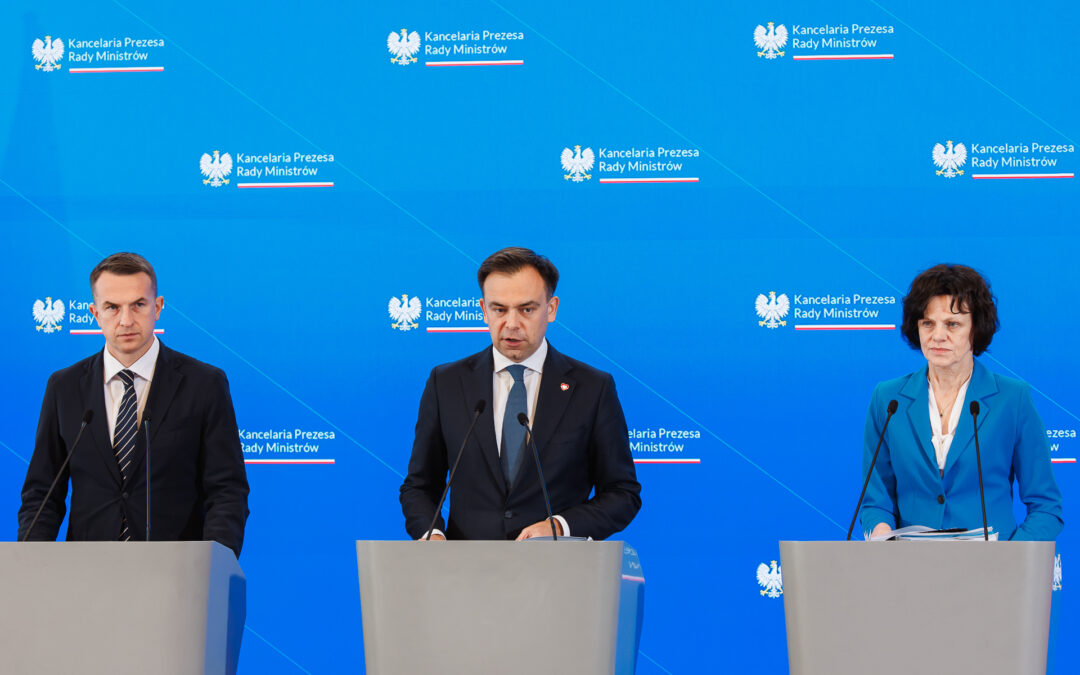
Main image credit: Kancelaria Premiera / Flickr (under CC BY-NC-ND 4.0)

Alicja Ptak is deputy editor-in-chief of Notes from Poland and a multimedia journalist. She has written for Clean Energy Wire and The Times, and she hosts her own podcast, The Warsaw Wire, on Poland’s economy and energy sector. She previously worked for Reuters.