Keep our news free from ads and paywalls by making a donation to support our work!

Notes from Poland is run by a small editorial team and is published by an independent, non-profit foundation that is funded through donations from our readers. We cannot do what we do without your support.
Prime Minister Donald Tusk said on Thursday that Polish airspace had been violated during a massive missile attack by Russia on western Ukraine overnight, adding that there were no casualties or immediate threat to civilians.
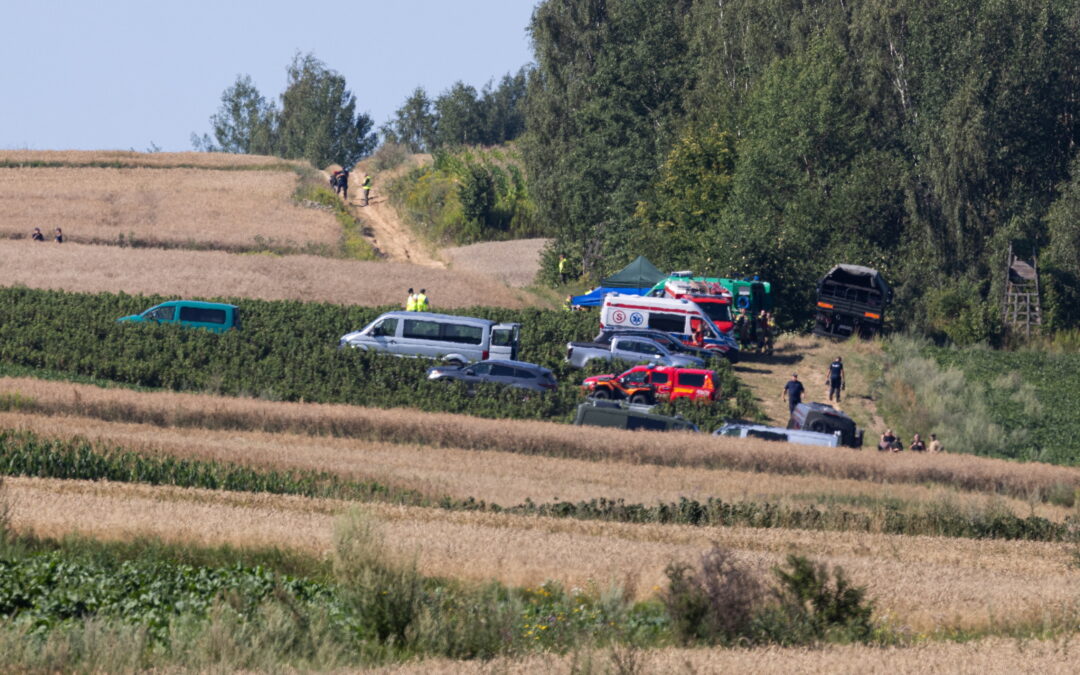
A suspected Russian Kh-101 cruise missile crashed in eastern Poland, around 100 km from the Ukrainian border, prompting the deployment of police counter-terrorism officers and other security services to the site.
The fall of the object, which is reported to have caused a powerful explosion, left a crater about 10 metres wide and scattered fragments in a field between Tarnawa-Kolonia and Tokary in Lublin province, about 2 km from the nearest buildings, according to local police.
TYLKO U NAS! Wybuch i ogromny krater na #Lubelszczyźnie. Mamy zdjęcia! >> https://t.co/BrX7XneP7F
Fot. Radio ESKA pic.twitter.com/BgzlhpSVag
— ESKA (@eska_pl) July 30, 2026
Lublin prosecutor Grzegorz Trusiewicz told reporters at the site of the incident that the crater was about 5 metres deep and that fragments had been scattered across an area of roughly 200 metres. Ukraine has offered Poland assistance in investigating the scene, he added.
Earlier in the morning, Poland’s Armed Forces Operational Command (DORSZ) said that air defence radars had detected at least a dozen missiles over western Ukraine overnight whose trajectories could have posed a potential threat to Polish airspace.
An unidentified object was detected in Polish airspace at 3:40 a.m. travelling westward, DORSZ said. An F-16 fighter jet was dispatched to identify and intercept it.
At 3:46 a.m., before the object could be clearly identified, it disappeared from the radar. An Mi-24 helicopter was then sent to the area of the last radar detection to verify the indications. Its crew located what was believed to be the crash site.
W trakcie rosyjskiego zmasowanego ataku rakietowego na zachodnią Ukrainę doszło do naruszenia polskiej przestrzeni powietrznej. Zwołałem w związku z tym zespół koordynacyjny z udziałem Ministra Obrony i odpowiednich służb, które od wielu godzin pracują na miejscu zdarzenia i…
— Donald Tusk (@donaldtusk) July 30, 2026
Tusk said the initial information suggested the object was likely a Russian Kh-101 cruise missile, echoing earlier comments made by Ukraine’s acting foreign minister, Andrii Sybiha, but stressed that investigators would need to establish the precise type and origin of the object.
“We will want to be 100% certain: what kind of missile, who launched it, whether it was the explosion of the payload or the impact of the missile itself that caused this crater,” he said at a press conference in Lublin.
The prime minister added that Polish forces had been prepared to shoot down the object had it continued flying in a way that posed a threat. Tusk added that another missile approached the Polish border but did not enter Polish airspace.
“This initial information clearly indicates that the relevant services, the military, our pilots, and our aircraft acted very quickly and efficiently. There was no immediate threat due to the missile falling in an undeveloped area,” Tusk said. He added that he had discussed the incident with President Karol Nawrocki.
Niezwykle ciężka noc dla naszej obrony powietrznej, systemów obserwacji i wykrywania zagrożeń. Dziękuję gen. I. Nowakowi i @DowOperSZ, wszystkim, którzy dziś koordynowali, obserwowali, analizowali i reagowali na wydarzenia nad Ukrainą i w naszej przestrzeni powietrznej.… https://t.co/RssjKTKAec
— Władysław Kosiniak-Kamysz (@KosiniakKamysz) July 30, 2026
This morning, Polish defence minister Władysław Kosiniak-Kamysz described the night as “extremely difficult for our air defence, surveillance and threat detection systems”.
Later, speaking alongside Tusk, he said Polish F-16 fighter jets had been operating near the Polish-Ukrainian border since about 2 a.m.
“In addition, reconnaissance aircraft operating over Polish airspace and allied aircraft for aerial refuelling, which took off from Germany, have been activated,” he said.
An early warning system was activated in Lublin and several other areas of the province because of Russian air attacks on Ukraine. The alarm lasted about 13 minutes, according to the interior minister.
The opposition criticised the authorities for not providing residents with further information about the reason for the alarm.
“A few minutes of alarm, no information in the mainstream media about what was happening, some residents didn’t even hear the sirens, and no text messages with an alert from the Government Centre for Security (RCB),” wrote Michał Dworczyk, a Law and Justice (PiS) MP, on social media.
Digital affairs minister Krzysztof Gawkowski defended the decision to sound the alarm. “If it hadn’t been for that alarm, if those sirens hadn’t gone off, and if the object hadn’t landed in a field but instead in a block of flats, a house or any other place where it could have caused injury or, God forbid, death,” he told Polsat News.
Polish airspace has been violated several times in recent years by objects entering from the direction of Ukraine amid the war there.
In September last year, an estimated 20 Russian military drones were recorded repeatedly violating Polish airspace. In 2022, a stray missile struck the Polish village of Przewodów, killing two people.
Poland has signed an agreement for a new anti-drone system that it claims will be the first of its kind in Europe.
The network is intended to protect Poland’s eastern borders, where last year around 20 Russian drones crossed in an unprecedented incursion https://t.co/WhWhJxDwXA
— Notes from Poland 🇵🇱 (@notesfrompoland) January 30, 2026
Notes from Poland is run by a small editorial team and published by an independent, non-profit foundation that is funded through donations from our readers. We cannot do what we do without your support.
Main image credit: Jakub Orzechowski / Agencja Wyborcza

Alicja Ptak is deputy editor-in-chief of Notes from Poland and a multimedia journalist. She has written for Clean Energy Wire and The Times, and she hosts her own podcast, The Warsaw Wire, on Poland’s economy and energy sector. She previously worked for Reuters.