Keep our news free from ads and paywalls by making a donation to support our work!

Notes from Poland is run by a small editorial team and is published by an independent, non-profit foundation that is funded through donations from our readers. We cannot do what we do without your support.
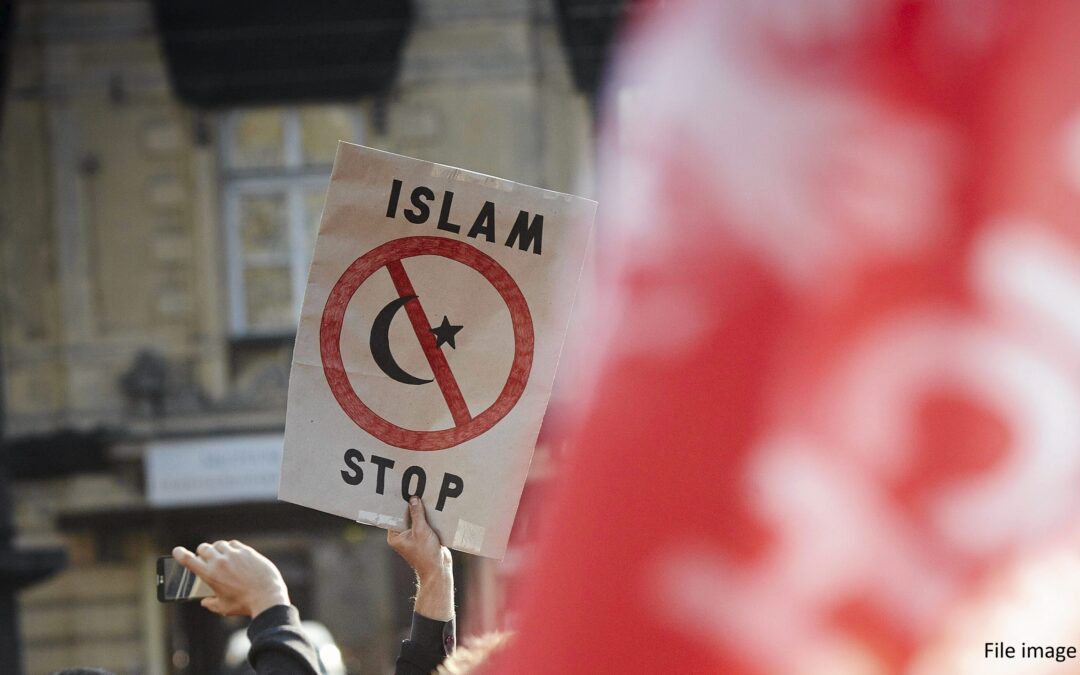
Polish nationalists have held a protest outside an Islamic centre in Kraków, Poland’s second-largest city. The demonstration follows a growing campaign against the centre, which is seeking to meet the needs of Kraków’s growing Muslim community.
In response, the municipal official responsible for equality policy in Kraków has criticised those who are “artificially fuelling fears”, while the Islamic centre itself has condemned the “unlawful threats and attempts at provocation aimed at our community”.
The protest outside the centre was organised by the National Movement (Ruch Narodowy), which is part of the far-right Confederation (Konfederacja) group that sits in Poland’s parliament.
“We do not consent to the spread of the Muslim religion in Poland,” wrote the National Movement’s leader in Kraków, Piotr Bartosz, in a post advertising the demonstration. “Poland is a European country and a Christian country.”
Confederation MP and National Movement deputy leader Witold Tumanowicz also expressed his support for the protest. “This [centre] is an example of the deliberate Islamisation of Poland,” he said in a message from parliament. “Time to say enough.”
On Monday evening, around 200 people gathered outside the centre, holding signs saying “We don’t want mosques here. It is not our culture” and “Defend Europe”. Some wore jackets with the logo of the Border Defence Movement (ROG) of Robert Bąkiewicz, a nationalist figure who has led anti-immigration protests.
The Islamic centre is run by the Al-Fajr Foundation, which describes itself as “an Islamic and cultural foundation based in Kraków, established to serve, support, and empower the Muslim community in Kraków and across Poland”.
Earlier this year, the foundation came to wider public attention when it began fundraising for a new cultural centre in Kraków that it said would be used for prayer as well as education and community support. It warned that the two current locations used by the city’s Muslim community “are stretched to their limits”.
However, newspaper Gazeta Krakowska notes that, contrary to claims by some local residents, media outlets and nationalist groups, the foundation’s premises are not a mosque. They do not, for example, have minarets or public calls to prayer five times a day.
An Islamic group wants to establish a new prayer centre in Kraków for the growing local Muslim community
The idea has drawn concern from some local residents and protests from right-wing groups, who say Poland should avoid "the mistakes of western Europe" https://t.co/ClCwusyhhp
— Notes from Poland 🇵🇱 (@notesfrompoland) February 23, 2026
Nevertheless, in recent weeks, nationalist activists have argued that the foundation is secretly operating a mosque. Many have shared videos on social media showing prayers taking place there.
“The illegal mosque in Kraków is still operating. The residents of the Podwawelskie estate have been deceived!” wrote the National Movement on Facebook. “Although we were told that it was a cultural centre and that we could always enter, this turned out to be untrue.”
In a statement issued on Saturday, before today’s protest, the Al-Fajr Foundation condemned “the false information and escalating acts of hostility directed at our activities”.
It noted that it had, from the outset, made clear that its facilities would have “religious functions” and said that it complied with all relevant laws – unlike those who are “unlawfully recording visitors to our premises without their consent” and directing “unlawful threats…at our community”.
Meanwhile, Kraków’s municipal plenipotentiary for equality, Ewelina Pytel, also criticised those whom she said were “attempting to artificially fuel fears and instigate conflicts” by raising fears about the Islamic centre.
She noted that Kraków is home to people of many faiths, and that their right to practise religion is enshrined in the constitution. In an effort to calm tensions, Pytel pledged to organise an open meeting between local residents and representatives of the Muslim community.
Over the last decade, Poland has experienced unprecedented levels of immigration. Although the vast majority of new arrivals have been from Ukraine and Belarus, there are also growing numbers from Asia and the Middle East.
Speaking to Radio Kraków, Karol Wilczyński, an academic from the Centre for Migration Studies at the Jagiellonian University, estimated that between 3,000 and 5,000 Muslims now live in Kraków, but that only around 300-400 of them regularly practise their religion.
Agata S. Nalborczyk, a scholar from the Faculty of Asian and African Cultures at the University of Warsaw, recently told the Polish Press Agency (PAP) that between 40,000 and 76,000 Muslims may live in Poland, making up 0.1-0.2% of the population.
Foreigners now make up almost 15% of Warsaw's population, while in Wrocław, Poland's third-largest city, the figure has reached 20%.
The new data from @StatPoland indicate there are now 2.3 million foreigners in Poland, 73% of whom are Ukrainians https://t.co/kUJ8ljRwzt
— Notes from Poland 🇵🇱 (@notesfrompoland) July 3, 2026
Notes from Poland is run by a small editorial team and published by an independent, non-profit foundation that is funded through donations from our readers. We cannot do what we do without your support.
Main image credit: Marcin Stepien / Agencja Wyborcza.pl
Olivier Sorgho is senior editor at Notes from Poland, covering politics, business and society. He previously worked for Reuters.