Keep our news free from ads and paywalls by making a donation to support our work!

Notes from Poland is run by a small editorial team and is published by an independent, non-profit foundation that is funded through donations from our readers. We cannot do what we do without your support.
The European Commission has launched infringement proceedings against Poland over its failure to restore and protect the Oder river after major environmental disasters there in recent years.
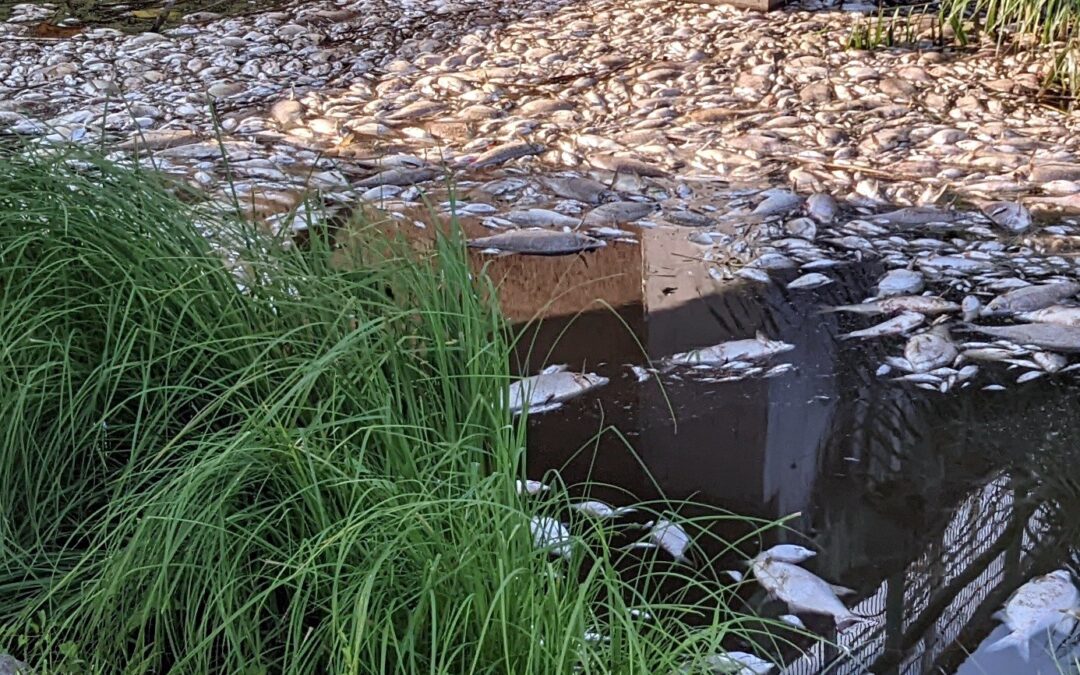
In 2022, over 360 tonnes of fish died in the river as a result of algal blooms caused by poor water quality, with a further 100 tonnes dying in 2024. The European Commission says that Poland has failed since then to take sufficient steps to protect the Oder, including limiting the discharge of saline water from mines into the river.
It has therefore filed a formal letter of notice to the Polish government, which now has two months to respond. If it fails to allay Brussels’s concerns, the commission may launch legal action against Poland at the Court of Justice of the European Union.
Komisja Europejska wszczęła postępowanie wobec Polski ws. naruszenia prawa UE. Chodzi o rzekę Odrę.https://t.co/IZBvVqe4vh
— PolsatNews.pl (@PolsatNewsPL) April 29, 2026
Announcing its decision on Wednesday, the commission said that, since the outbreaks of toxic golden algae in 2022 and 2024, “the measures taken by Poland have been insufficient to reverse the deterioration and ensure that water bodies achieve good status”.
It noted that “Poland has authorised saline mine water discharges into the river despite their acknowledged negative impact on the water status” and has “failed to take the necessary measures to ensure restoration of the protected habitats and species present along the river”.
As a result, “the ‘golden algae’ remains present in the Oder River basin and the salinity of the water remains high”. The country’s official river basin management plan for the Oder did not even take into account the 2022 disaster, notes the commission.
It therefore believes that Poland has failed to fulfil its obligations stemming from European directives relating to water management, industrial emissions, natural habitats, and protection of birds, including failing to properly assess the impact of plans for the river on EU-protected natural areas.
Commenting on the decision, Maria Włoskowicz, a lawyer from environmental group ClientEarth, told news website Gazeta.pl that some of the causes of the 2022 and 2024 disasters do indeed remain in place.
“Saline water discharges from mines continue as before,” said Włoskowicz. “The government has not changed the regulations on this. We do not even have an early response system or adequate, up-to-date and widespread monitoring.”
She noted that successive governments have had years to deal with the issue, but that expert findings and a damning report by the Supreme Audit Office (NIK) had failed to prompt them to act. “We hope that the opening of infringement proceedings will be a warning that the government will take seriously.”
At the time of writing, neither Poland’s climate and environment ministry nor other government departments had commented on the European Commission’s announcement.
Jedną z głównych przyczyn katastrofy było wysokie zasolenie Odry, tymczasem zrzuty solanki z kopalń mają miejsce tak samo jak wcześniej – nasza prawniczka Maria Włoskowicz w @gazetapl_news o wszczęciu postępowania wobec Polski przez @EU_Commission 🐟https://t.co/sJOEEf32M1
— ClientEarth Polska (@ClientEarth_PL) April 29, 2026
In 2022, it was estimated that over half of the Oder’s fish died in the environmental disaster. Various investigations found that the ultimate cause of the mass die-off was algal blooms that produced toxins which damaged the ecosystem.
An EU report published in 2023 noted that industrial waste entering the water was a “key factor” leading to the catastrophe, while poor communication by the Polish authorities hampered the response. Soon after, Germany, along whose border the river runs, criticised Poland for failing to protect the Oder.
Later that year, NIK published a report that identified numerous failings by the then Law and Justice (PiS) government and other state authorities. It pointed to years of negligence and poor decision-making that led to the catastrophe, and said that the response was initially passive.
Last year's environmental disaster in the Oder river resulted from "years of inaction and mistakes" by the Polish authorities, says the state audit office.
It also found that failings in the government's response to the crisis made the situation worse https://t.co/8bsnRMzVNA
— Notes from Poland 🇵🇱 (@notesfrompoland) November 16, 2023
After a new coalition government led by Prime Minister Donald Tusk and his centrist Civic Coalition (KO) took power in 2023, it claimed that the measures promised by PiS, such as 800 monitoring points along the river, had in fact not been put it place.
In 2024, the climate ministry informed prosecutors of potential crimes by officials under the PiS government, whom they said had mismanaged finances intended for the monitoring system.
In that same year, the death of more than 100 tonnes of fish in a canal and lake linked to the Oder led to fears of a renewed crisis.
Since early August, over 100 tonnes of dead fish have been removed from a lake and canal in Poland.
PiS, which was in power during the height of a similar crisis in 2022, accuses the government of hypocrisy and downplaying the disasterhttps://t.co/uQVefxHuVT
— Notes from Poland 🇵🇱 (@notesfrompoland) August 19, 2024
In January this year, Poland’s climate ministry announced plans to reduce salinity in the Oder river in summer months by 59% in Lower Silesia and 14% in Upper Silesia. It said that one of the main objectives of the plan is to ensure compliance with European directives.
The first phase of the project aims at increasing wastewater retention capacity in mines as well as piloting desalination technologies.
In March, Poland’s climate minister, Paulina Hennig-Kloska, and her German counterpart, Carsten Schneider, discussed efforts to monitor water quality in the Oder and counteract environmental threats.
Earlier this month, the Polish ministry claimed that, thanks to measures it has taken since the change of government in 2023, last summer saw no golden algae enter the river.
Germany says Poland is not doing enough to protect the Oder after a new report found that over half the river's fish died off due to last year’s environmental disaster.
But a Polish government official says Germany is spreading disinformation https://t.co/gOQ0HReJvN
— Notes from Poland 🇵🇱 (@notesfrompoland) June 29, 2023
Notes from Poland is run by a small editorial team and published by an independent, non-profit foundation that is funded through donations from our readers. We cannot do what we do without your support.
Main image credit: Hanno Böck/Wikimedia Commons (under CC BY-SA 4.0)

Daniel Tilles is editor-in-chief of Notes from Poland. He has written on Polish affairs for a wide range of publications, including Foreign Policy, POLITICO Europe, EUobserver and Dziennik Gazeta Prawna.