Keep our news free from ads and paywalls by making a donation to support our work!

Notes from Poland is run by a small editorial team and is published by an independent, non-profit foundation that is funded through donations from our readers. We cannot do what we do without your support.
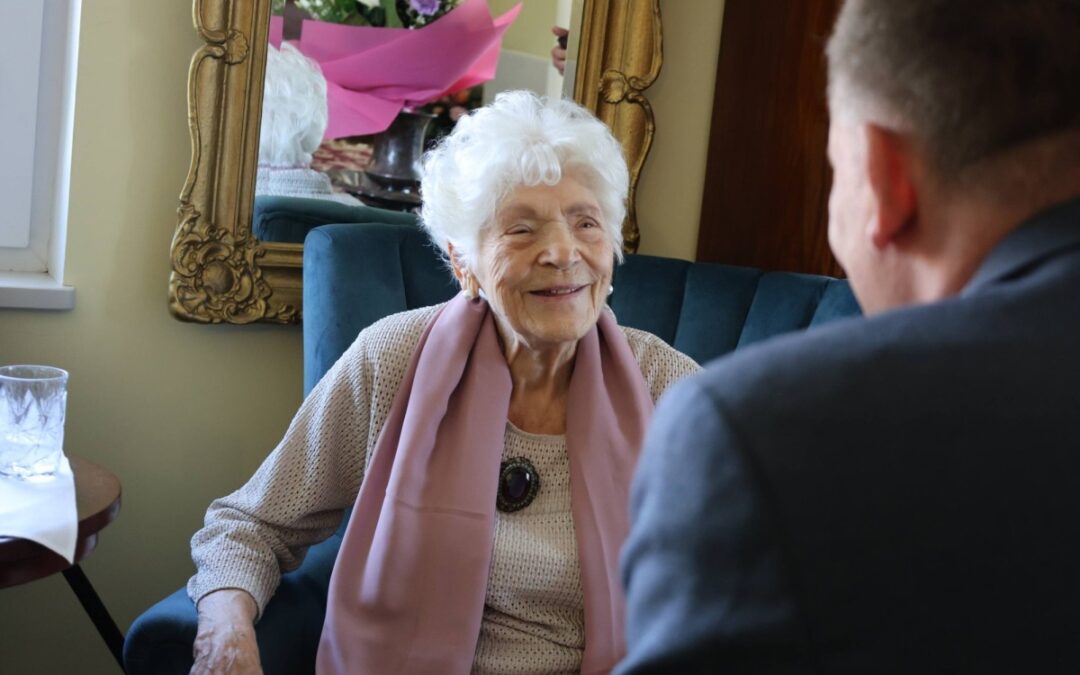
A veteran of Poland’s wartime resistance who participated in the Warsaw Uprising has been promoted to the rank of colonel by the defence minister to mark her 105th birthday.
Urszula Tauer, who served during the war under the pseudonym “Ala”, took “enormous risks every day, fully aware of the potential consequences”, wrote the head of the regional government of Kuyavia-Pomerania province, where she lives, in a letter of congratulations.
“Thank you for your unyielding resolve – you are…the pride of our province,” he added.
Tauer was awarded a promotion to the rank of colonel by the defence minister ahead of the forthcoming celebrations of Polish Constitution Day on 3 May, according to the Kuyavian-Pomeranian Provincial Office.
She was also presented with the “Pro Bono Poloniae” commemorative medal by the Office for War Veterans and Victims of Oppression.
Born on 24 April 1921 in the city then known as Lwów, when it was part of prewar Poland (but which is now Lviv in Ukraine), Urszula Tauer (née Kraft) moved to Bydgoszcz, in northern Poland, as a young child.
She had just completed secondary school when the war broke out in September 1939. In that same month, her grandfather was executed by the invading Germans, “an event that forever shaped her patriotic stance”, writes Beata Krzemińska, a spokeswoman for the provincial authorities, in an article for the KAI press agency.
Tauer was first detained by the Gestapo the next year, before escaping to Warsaw. There, she became a liaison and courier for the Union of Armed Struggle, Poland’s main underground resistance force, which was in 1942 renamed as the Home Army (AK).
Her knowledge of German allowed her to carry out dangerous missions, even travelling to Berlin to re-establish contacts with the Polish underground there.
“I wasn’t afraid of death. I was only afraid of being a traitor. After all, how much can a person endure?” Tauer once told Gazeta Wyborcza in an interview about her wartime experiences.
Today marks the 78th anniversary of the outbreak of the Warsaw Uprising in 1944, when Poland's underground resistance rose up against the Nazi German occupiers.
The struggle was documented by photographer Sylwester Braun, a member of the resistance https://t.co/OprNr0Y0vX
— Notes from Poland 🇵🇱 (@notesfrompoland) August 1, 2022
In 1944, she headed a unit responsible for legalising false documents issued to underground couriers, who were responsible for carrying information, documents or other important materials between various sections of the underground resistance.
Tauer participated and was wounded twice as a liaison for the Home Army headquarters during the Warsaw Uprising of August-October 1944, when the Polish underground rose up against the German occupiers in the largest single military operation by any European resistance movement in the war.
After the war, Tauer returned to civilian life, raising three children and running a chemical laboratory.
“I’ve always been someone able to adapt very quickly, understand that various issues need to be steered into a pleasant conversation, not an argument,” she told the local Bydgoszcz TVP station last week. “I’ve simply done what I had to do in life.”
Najstarsza uczestniczka Powstania Warszawskiego z Kujaw i Pomorza skończyła 105 lat!https://t.co/yHgqrLSI0I
— TVP3 Bydgoszcz (@tvpbydgoszcz) April 24, 2026
Notes from Poland is run by a small editorial team and published by an independent, non-profit foundation that is funded through donations from our readers. We cannot do what we do without your support.
Main image credit: Urząd do Spraw Kombatantów i Osób Represjonowanych (under CC BY-NC-ND 4.0)
Ben Koschalka is a translator, lecturer, and senior editor at Notes from Poland. Originally from Britain, he has lived in Kraków since 2005.