
Keep our news free from ads and paywalls by making a donation to support our work!

Notes from Poland is run by a small editorial team and is published by an independent, non-profit foundation that is funded through donations from our readers. We cannot do what we do without your support.
Polish firm Vigo Photonics, which specialises in producing advanced infrared sensors, photon detectors and semiconductor materials, has acquired US rival InfraRed Associates for $8.4 million (31.2 million zloty).
The Polish firm hailed the deal as a “major step in the company’s global expansion strategy” that will “significantly strengthen Vigo’s footprint in the United States and enhance its ability to serve the defence and high-tech sectors”.
Vigo Photonics develops and manufactures advanced infrared detectors, detection modules and semiconductor materials used to analyse environments through light invisible to the human eye.
The company’s products are used for a wide range of applications, including pollution analysis, food and waste sorting, early disease detection, as well as defence systems and high-speed transport diagnostics.
Its detectors have also been deployed in space exploration, including supplying key components for NASA’s Curiosity rover mission to study methane levels on Mars.
Astronaut @astro_slawosz‘s recent trip to the International Space Station highlighted the Polish space industry’s growing importance.
Once limited to making components for others, Poland is now building its own spacecraft and participating in missions https://t.co/TmQiD91IzZ
— Notes from Poland 🇵🇱 (@notesfrompoland) October 6, 2025
InfraRed Associates, which was founded in the 1970s and is headquartered in Florida, meanwhile, produces liquid nitrogen-cooled detectors and serves customers across the industrial, scientific and military sectors in the United States, Asia and Europe.
Vigo said the deal, which was caried out through a US subsidiary, would give it access to a US-based production facility, helping it meet “supply requirements for the American defence sector” and “significantly increase” its revenue in the country.
It also “paves the way for the reduction of tariff and administrative barriers, facilitating access to the strategic US market”, says Adam Piotrowski, the president of Vigo’s management board.
The deal was supported by financing of $5.5 million, repayable over ten years, from the Polish Development Fund (PFR), a state entity that supports strategic investments.
The United States is already Vigo’s third-largest market, accounting for 12.1% of its 93.1 million zloty of revenue in 2025. Europe (excluding Poland) was its largest market, contributing 54%, followed by Poland at 17.3%.
Across all markets, the defence sector accounted for 18.8% of revenue and the firms acquisition of InfraRed Associates – reported revenue of $8.9 million (33.1 million zlotys) in 2024 and $8.7 million in 2025 – is seen as a further step in developing this.
“For VIGO Photonics, defence has been one of our key priorities for years. This transaction is a major milestone in the company’s long-term strategy,” the company said in a statement.
Poland’s largest manufacturer of trains and trams, Pesa, has announced the acquisition of German rival HeiterBlick as it seeks to expand its operations across Europe https://t.co/N1wE1aYL5m
— Notes from Poland 🇵🇱 (@notesfrompoland) January 12, 2026
Following more than 30 years of largely uninterrupted economic growth, Polish companies are increasingly expanding their investments abroad.
Recent examples include Polish delivery giant InPost, which has made several major acquisitions in western Europe, and Polish train and tram manufacturer Pesa, which recently acquired German rival HeiterBlick.
Notes from Poland is run by a small editorial team and published by an independent, non-profit foundation that is funded through donations from our readers. We cannot do what we do without your support.
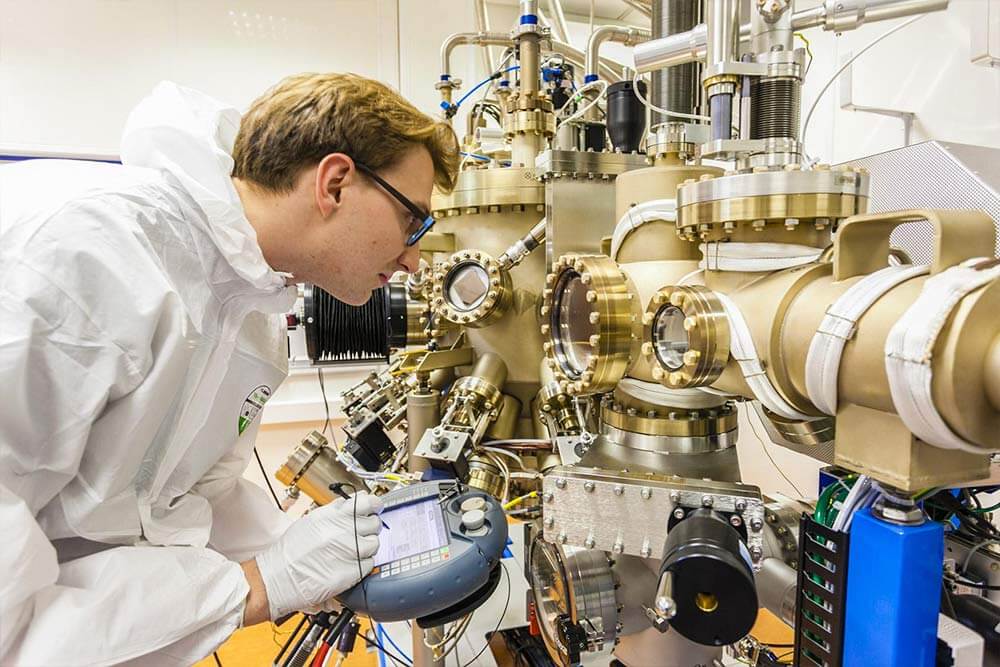
Main image credit: Vigo Photonics press materials

Alicja Ptak is deputy editor-in-chief of Notes from Poland and a multimedia journalist. She has written for Clean Energy Wire and The Times, and she hosts her own podcast, The Warsaw Wire, on Poland’s economy and energy sector. She previously worked for Reuters.