Keep our news free from ads and paywalls by making a donation to support our work!

Notes from Poland is run by a small editorial team and is published by an independent, non-profit foundation that is funded through donations from our readers. We cannot do what we do without your support.
American Nobel laureate Victor Ambros, whose father was a Polish postwar migrant to the United States, has announced that he is seeking Polish citizenship in order to honour his family “and all those who fought and survived so that I could exist today”.
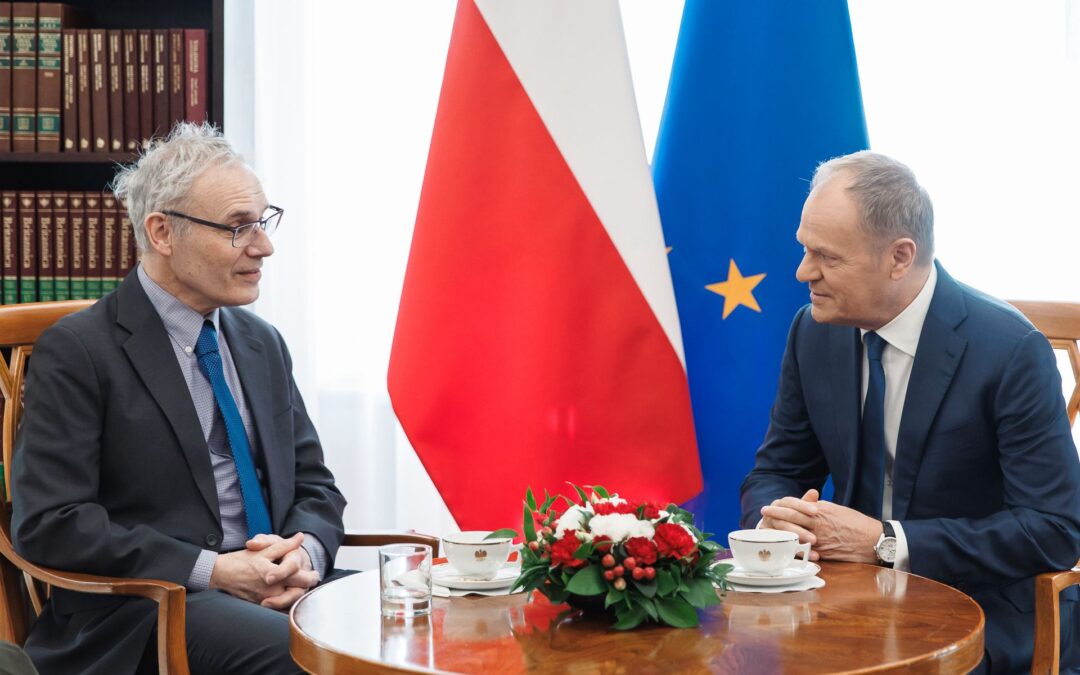
Ambros, who won the 2024 Nobel Prize in Medicine for his research on microRNA, said during a visit this week to Warsaw, where he delivered a lecture and met with Prime Minister Donald Tusk, that he also hopes to help strengthen Poland’s scientific standing worldwide.
Noblista prof. Victor Ambros stara się o polskie obywatelstwohttps://t.co/YqgMk6d2gn pic.twitter.com/p1JEIfcFOo
— Dzieje.pl (@dziejepl) March 9, 2026
Ambros’s father, Longin, was born in 1923 in what was then the village of Dordziszki in Poland but which, after postwar border changes, is now Dordishki in Belarus. He later attended high school in the city then known as Wilno, and which was part of Poland, but is now Vilnius, the capital of Lithuania.
During World War Two, Longin Ambros was deported to Nazi Germany and used as forced labour, before being liberated at the end of the war by American forces, who then employed him as an interpreter.
In 1946, Longin emigrated to the United States, where he settled on a farm and raised a family. Victor was one of eight children and the first scientist in the family.
Ambros told the Polish Press Agency (PAP) that his father never spoke Polish at home, which is why he did not learn the language. However, he did often speak about his homeland.
“He talked about Poland as a country whose borders kept shifting on the map, [which] gave me the feeling that Poland was something almost unreal, like an illusion,” said Ambros.
“Only later, especially in recent years, did I increasingly see how incredibly resilient the Polish nation proved to be, how it was able to survive the onslaught of history and the forces that sought to annihilate it,” he added. “Today, it is stronger than ever.”
Of his decision to seek Polish citizenship, the scientist said told PAP that “it would be a way to honour my father, my aunt, their parents, and all those who fought and survived so that I could exist today”.
Hollywood star Jesse Eisenberg, whose ancestors were Jews from Poland, has been handed Polish citizenship by President @AndrzejDuda.
The filmmaker – whose latest movie, A Real Pain, was set entirely in Poland – described it as "the honour of a lifetime" https://t.co/krLk8VgUjg
— Notes from Poland 🇵🇱 (@notesfrompoland) March 5, 2025
Ambros added that he also saw this “as an opportunity to make even a small contribution…to the development of Polish science and Poland’s position in the world”.
On Monday this week, Ambros, who is a professor at the University of Massachusetts Medical School, delivered a lecture in Warsaw on microRNA. He also met with Polish Prime Minister Donald Tusk.
Last June, Ambros received an honorary doctorate from the Silesian University of Technology in Poland. He also chairs the scientific council of the International Institute of Molecular Mechanisms and Machines of the Polish Academy of Sciences (PAN).
📍Warszawa | Premier @donaldtusk spotkał się z laureatem Nagrody Nobla prof. Victorem Ambrosem. pic.twitter.com/kHv6XTrwtu
— Kancelaria Premiera (@PremierRP) March 9, 2026
There has been a growing trend in recent years for foreigners to seek Polish citizenship. There are three paths for those wishing to obtain it.
The first is through Polish ancestry. People with a Polish parent, grandparent or great-grandparent who lived in Poland after 1920 and never lost their citizenship can apply to have their status as a Polish citizen officially confirmed.
Last year, Hollywood star Jesse Eisenberg, whose ancestors were Jews from Poland, received Polish citizenship, describing it as the “honour of a lifetime”. His Oscar-nominated 2024 film A Real Pain was set entirely in Poland.
The second route is for foreign residents in Poland who meet requirements relating to their length of residency, language skills and personal situation to apply to the governor of the province where they live.
Poland’s interior ministry has proposed tougher rules for obtaining Polish citizenship.
They would increase the residency period from three to eight years and require applicants to take a test proving they are integrated and sign a declaration of loyalty https://t.co/S7MfkPVZzD
— Notes from Poland 🇵🇱 (@notesfrompoland) October 10, 2025
The third is by applying directly to the president, who has discretion to grant citizenship without any specific legal requirements being met. Applicants are expected to show personal ties to Poland and explain their reasons for seeking citizenship.
One recent example was Russian-born speed skater Vladimir Semirunniy, who fled to Poland and was granted citizenship last year by President Karol Nawrocki. This allowed him to win a medal for Poland at the recent Winter Olympics.
In 2024, a record 16,000 people without Polish ancestry were granted citizenship, either through provincial governors or directly from the president. Applications to confirm citizenship through descent have also risen sharply, in particular among Israelis, many of whom have roots in Poland.
The number of Israelis applying for Polish citizenship by descent has surged from around 2,500 in 2021 to over 9,000 in 2024.
Applications from other countries have also risen but Israelis are the largest group.
See all the data and our full report here: https://t.co/NkuP8d5ZKm pic.twitter.com/QbjMogT1qh
— Notes from Poland 🇵🇱 (@notesfrompoland) February 12, 2025
Notes from Poland is run by a small editorial team and published by an independent, non-profit foundation that is funded through donations from our readers. We cannot do what we do without your support.
Main image credit: Kancelaria Premiera/X

Alicja Ptak is deputy editor-in-chief of Notes from Poland and a multimedia journalist. She has written for Clean Energy Wire and The Times, and she hosts her own podcast, The Warsaw Wire, on Poland’s economy and energy sector. She previously worked for Reuters.