Keep our news free from ads and paywalls by making a donation to support our work!

Notes from Poland is run by a small editorial team and is published by an independent, non-profit foundation that is funded through donations from our readers. We cannot do what we do without your support.
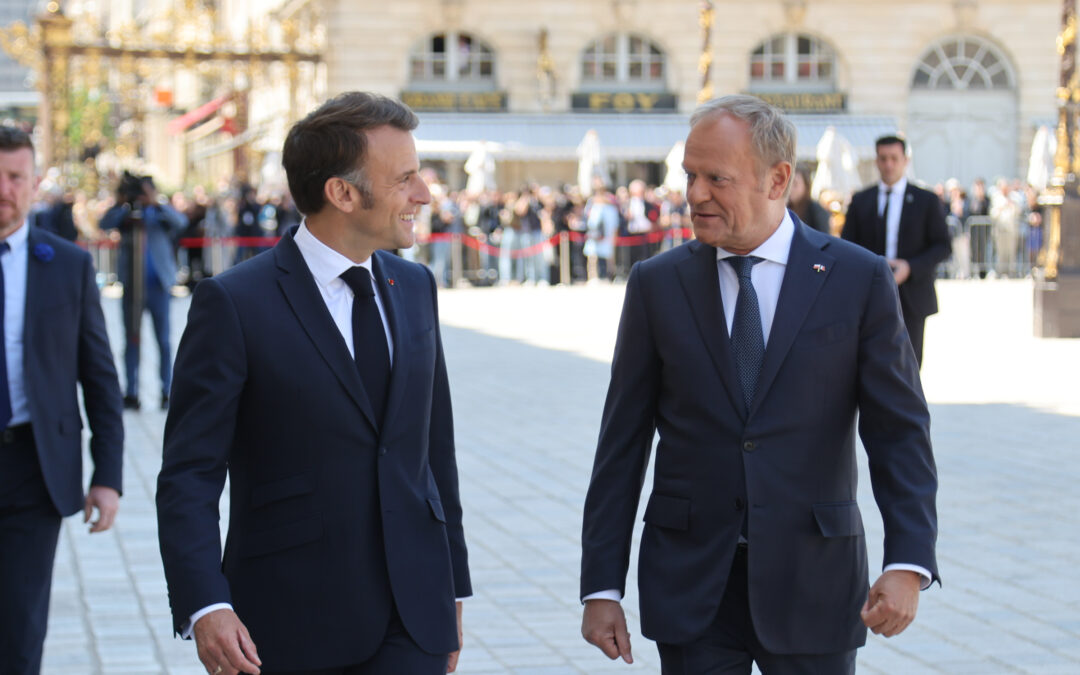
Prime Minister Donald Tusk has confirmed that Poland is in talks with France over joining its “advanced nuclear deterrence programme”.
His comments came shortly after President Emmanuel Macron announced that France plans to increase the size of its nuclear arsenal and cooperate with eight European allies, including Poland, who would be able to host nuclear assets.
Poland is in talks with France and a group of closest European allies on the programme of advanced nuclear deterrence. We are arming up together with our friends so that our enemies will never dare to attack us.
— Donald Tusk (@donaldtusk) March 2, 2026
“Poland is in talks with France and a group of the closest European allies on the programme of advanced nuclear deterrence,” wrote Tusk on social media. “We are arming up together with our friends so that enemies will never dare to attack us.”
Earlier on Monday, during a speech at the Île Longue nuclear submarine base, Macron revealed that “contacts have been made with an initial group of allies” about launching a “nuclear alliance” that would mark “a new phase of French deterrence”.
He identified the UK, Germany, Poland, the Netherlands, Belgium, Greece, Sweden and Denmark as the countries in question, and said they had “responded favourably to France’s offer”.
The plans would involve “participation of allied forces in our nuclear activities”, including “the deployment, as needed, of strategic force elements to our allies”.
“Just as our strategic [nuclear-armed] submarines naturally disperse throughout the oceans, guaranteeing a permanent strike capability, our strategic air forces could thus be deployed deep within the European continent,” explained Macron.
This would “complicate our adversaries’ calculations”, provide “advanced deterrence” and “offer a new strategic depth”, he said. “Its value will, I believe, also be very strong for the partners who adopt this approach with us and whose territory will gain a firm link with our deterrent.”
Macron emphasised, however, that decisions on the use of France’s nuclear weapons would rest solely with the French president.
He also revealed that he had “ordered an increase in the number of nuclear warheads in our arsenal”, though added that France would “no longer disclose the size of our nuclear arsenal”. The country is currently believed to have around 290 warheads, the world’s fourth-largest nuclear arsenal.
Macron lays out France’s new doctrine of nuclear deterrence here at Ile Longue. France will increase its number of warheads, no longer communicate the number, open nuclear exercises to other allies, and include option of stationing nuclear assets in allied countries pic.twitter.com/RphFMFKOyV
— Sophie Pedder (@PedderSophie) March 2, 2026
Poland, which has never had nuclear weapons of its own, has increasingly discussed the idea of a nuclear deterrent since Russia’s full-scale invasion of Ukraine in 2022.
In that year, then-President Andrzej Duda said that Poland was open to hosting nuclear weapons and had discussed the idea with the United States.
Two years later, Duda reiterated that Poland was willing to host nuclear weapons from its NATO allies and, in 2025, he said that he welcomed Macron’s idea of extending France’s “nuclear umbrella” to cover European allies.
Last month, Poland’s current president, Karol Nawrocki, likewise said that he was “a huge advocate” of Poland seeking a nuclear deterrent, saying that it is necessary in the face of an “aggressive, imperial Russia”.
President @NawrockiKn has called for Poland to seek a nuclear deterrent, saying that it is necessary in the face of an “aggressive, imperial Russia” https://t.co/L9oAshZUEb
— Notes from Poland 🇵🇱 (@notesfrompoland) February 15, 2026
Notes from Poland is run by a small editorial team and published by an independent, non-profit foundation that is funded through donations from our readers. We cannot do what we do without your support.
Main image credit: KPRP (under CC BY-SA 4.0)

Daniel Tilles is editor-in-chief of Notes from Poland. He has written on Polish affairs for a wide range of publications, including Foreign Policy, POLITICO Europe, EUobserver and Dziennik Gazeta Prawna.