Keep our news free from ads and paywalls by making a donation to support our work!

Notes from Poland is run by a small editorial team and is published by an independent, non-profit foundation that is funded through donations from our readers. We cannot do what we do without your support.
By Aleks Szczerbiak
A far-right politician’s unexpectedly strong presidential bid has upended Poland’s right-wing landscape, transforming him from a political eccentric into a disruptive force that the mainstream can no longer ignore.
His surge exposes deep fractures on the Polish right and raises the question of whether his radical “anti‑system” appeal marks a temporary protest spike or more lasting realignment.
Presidential election wild card
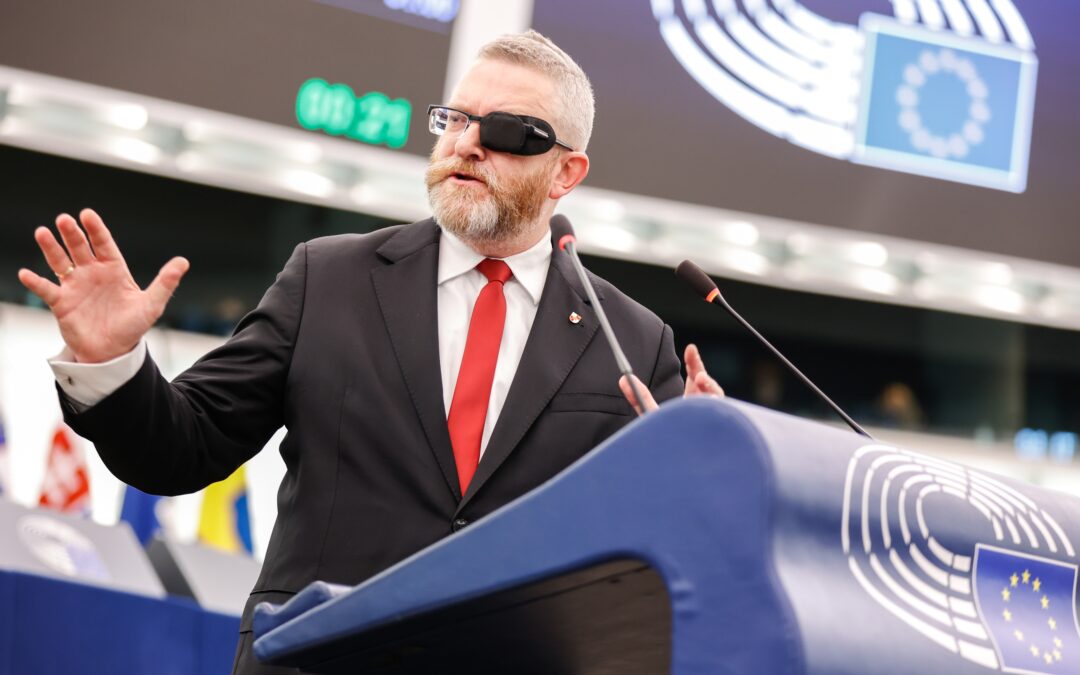
One of the big political surprises in Poland last year was the rise of far-right politician Grzegorz Braun and his nationalist-monarchist Confederation of the Polish Crown (KKP).
Previously a filmmaker and long known for his eccentric manner as a political provocateur, Braun was one of the best-known and widely recognised leaders of the radical-right Confederation (Konfederacja) alliance, which united free-marketeers, nationalists and monarchists under one banner.
Last January, after Confederation endorsed Sławomir Mentzen as its official candidate in the May-June 2025 presidential election (who finished a strong third with 14.8% of the first-round votes), Braun announced his own rival bid, leading to his expulsion from the broader alliance. However, Braun significantly exceeded pre-election forecasts, securing fourth place with 6.3%.
This result paved the way for Braun to establish himself as a significant political actor, and since then his party’s popularity has surged.
A new poll shows the party of far-right leader Grzegorz Braun reaching third place for the first time, with support of 11%
The finding continues a dramatic recent rise for Braun, who is currently on trial for attacking a Hanukkah celebration in parliament https://t.co/XeKwJy6YLG
— Notes from Poland 🇵🇱 (@notesfrompoland) December 17, 2025
Notably, he has picked up not just ex-Confederation voters but also disillusioned supporters of the right-wing Law and Justice (PiS), Poland’s ruling party between 2015 and 2023 and currently the main opposition grouping.
According to the Politico Europe aggregator of Polish opinion polls, Braun’s party is currently averaging around 9% (firmly above the 5% parliamentary representation threshold).
A “purer” conservative-nationalist voice
Through its attachment to traditionalist Catholicism and moral-cultural values and support for a monarchy as the ideal system of government, Braun’s party appeals to staunchly socially conservative voters, although it also includes many individuals whose views are at odds with Christianity or contradict mainstream church teaching.
However, its broader appeal is rooted in a combination of far-right, anti-establishment talking points that attract a number of particular constituencies, each of which has a specific issue that they are strongly engaged with.
Above all, Braun‘s movement claims to be the only “true”, credible and authentic anti-establishment choice and offers a “purer” version of conservative-nationalism to those disillusioned Polish voters who feel that other right-wing parties have compromised too much with the status quo.
Not only does Braun argue that the original Confederation is now too mainstream, many commentators say he is also increasingly picking up ex-PiS voters who feel that the former ruling party has not atoned sufficiently for its perceived strategic and moral errors during its period of office.
These were felt to include surrendering too much power to the EU, turning into a “new elite” that abandoned its original anti-system roots, and being too pro-Ukrainian.
Opposing foreign influences
Indeed, Braun attracts those voters who oppose Russia’s isolation and do not see Moscow as a security threat. For sure, such narratives are almost invisible in Polish public discourse, and openly Russophile Poles probably account for less than 10% of the electorate.
However, broader anti-Ukrainian sentiment has increased in recent months and many more Poles are worried about their country being dragged into the armed conflict. Braun appeals to these voters by opposing both military aid to Ukraine and the so-called “Ukrainisation” of Poland.
The owner of a Polish hotel group that hosted an event organised by a far-right leader known for his anti-Ukrainian views has pledged to donate all proceeds to support Ukraine.
His company claims that it cannot screen clients who are booking events https://t.co/TuioDss6LI
— Notes from Poland 🇵🇱 (@notesfrompoland) February 2, 2026
Indeed, arguably it is the Ukraine issue that has played a particularly important role in generating support for Braun. His party performs disproportionately well in the southeastern regions of Poland close to the border, where memories of wartime atrocities by Ukrainian nationalists are much fresher in historical memory.
Many of the PiS switchers to Braun’s party are likely to have been motivated by a feeling that the former ruling party did not advance Polish interests sufficiently in its relations with Ukraine.
Braun also draws upon anti-Jewish discourses, criticising the so-called “Judaisation” of Polish politics and even claiming that the current gas chambers at the Auschwitz German-Nazi death camp are fake.
Far-right leader Grzegorz Braun says the gas chambers at Auschwitz are “fake” and it is a “fact” that Jews have committed ritual murder.
Prosecutors have launched an investigation into whether he violated Poland's law against denying Nazi crimes https://t.co/7UUKzH5ndG
— Notes from Poland 🇵🇱 (@notesfrompoland) July 10, 2025
This obviously puts him on a collision course with any US administration, but his anti-Jewish rhetoric is often linked with pledges to downgrade transatlantic cooperation as part of a broader package of cleansing Poland of alleged foreign influences.
Indeed, concerns about defending Polish national sovereignty are at the heart of Braun’s programme, including a call for Poland to withdraw immediately from the EU, so-called “Polexit”.
A highly effective political performer
Together with his radical rhetoric, among Braun’s trademarks are his provocative and highly visible performative protests and “outrage stunts” designed to generate media traction, which his supporters view as uncompromising acts of defiance and strength.
These include: burning and vandalising Ukrainian, EU and LGBT symbols and flags; attacking a gynaecologist who performed late-term abortions; disturbing a minute’s silence for Holocaust victims in the European Parliament; and using a fire extinguisher to disrupt a Hanukkah candle-lighting ceremony in the Polish parliament.
The Hanukkah incident, which gained him international notoriety, formed the basis of Braun’s presidential campaign symbol and rallying slogan for his so-called “broad fire-extinguisher front” (szeroki front gaśnicowy) resistance movement.
The trial of Polish far-right leader Grzegorz Braun for his attacks on a Hanukkah celebration in parliament and a Holocaust lecture has begun.
He declared in court that he was facing trial because he had "dared to defend myself against Jewish supremacy" https://t.co/NRZLw7yzyo
— Notes from Poland 🇵🇱 (@notesfrompoland) December 8, 2025
In essence, the key to Braun’s success is his ability to tap into, harness and amplify a deep vein of voter discontent and position himself as a radical, uncompromising “anti-system” voice; the political vehicle for those Poles who believe traditional societal norms and social relations are in crisis.
In any political bidding war, he pushes the rhetorical boundaries and does not impose any limits upon himself, speaking openly about subjects that the mainstream parties and media avoid.
Moreover, despite his controversial views, Braun is well spoken and presents himself as a calm, articulate and highly effective media performer and debater, with a demeanour and speaking style that some voters find more authentic than mainstream politicians.
A headache for the Polish right
The surge in support for Braun’s party has fragmented – and exacerbated ideological and personal conflicts within – the right-wing camp. In addition to deep bitterness between Braun and the original Confederation, this includes fundamental disagreements in areas such as national security and transatlantic relations, which significantly complicate efforts to build a unified right-wing front ahead of the next parliamentary election, scheduled for autumn 2027.
The problem is that, even though the Polish right currently enjoys a numerical overall majority in the polls, electoral simulations indicate that Braun’s party has become an indispensable component of any future right-wing governing coalition.
However, a coalition of necessity with Braun would be a minefield because his radical rhetoric and actions mean that any hint of a formal alliance will be leveraged by the current liberal-centrist and left-wing governing parties to discredit the entire right-wing camp as unfit for office.
A possible link-up with Braun’s party could also emerge before the election around the question of whether to form a united right-wing slate to challenge the ruling coalition in the Senate, Poland’s less powerful second chamber, which is elected by the first-past-the-post system that favours large, unified electoral blocs.
Too extreme even for most conservative Poles?
Despite the momentum that Braun’s party has developed during the last few months, it still faces significant hurdles.
Although held together at its core by a strong anti-establishment and “anti-system” radicalism and rejection of the existing political order, the grouping is ideologically diverse, attracting a wide range of fringe radicals with very different motivations. This lack of coherent programmatic foundations poses a significant risk to the party’s long-term stability.
Indeed, some commentators argue that, notwithstanding his apparently uncompromising and intransigent approach, Braun’s vision of politics is essentially as a theatrical performance with little real-world impact beyond drawing attention to himself.
Two far-right leaders claim the Russian drone incursions were faked by Poland’s own government as part of a conspiracy to drag the country into the war in Ukraine.
They have submitted a notification to prosecutors against foreign minister @sikorskiradek https://t.co/YixQCpQBd7
— Notes from Poland 🇵🇱 (@notesfrompoland) September 19, 2025
Moreover, some right-wing critics say that, by rejecting mainstream norms, Braun’s stunts and shock tactics actually overshadow and discredit more reasoned conservative arguments on issues such as the overcentralisation of power by EU institutions.
The grouping’s appeal is also limited by the fact that, beyond Braun himself, it lacks well-known leaders, while some of those who are associated with the party have chequered pasts and are easy to discredit.
While Braun’s radical rhetoric and actions have not prevented his growth in support up until now, he appeals to a very specific, radicalised “anti-system” voter demographic. This could comprise as much as 15% of the electorate, but it is difficult to see his support base expanding much beyond that.
His toxic reputation, idiosyncrasy and ideological rigidity, together with a harsh and unadulterated political message, probably make Braun unpalatable for the majority of even more conservative Poles.
Far-right leader Grzegorz Braun, whose party has recently been rising in the polls, has announced that he wants Mateusz Piskorski, a man currently on trial for alleged espionage on behalf of Russia, to be one of his parliamentary election candidates https://t.co/KIan2hNedn
— Notes from Poland 🇵🇱 (@notesfrompoland) January 7, 2026
Moreover, his party’s economic programme – which combines support for national economic sovereignty and protectionism with deregulation, abolishing income tax and opposition to large fiscal transfers – presents a significant ideological barrier to winning over a broader swathe of PiS voters.
However disillusioned and frustrated the latter may be, it is questionable how many of them will be prepared to support a grouping that departs so radically from the state-interventionist and welfare-oriented model that PiS has championed and which originally attracted many of its voters to the party.
Another problem is the fact that, although moderately successful political formations have been built on the strength of a credible presidential election performance, the next scheduled parliamentary poll is not until autumn 2027.
However adept a performer Braun may be, it will be very difficult for him to keep up this level of interest for that length of time in such a fast-moving, social media-driven political age. Moreover, arguably Braun’s party’s poll ratings, and even his earlier presidential election result, may simply be a “safe” expression of mid-term voter frustration and not translate into support at the ballot box when the composition of the next government is at stake.
Shifting the “Overton window”?
On the other hand, given that Braun’s party is a controversial, radical insurgent grouping aimed explicitly at “anti-system” and anti-establishment voters, it may be that it has a “hidden” electorate that avoids declaring its voting intentions, and polling is actually underestimating its true level of support. Moreover, Braun has been able to bypass the traditional media successfully by utilising new social media platforms.
At the same time, attempts by his political opponents to use legal channels against him – such as criminal prosecutions arising from his various stunts, and attempting to censor or even ban his party – could backfire, simply galvanising and boosting Braun’s support by allowing him to frame these actions as the establishment persecuting an unpalatable truth-teller.
Polish far-right leader Grzegorz Braun has again been stripped of immunity by the European Parliament to face charges in Poland, including for inciting hatred against Jews and an incident in which he confronted a doctor involved in a late-term abortion https://t.co/h8CPTKp9DC
— Notes from Poland 🇵🇱 (@notesfrompoland) November 13, 2025
Given the importance of the Ukraine issue in fuelling support for Braun’s party, a key question is: how might an end to hostilities impact upon its continuing appeal?
On the one hand, concerns about Poland being drawn into the armed conflict would no longer be such a priority for voters. On the other hand, Braun could probably find a politically salient substitute; for example, questioning the continued presence in Poland of hundreds of thousands of Ukrainians once the war was over.
Some commentators argue that, regardless of whether his grouping establishes itself as a long-term fixture on the Polish political scene, Braun has already had an impact on the country’s political discourse, shifting the so-called “Overton window” range of policies or issues that society finds acceptable for public discussion at a given time.
If Braun’s support continues to grow, it could cause panic within the ranks of PiS and the original Confederation, forcing them to compete on both general radicalism and specifically anti-Ukrainian, anti-EU and anti-establishment discourses.
On the other hand, Confederation may actually benefit from its relative “mainstreaming”, while PiS is aware that, if the party tries too hard to emulate Braun’s more radical policies or harsher rhetoric, it risks alienating the more moderate conservative-centrists that it needs to return to power.
Notes from Poland is run by a small editorial team and published by an independent, non-profit foundation that is funded through donations from our readers. We cannot do what we do without your support.
Main image credit: Mathieu Cugnot/European Union 2025