Keep our news free from ads and paywalls by making a donation to support our work!

Notes from Poland is run by a small editorial team and is published by an independent, non-profit foundation that is funded through donations from our readers. We cannot do what we do without your support.
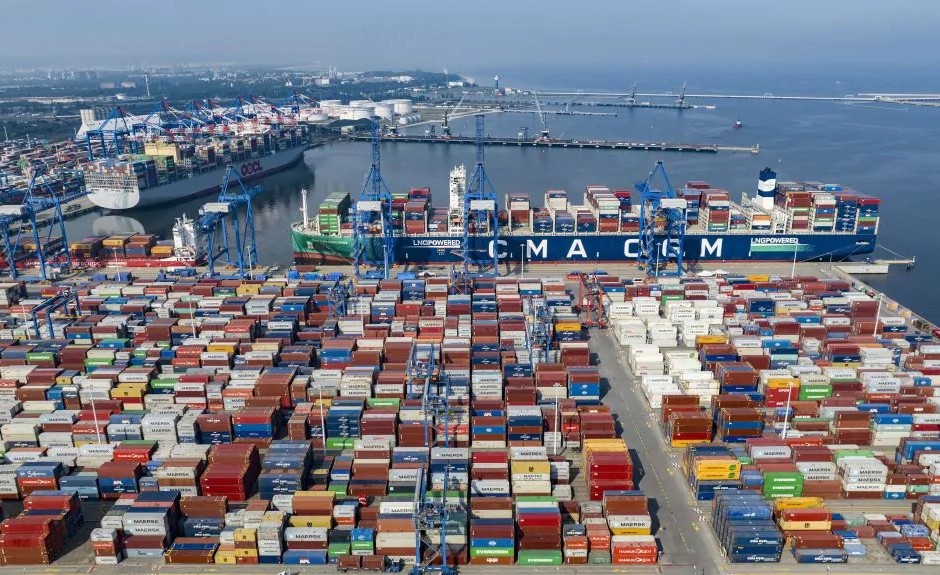
Poland’s ports handled a record amount of cargo in 2025, driven by strong growth in container traffic and liquefied natural gas (LNG) shipments.
The Baltic Sea ports of Gdańsk, Gdynia, Szczecin and Świnoujście handled a combined 3.9 million twenty-foot equivalent units (TEU) of containers last year, an increase of 18% compared with 2024. Total freight volumes reached 141 million tonnes, nearly 5 million tonnes more than a year earlier.
The results “confirm that Polish ports are playing an increasingly important role in international trade and are an important gateway in this part of Europe”, declared deputy infrastructure minister Arkadiusz Marchewka.
Rekordowe wyniki polskich portów. pic.twitter.com/xuQnI3G9xj
— Arkadiusz Marchewka (@A_Marchewka) January 26, 2026
The surge in volumes translated into stronger financial results. Preliminary estimates show that the ports generated a combined net profit of around 650 million zloty (€155 million), up almost 50% compared to two years ago, when the current coalition government took office, said Marchewka.
According to business daily Puls Biznesu, the structure of freight handled by Polish ports shifted last year. LNG shipments via the Świnoujście terminal increased by 32% year-on-year, while general cargo rose by 10% and other bulk cargo, including steel, by 9%.
Timber shipments, however, fell by 44% in 2025, while grain volumes declined by 17%. Coal volumes also fell to 9.3 million tonnes, down from 10.5 million tonnes in 2024 and 19 million tonnes in 2023. Poland sharply increased coal imports during the energy crisis following Russia’s 2022 invasion of Ukraine.
Amid the war, increased amounts of LNG – primarily from the United States and Qatar – have arrived via the Baltic Sea. Most of it is used by Poland itself, but some is transported onwards to neighbouring countries such as Ukraine.
Meanwhile, Poland has also become the main hub for delivering international humanitarian and military aid to Ukraine. As a result, in 2022, Gdańsk recorded the EU’s second-highest growth in tonnes of cargo handled, and in 2023 it ranked fifth among the EU’s busiest ports.
However, Eurostat data published last month showed that this upward trend was interrupted in 2024, when cargo handling at the port of Gdańsk fell by 11%. Eurostat is expected to publish the 2025 data in December.
Gdańsk in Poland has become the EU’s fifth-busiest port, overtaking Algeciras in Spain and HAROPA in France, the latest @EU_Eurostat data show.
Meanwhile, national data show that Poland’s ports reported record financial and operational results in 2024 https://t.co/q4QFf8df2G
— Notes from Poland 🇵🇱 (@notesfrompoland) January 15, 2025
Data from the Port Economics service showed that, in the third quarter of 2025, the port of Gdańsk recorded the EU’s largest increase in container traffic, up 21.7% year on year.
Its data also showed that, between 2007 and 2024, Gdańsk recorded the strongest growth among the EU’s 15 busiest ports, with container traffic increasing by more than 2,200%.
To support further expansion, the government plans to increase spending on the maritime sector. Nearly 3 billion zloty have been allocated for maritime development in the 2026 state budget, representing a 49.5% increase from the previous year, Marchewka told Puls Biznesu.
With growing military, economic and energy ties around the Baltic Sea, Poland's geopolitical focus is increasingly towards the north, unlike for most of its recent history, writes @danieltilles1 https://t.co/RQIHf01mFj
— Notes from Poland 🇵🇱 (@notesfrompoland) October 10, 2025
Notes from Poland is run by a small editorial team and published by an independent, non-profit foundation that is funded through donations from our readers. We cannot do what we do without your support.
Main image credit: Port Gdańsk

Alicja Ptak is deputy editor-in-chief of Notes from Poland and a multimedia journalist. She has written for Clean Energy Wire and The Times, and she hosts her own podcast, The Warsaw Wire, on Poland’s economy and energy sector. She previously worked for Reuters.