Keep our news free from ads and paywalls by making a donation to support our work!

Notes from Poland is run by a small editorial team and is published by an independent, non-profit foundation that is funded through donations from our readers. We cannot do what we do without your support.
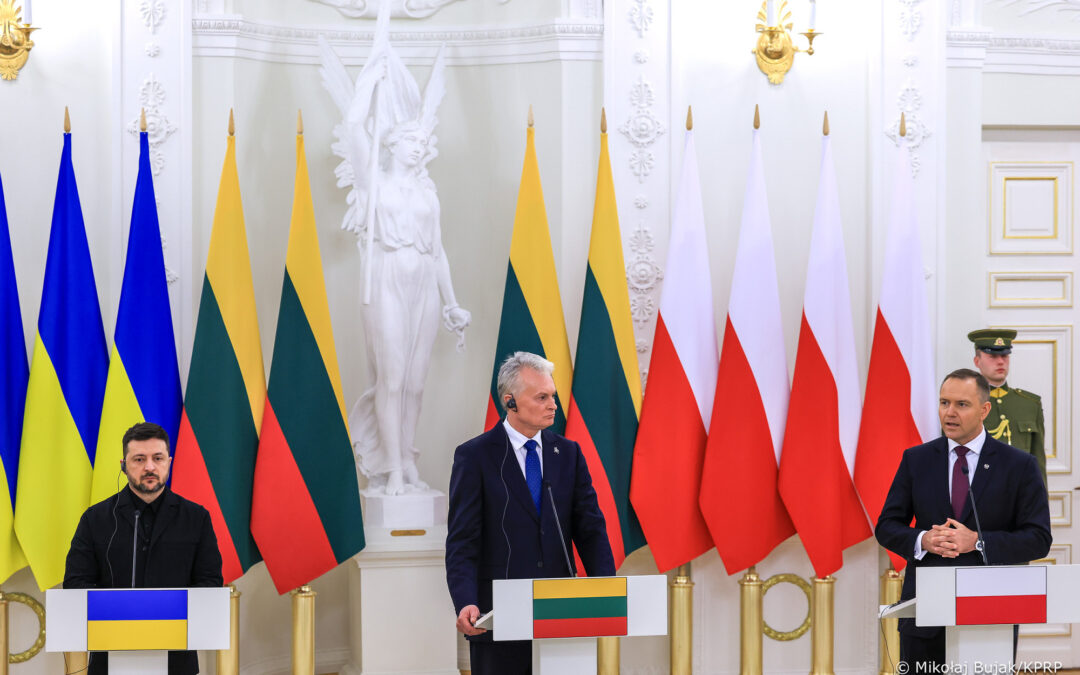
The presidents of Poland, Ukraine and Lithuania have jointly commemorated the anniversary of the 1863 January Uprising against Russian rule. The trio also held talks focused on security, and in particular Russia’s war in Ukraine.
“One reflection that dominated today is that it’s been 163 years since the January Uprising and one thing remains unchanged: Russia is still a threat to the region,” said Poland’s Karol Nawrocki. “Regardless of whether it is Tsarist Russia, Bolshevik Russia or Vladimir Putin’s Russia.”
Speaking alongside him, Ukraine’s Volodymyr Zelensky emphasised that the event was a reminder that “all of us in our part of Europe must fight and struggle to protect our sovereignty, our freedom and our independence”.
Lithuanian President Gitanas Nausėda, who hosted the summit, likewise declared that the “courage, faith and sacrifice [of the January insurgents] are an example to us all”, showing that “commitment to freedom and refusal to submit to tyranny are a shared historical legacy”.
Vilnius. Rasos Cemetery.
We honored the memory of those who were killed during the January Uprising of 1863-1864 – an uprising of the Ukrainian, Polish, Lithuanian, and Belarusian peoples against the Russian Empire and oppression.
Generations before us fought so that we could… pic.twitter.com/uhWWddQxI7
— Volodymyr Zelenskyy / Володимир Зеленський (@ZelenskyyUa) January 25, 2026
The January Uprising began on 22 January 1863 in so-called Congress Poland, which was a puppet state of Russia. Its area covered much of modern-day central and eastern Poland, as well as parts of Lithuania.
The insurrection initially broke out among Poles conscripted into the Russian army, and was joined by tens of thousands more, including Lithuanians and Belarusians. (Exiled Belarusian opposition leader Sviatlana Tsikhanouskaya also joined today’s ceremonies.)
The uprising was brutally suppressed by Russia – with thousands of Poles killed and many more deported to Siberia – and was eventually brought to an end in 1864, though Russian reprisals against the local population continued long after.
Today’s meeting took place under the auspices of the Lublin Triangle, a regional alliance established in 2020 between Poland, Lithuania and Ukraine. It is named after the 1569 Treaty of Lublin, which created the Polish-Lithuanian Commonwealth, a state that also contained much of modern-day Ukraine.
Speaking afterwards, Nawrocki recalled that the countries of their region had been proven right in their longstanding warnings about Russia. That emphasises why “it is important for the voice of central and eastern Europe, and forums like this one, to be heard worldwide”.
He and Nausėda noted that Zelensky had updated them on the progress of peace negotiations, with Nausėda commenting that, “not for the first time, we see Russia not wanting to commit to peace”.
Prezydenci @NawrockiKn, @GitanasNauseda i @ZelenskyyUa w #Wilno podczas wspólnych obchodów 163 rocznicy wybuchu Powstania Styczniowego. pic.twitter.com/lnIbrSZwAh
— Kancelaria Prezydenta RP (@prezydentpl) January 25, 2026
Zelensky, meanwhile, thanked Poland and Lithuania for their strong support since Russia’s full-scale invasion. In particular, he expressed gratitude for recent efforts to help Ukraine deal with Russian attacks on its energy infrastructure.
Zelensky also said that he was “happy that our partners in Lithuania and Poland support the idea of [Ukraine] joining the European Union”, which is a “priority” for Kyiv.
However, although Poland’s government supports Ukrainian membership, Nawrocki – who is aligned with the right-wing opposition and regularly clashes with the government – said last year that he is “against Ukraine’s entry at the moment”.
After today’s summit, Nausėda made clear that “Lithuania is seeking to integrate Ukraine into the European structures”, which he said would help “prevent renewed Russian aggression”.
The Polish government is sending 379 power generators to Ukraine, where Russian attacks have left many without heat and power
The city of Warsaw is providing an additional 90 generators, while a public appeal has raised €1.6 million to buy more equipment https://t.co/DzFlZ1bXe7
— Notes from Poland 🇵🇱 (@notesfrompoland) January 24, 2026
Notes from Poland is run by a small editorial team and published by an independent, non-profit foundation that is funded through donations from our readers. We cannot do what we do without your support.
Main image credit: Mikołaj Bujak/KPRP

Daniel Tilles is editor-in-chief of Notes from Poland. He has written on Polish affairs for a wide range of publications, including Foreign Policy, POLITICO Europe, EUobserver and Dziennik Gazeta Prawna.