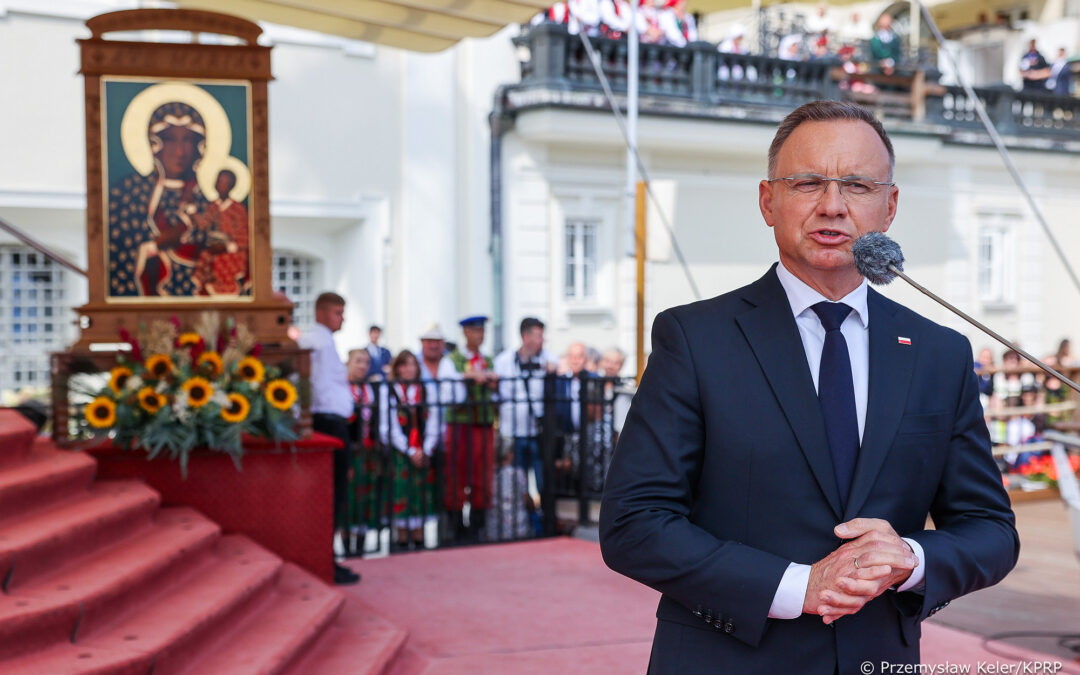
Amid efforts by the government to reduce and reorganise Catholic catechism classes in public schools, conservative President Andrzej Duda has warned that taking away religious teaching would “remove an inalienable part of Polishness”.
Duda, who is aligned with the opposition Law and Justice (PiS) party, was speaking at Jasna Góra monastery in Częstochowa, home to Poland’s holiest Catholic shrine, at a pilgrimage to mark a harvest festival.
The president said that the gathering of so many faithful was “an answer to all those who say that we do not need religion and that it is not necessary to teach it to young people”.
“When someone tries to take this away from us, they are also taking away an important, inalienable part of Polishness that we can never give up,” he continued. “It is thanks to [religion], among other things, that we survived the most difficult times, when it was in [religion] that we found support.”
Gdy ktoś próbuje odebrać nam religię, to zarazem odbiera nam jakąś ważną, niezbywalną część polskości, której oddać nam nigdy nie wolno; dobrze, że rolnicy o tym pamiętają – powiedział prezydent Andrzej Duda podczas Dożynek Jasnogórskich w Częstochowie.https://t.co/FJm96DOLWd
— niedziela_pl (@niedziela_pl) September 1, 2024
In Poland’s education system, religion classes usually consist of the teaching of Catholic catechism, with teachers and curriculums chosen by the church but the lessons hosted and funded by public schools. The classes are optional, but a majority (though a declining one) of Polish children attend.
The more liberal ruling coalition that replaced PiS in power last December wants to halve the number of teaching hours of such classes. It has also moved to remove religion grades from end-of-year averages and to allow schools to combine different year groups together for religion classes.
Those changes have been criticised by the Catholic church. The latter of them was also legally challenged, at the church’s behest, by the president of the Supreme Court, resulting last week in the Constitutional Tribunal (TK) ordering that the policy be temporarily suspended while it considers the issue.
Sorry to interrupt your reading. The article continues below.

Notes from Poland is run by a small editorial team and published by an independent, non-profit foundation that is funded through donations from our readers. We cannot do what we do without your support.
However, the government does not recognise the legitimacy of some TK judges, including its chief justice, and the education ministry immediately announced that it did not regard the tribunal’s interim order as having any legal effect.
That position was criticised by one of Poland’s most senior Catholic bishops, Cardinal Kazimierz Nycz, the archbishop of Warsaw, on Saturday at a meeting with catechism teachers.
“In any normal country that respects constitutional institutions, after such a ruling as the one the Constitutional Tribunal issued, the matter would cease to exist,” he said. “We do not know how it will be in Poland, because respect for the Supreme Court and the Constitutional Tribunal is what it is.”
The constitutional court has ordered a halt to planned changes by the government to the organisation of school religion classes.
The measure was requested by Christian churches and is in place until the court issues a ruling on the legality of the changes https://t.co/ASP8TLIbtb
— Notes from Poland 🇵🇱 (@notesfrompoland) August 30, 2024
According to Poland’s most recent national census, taken in 2021, 71% of Poles identify as Roman Catholic, down from 88% a decade earlier. The next largest religious denomination, Orthodox Christianity, accounts for just 0.4% of the population
Historically, Poland was home to greater religious diversity, with large numbers of Jews as well as significant Protestant and Orthodox Christian communities. However, the Holocaust and postwar border changes left Roman Catholicism as the predominant faith.
Catholicism has also long been seen by many Poles as an integral part of Polishness, acting as an important element of identity in particular during the long periods when Poland was under foreign rule.
A growing number of Poles are turning away from the Catholic church, but not from religious belief itself.
This creates challenges for the church, but also for Polish identity, which has historically been linked to Catholicism, writes Katarzyna Skiba https://t.co/udWGzd0X7F
— Notes from Poland 🇵🇱 (@notesfrompoland) April 18, 2023
Main image credit: Przemysław Keler/KPRP

Daniel Tilles is editor-in-chief of Notes from Poland. He has written on Polish affairs for a wide range of publications, including Foreign Policy, POLITICO Europe, EUobserver and Dziennik Gazeta Prawna.