Keep our news free from ads and paywalls by making a donation to support our work!

Notes from Poland is run by a small editorial team and is published by an independent, non-profit foundation that is funded through donations from our readers. We cannot do what we do without your support.
The Left, a junior partner in Poland’s ruling coalition, has proposed a bill to abolish the Church Fund, which provides state subsidies for the health insurance contributions of clergy. It says it is frustrated by delays in fulfilling a pledge made by most parties in the wide ruling coalition to reform the fund.
However, another coalition partner, the centre-right Polish People’s Party (PSL), says that it will oppose the bill, calling instead for a system allowing taxpayers to allocate part of their taxes to religious institutions of their choice. Senior church figures also say they have not been consulted.
📣 Lewica składa ustawę likwidującą Fundusz Kościelny. Czas na realizację umowy koalicyjnej w zakresie świeckiego państwa‼️
Co zakłada nasz projekt? ⬇️
✅ Składki na duchownych przestają być w 80 procentach finansowane z budżetu państwa jak dotychczas. 50% składek pokrywać… pic.twitter.com/syqUMdCugr
— Lewica (@__Lewica) October 29, 2026
The Church Fund, originally established in 1950 to compensate religious communities for property seized by the communist authorities, provides state subsidies for the health insurance contributions of clergy, for religious organisations’ charitable activities, and for the renovation of religious buildings.
It now supports all legally recognised religious denominations in Poland, including those that did not lose property at the time. Last year, the state spent 275.7 million zloty on the Church Fund. This year it has budgeted 272.6 million zloty.
Most of this money is then used to cover 80% of clergy members’ social security contributions. Under the bill proposed by The Left, churches would pay half of the contributions, with clergy covering the other half.
For regular workers, such contributions are funded jointly by employees and their employers, Anna Maria Żukowska, the head of The Left’s parliamentary caucus, pointed out, as quoted by the Polish Press Agency (PAP). “We are introducing the same arrangement for priests and members of the clergy.”
At least 17.5bn zloty in state funds went to religious bodies from 2021-23, with over 95% going to Catholic organisations, the state auditor has found.
In response, the speaker of parliament has proposed measures to reduce and better oversee such spending https://t.co/IN3dpY4La2
— Notes from Poland 🇵🇱 (@notesfrompoland) May 16, 2025
An exception is made in the bill for members of enclosed religious orders and missionaries, who would have their contributions paid in full by their churches. The cost of maintaining historic churches would be covered by the National Fund for the Protection of Monuments, Żukowska explained.
Włodzimierz Czarzasty, who is the leader of The Left as well as the speaker of the Sejm, the more powerful chamber in the Polish parliament, said the party did not oppose religion but wanted clergy to be treated equally under the law.
“I would like to remind my coalition partners: our coalition agreement includes a commitment to work toward establishing the principles of a secular state in Poland,” he said, speaking alongside Żukowska. “Our patience is running out”.
Ahead of the 2023 election, both the centrist Civic Coalition (KO) led by Prime Minister Donald Tusk and The Left pledged to abolish the Church Fund, while the centre-right Poland 2050 (Polska 2050) proposed replacing state funding with voluntary taxpayer contributions. PSL had no equivalent formal party-wide pledge.
In 2024, after the coalition came to power, Tusk announced plans to reform the fund and appointed a government working group led by the PSL leader and deputy prime minister, Władysław Kosiniak-Kamysz. The group’s work has since stalled.
Kosiniak-Kamysz yesterday dismissed The Left’s proposal, saying it has “not the slightest chance of support in parliament”. His party, the second largest in the coalition with 32 of 239 MPs, sees the existing fund as an inexpensive form of compensation and will oppose abolishing it, he vowed.
Instead, taxpayers should be able to allocate part of their taxes to a religious institution of their choice, a system used in several European countries, to “let the Polish people themselves decide whether or not they want to contribute,” he said, quoted by broadcaster Polsat News.
Interior minister Marcin Kierwiński, a member of Tusk’s Civic Coalition (KO), said that he supported reform, but criticised The Left for submitting the bill without consulting its coalition partners.
A long-term decline in trust in the Catholic church in Poland has accelerated over the last year, with only 35% of Poles now saying they trust the church.
Meanwhile, the armed forces now enjoy record-high trust of 94% https://t.co/ErCBE4HwWR
— Notes from Poland 🇵🇱 (@notesfrompoland) September 17, 2025
Religious communities also criticised the proposal for not having been discussed with them in advance.
In a press statement sent to PAP, the Polish Episcopal Conference (KEP), the main organ of the Catholic church in Poland, said any solution should comply with the country’s agreement with the Vatican, as well as the constitutional principle that relations between the state and religious communities be regulated by mutual agreement.
Bishop Jerzy Samiec, head of the Evangelical-Augsburg Church in Poland, the country’s biggest Protestant body, pointed to the significant costs churches face in maintaining their properties, including care homes and other facilities.
The Catholic Church, Poland’s dominant religious institution, has seen a long-term decline in public trust, with only 35% of Poles saying they trusted it in 2025. That has coincided with a series of crises in recent years, in particular over revelations of child sexual abuse by members of the clergy and negligence in dealing with them by the church hierarchy.
A variety of surveys, including from the church itself, show that religious attendance and identification have been declining in Poland in recent years.
A growing number of Poles are turning away from the Catholic church, but not from religious belief itself.
This creates challenges for the church, but also for Polish identity, which has historically been linked to Catholicism, writes Katarzyna Skiba https://t.co/udWGzd0X7F
— Notes from Poland 🇵🇱 (@notesfrompoland) April 18, 2023
Notes from Poland is run by a small editorial team and published by an independent, non-profit foundation that is funded through donations from our readers. We cannot do what we do without your support.
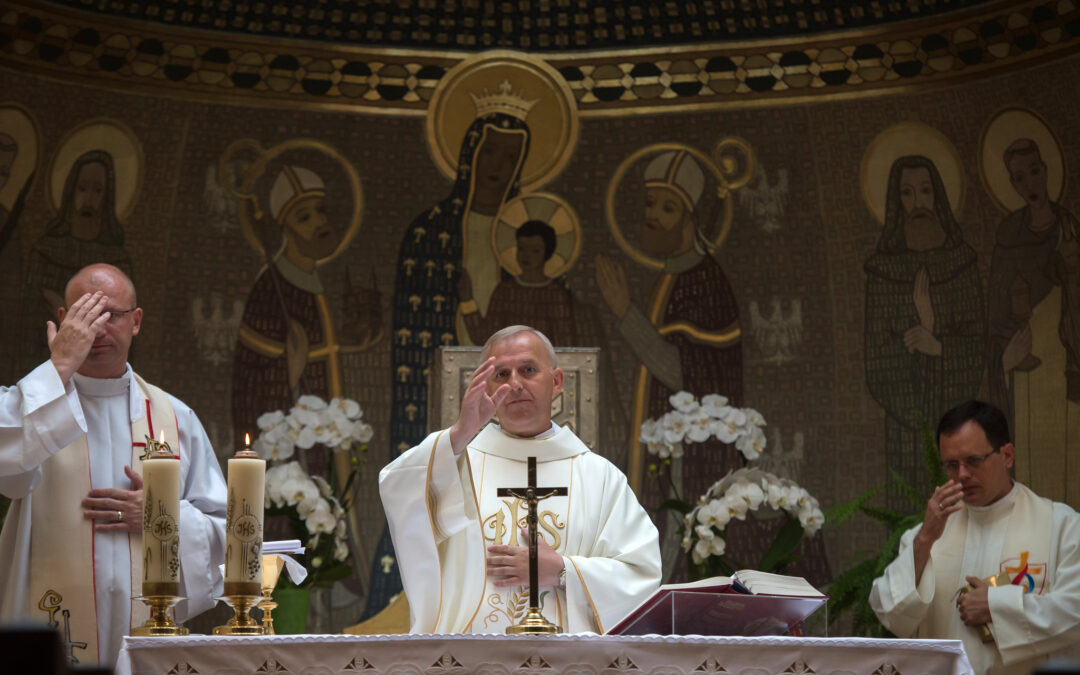
Main image credit: EpiskopatNews / Flickr (under CC BY-NC-SA 2.0)

Alicja Ptak is deputy editor-in-chief of Notes from Poland and a multimedia journalist. She has written for Clean Energy Wire and The Times, and she hosts her own podcast, The Warsaw Wire, on Poland’s economy and energy sector. She previously worked for Reuters.