Keep our news free from ads and paywalls by making a donation to support our work!

Notes from Poland is run by a small editorial team and is published by an independent, non-profit foundation that is funded through donations from our readers. We cannot do what we do without your support.
Jarosław Kaczyński, the leader of Poland’s largest opposition party, has sparked controversy by appearing to suggest that Poland and some other allied European Union member states could launch the process of leaving the EU if they fail in efforts to reform it.
His remarks were condemned by Prime Minister Donald Tusk and other figures from the pro-EU ruling coalition, who have long accused Kaczyński and his national-conservative Law and Justice (PiS) party of seeking “Polexit” from the EU.
However, Kaczyński responded by accusing Tusk of misrepresenting his words, insisting that he wants Poland to reform the EU rather than leave it.
Kaczyński pomylił Krynicę z Kremlem. pic.twitter.com/tX0G04krze
— Cezary Tomczyk (@CTomczyk) October 29, 2026
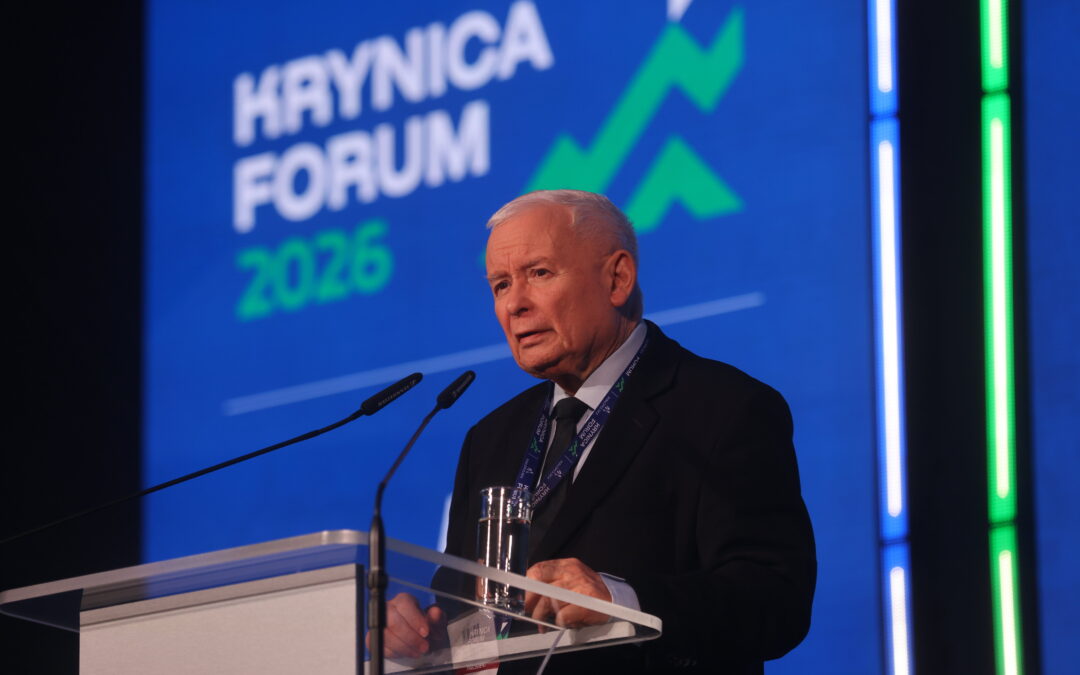
The comments in question came in an hour-long speech by Kaczyński at the Krynica Forum, an annual conference bringing together leaders from politics, business and civil society, which he used to outline his vision for sweeping reforms of the EU.
Repeating his longstanding criticism of Brussels, Kaczyński warned that there had been a “consistent drive to transform the EU into a centralised state” with too much power over national governments. He also called the European Parliament in its current form a “parody”.
But soon, said Kaczyński, “a window of opportunity” for reform may appear because “completely different governments could emerge” in Poland, France and Spain, all of which will hold elections within the year.
PiS has previously enjoyed close relations with Marine Le Pen’s far-right National Rally (RN) party in France and the nationalist Vox party of Santiago Abascal in Spain.
The EU is preparing a "German plan" that would "annihilate the Polish state", said Kaczyński as Poland marks Independence Day.
He warned that the incoming opposition government will "strive to implement this plan" and called on Poles to "fight" against it https://t.co/QDbxmiaazJ
— Notes from Poland 🇵🇱 (@notesfrompoland) November 11, 2023
Kaczyński suggested that Poland, if led by PiS, could work with other like-minded EU governments to push for reform of the bloc by influencing public opinion, identifying breaches of EU treaties, creating a blocking minority in the European Council, and trying to change the EU’s treaties.
However, the PiS leader then warned that, “if [those] approaches fail to yield results, the states that want change could conclude a new treaty with the elements we are seeking, but with a delayed entry into force”.
Kaczyński then noted that the EU treaties “include provisions specifying the terms under which a state may withdraw from the EU. This all begins with negotiations. And simply begin these negotiations”.
“It is a tough approach, a risky one, but the situation is so dire that it is worth employing such a method if all others fail to yield results,” he added.
The remarks immediately prompted condemnation from figures in Tusk’s ruling coalition, which ranges from left to centre right. They accused Kaczyński of effectively calling for Polexit – something they have long claimed he wants, even though PiS has not explicitly called for it before.
“Jarosław Kaczyński has just announced that Poland should begin negotiations on the terms of its withdrawal from the EU,” wrote Tusk himself on X. “This is, among other things, what the current struggle in Poland is about – a tough struggle. I do not intend to lose it.”
“So they do want Polexit after all,” wrote foreign minister Radosław Sikorski. “Customs borders with Germany, the Czech Republic, Slovakia and Lithuania…An end to subsidies for farmers and investments…And they swore on their lives that they’d never do that.”
In a video published later on Thursday, Tusk declared that next year’s parliamentary elections would help decide “whether Poland remains in the European Union or leaves it”.
Jarosław Kaczyński ogłosił właśnie, że Polska powinna zacząć rokowania o warunkach wyjścia z Unii Europejskiej. O taką między innymi stawkę toczy się dziś w Polsce walka. Twarda walka. Nie zamierzam jej przegrać, nawet jeśli nie wszyscy zagrają ze mną.
— Donald Tusk (@donaldtusk) October 29, 2026
Kaczyński responded by saying that “Tusk is lying as usual”. He emphasised that he believes “the EU is needed but it requires thorough reform” so that it “benefits not the elites, but ordinary citizens”.
PiS deputy leader Przemysław Czarnek said on Thursday that his party was “considering all scenarios, including the possibility that the EU will kill itself”. However, he added that the priority remained reforming the bloc and “PiS has no plans to leave the EU”, reports the Polish Press Agency (PAP).
When PiS was in power from 2015 to 2023, it regularly clashed with Brussels over a variety of issues, including judicial reform, trade, climate policy, and migration. Since Tusk, a former president of the European Council, took power in 2023, his government has greatly improved relations with Brussels.
Tusk jak zwykle kłamie. Najwyraźniej wychodzi z założenia, że dzień bez kłamstwa jest dniem straconym…
Unia Europejska jest potrzebna, ale wymaga gruntownej reformy. Kryzys i zapaść w jej obecnym kształcie to efekt rządów Merkel i jednego z jej pomocników, Tuska. Nie ma co się…
— Jarosław Kaczyński (@OficjalnyJK) October 29, 2026
Poland has been the largest net recipient of EU funding since joining the bloc in 2004. A study published earlier this year found that the country’s economy is 42% larger than it would have been had Poland not been part of the EU.
Opinion polls consistently show a large majority of Poles in favour of remaining part of the EU. However, recent years have seen an uptick in support for Polexit, as well as for anti-EU far-right parties.
Regular polling by state research agency CBOS shows that, while opposition to EU membership fell to a record low of 5% in 2022, it has subsequently risen and stood at 14% in the most recent survey.
Notes from Poland is run by a small editorial team and published by an independent, non-profit foundation that is funded through donations from our readers. We cannot do what we do without your support.
Main image credit: Marek Podmokly / Agencja Wyborcza.pl

Alicja Ptak is deputy editor-in-chief of Notes from Poland and a multimedia journalist. She has written for Clean Energy Wire and The Times, and she hosts her own podcast, The Warsaw Wire, on Poland’s economy and energy sector. She previously worked for Reuters.