Keep our news free from ads and paywalls by making a donation to support our work!

Notes from Poland is run by a small editorial team and is published by an independent, non-profit foundation that is funded through donations from our readers. We cannot do what we do without your support.
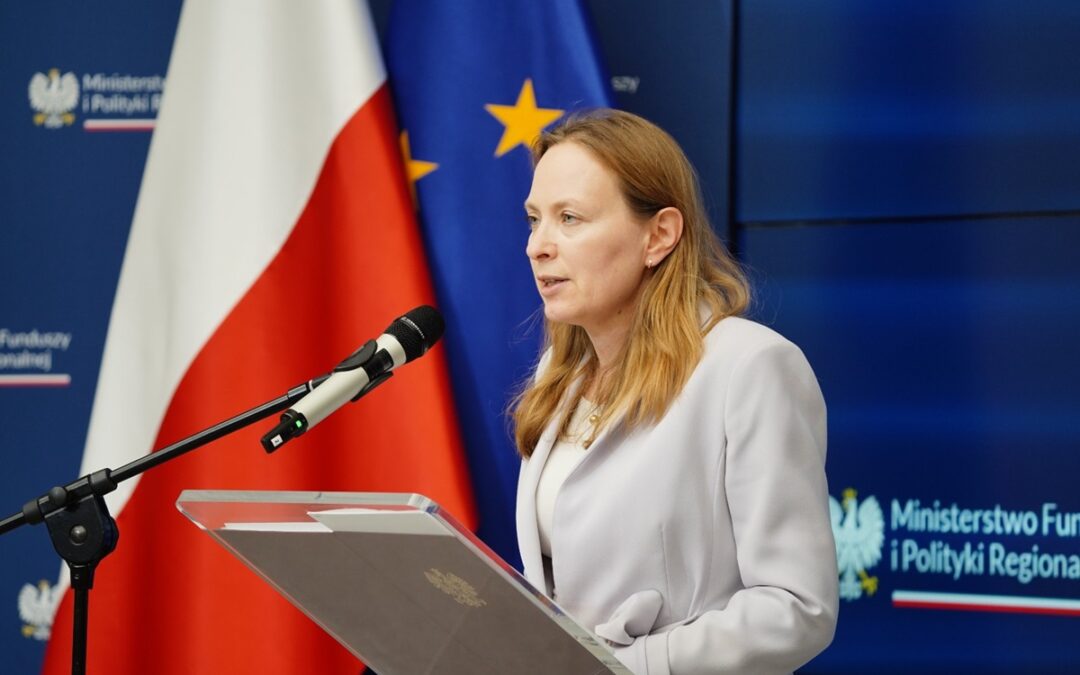
Katarzyna Pełczyńska-Nałęcz, the leader of a junior party in Poland’s ruling coalition, has announced that her resignation from the government and the leadership of her party, the centrist Poland 2050 (Polska 2050), in protest over a parliamentary vote on Thursday.
Poland 2050 (Polska 2050) is set to remain in the government, thereby maintaining Prime Minister Donald Tusk’s parliamentary majority. However, the dispute has highlighted tensions within the ruling coalition just a year ahead of parliamentary elections at which it will seek another term.
Dwukadencyjność samorządów została utrzymana. Tak zdecydował dziś Sejm. Wygraliśmy! Zmiana, której chce 75% Polaków dojdzie do skutku!
Stało się to jednak pomimo głosów K15X. Koalicja, w tym niestety znaczna część posłów Polski 2050, stanęła przeciw ludziom, a za politykierskimi…
— Katarzyna Pełczyńska (@Kpelczynska) October 22, 2026
Pełczyńska-Nałęcz’s decision was triggered by an unusual voting result in the Sejm, the more powerful lower house of parliament, on Thursday.
Another junior partner in the ruling coalition, the centre-right Polish People’s Party (PSL), had proposed a bill abolishing two-term limits for mayors. That limit is aimed at reducing corruption and cronyism by preventing local officials from becoming entrenched in power.
However, although the government has a majority in the Sejm, the bill was narrowly defeated, with 213 votes in favour and 215 against, after 15 MPs from the ruling coalition joined with the right-wing opposition in voting against it.
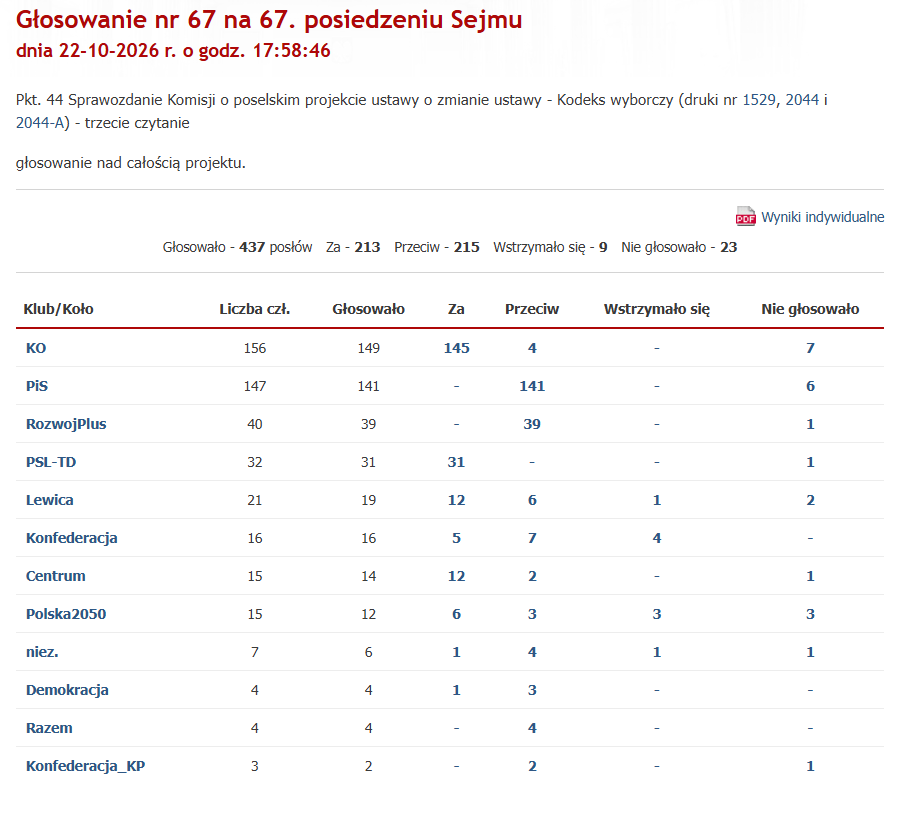
How MPs from each parliamentary group voted on the bill (za = for, przeciw = against, wstrzymało się = abstained, nie głosowało = did not vote)
Pełczyńska-Nałęcz herself is not a member of parliament, so did not vote. Her party was split, with six MPs voting for the bill, three against, three abstaining, and three not voting at all.
Aftewards, Pełczyńska-Nałęcz made clear that she opposed the bill and celebrated the fact that it was blocked. She also announced her resignation from the government and the leadership of her party.
“The coalition, unfortunately including a significant portion of MPs from Poland 2050, stood against the people and in favour of backroom political deals,” she wrote. “I am leaving Donald Tusk’s government because values are more important to me than positions.”
“I am leaving the party in the hands of its founder, who stepped away but then returned,” she added, referring to Poland 2050’s founder, Szymon Hołownia. “I hope that he remembers what values he came to power in the name of.”
Pełczyńska-Nałęcz’s decision follows a year of turmoil for Poland 2050. In September 2025, Hołownia, who had led the party since founding it in 2021, announced that he was stepping down.
However, a first attempt to choose a new leader was invalidated in January after technical problems with voting. Hołownia then hinted that he may reverse course and seek to continue leading the party, though in the end that did not happen.
In February, Pełczyńska-Nałęcz was chosen as the new leader. That prompted her rival candidate, Paulina Hennig-Kloska, to quit the party, taking half of its MPs with her. They formed a new group called Centrum (Centre).
Both Poland 2050 and Centrum remain in the ruling coalition. However, Pełczyńska-Nałęcz, who serves as minister for funds and regional policy, has had an uneasy relationship with Tusk.
Around half the MPs from Poland 2050, a junior member of Poland’s ruling coalition, have split from the party and formed a new parliamentary caucus.
They expressed dissatisfaction with the actions of the party's recently elected new leader, @Kpelczynska https://t.co/IqU4vE1EEe
— Notes from Poland 🇵🇱 (@notesfrompoland) February 18, 2026
On Friday, Tusk, who is on a state visit to India, sarcastically responded to Pełczyńska-Nałęcz’s resignation by saying, “I thought she’d at least call before she left”. He admitted that “cooperation [with her] has not been the easiest for a long time”.
The prime minister, however, added that he “does not think [her resignation] will have any impact on the future work of the coalition…My intuition tells me that this is her individual decision”.
Hołownia, who currently serves as head of Poland 2050’s parliamentary caucus, confirmed at a press conference on Friday alongside fellow MPs that the party intends to remain in Tusk’s coalition. But he also warned that, without Poland 2050, the government would not have a parliamentary majority.
W @PL_2050 dowiedzieliśmy się o decyzji @Kpelczynska z mediów.
Zaskakująca rezygnacja przewodniczącej z zaufania wyborców i odpowiedzialności powierzonej jej w bardzo trudnym momencie przez ludzi (w tym mnie) zaledwie po niespełna 1/3 kadencji – dla każdej organizacji byłaby…
— Szymon Hołownia (@szymon_holownia) October 22, 2026
The episode highlights the tensions within the ruling coalition, which ranges from left to centre right and contains parties that disagree on a number of issues.
It also points to the pressure smaller coalition partners are feeling ahead of next autumn’s parliamentary elections. Only parties that win at least 5% of the vote nationally can enter parliament. But Poland 2050 has been polling at around 1% and PSL is on 3%.
In the 2023 election, Poland 2050 and PSL in fact stood together as an alliance called the Third Way (Trzecia Droga), helping ensure that the two parties won enough votes to enter parliament. However, in 2025, they split from one another and confirmed that they would not stand together again.
PSL and Poland 2050, the two parties that make up the Third Way alliance, have confirmed that they are splitting and will stand separately at the next elections.
They will, however, remain part of @donaldtusk's ruling coalition https://t.co/NduEJY25eE
— Notes from Poland 🇵🇱 (@notesfrompoland) June 18, 2025
The fact that the bill to end two-term limits for mayors was defeated has also caused tension between PSL and its coalition partners.
In the wake of yesterday’s vote, PSL immediately announced that it would push for the introduction of two-term limits for members of parliament, arguing that the same rules should apply to national and local elected representatives.
The right-wing opposition has long hoped that it could tempt PSL, the most conservative element of Tusk’s coalition, to quit the government. A recent report even claimed that US President Donald Trump had, at the behest of Poland’s opposition, suggested to PSL’s leader that he leave Tusk.
Notes from Poland is run by a small editorial team and published by an independent, non-profit foundation that is funded through donations from our readers. We cannot do what we do without your support.
Main image credit: MFiPR (under CC BY-SA 4.0)

Daniel Tilles is editor-in-chief of Notes from Poland. He has written on Polish affairs for a wide range of publications, including Foreign Policy, POLITICO Europe, EUobserver and Dziennik Gazeta Prawna.