Keep our news free from ads and paywalls by making a donation to support our work!

Notes from Poland is run by a small editorial team and is published by an independent, non-profit foundation that is funded through donations from our readers. We cannot do what we do without your support.
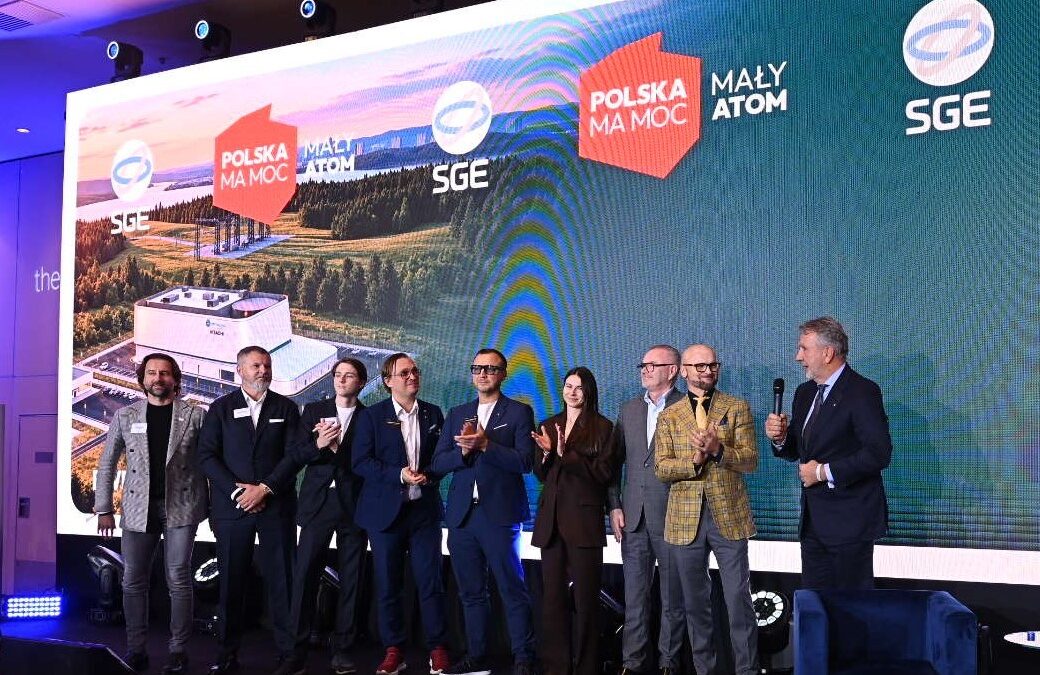
A group of prominent Polish businesspeople have announced that they are investing in a project to develop small modular nuclear reactors being led by the country’s richest man, Michał Sołowow.
Among them are Rafał Brzoska, founder of delivery giant InPost, and Mati Staniszewski, CEO of ElevenLabs, a leading artificial intelligence firm.
The group is investing 500 million zloty (€114 million) in Sołowow’s Synthos Green Energy (SGE), which, together with 1.35 billion zloty from foreign investors, will secure the company’s financing for the next two years as it seeks to roll out BWRX-300 reactors in Poland, Central and Eastern Europe and the UK.
As a European SMR development platform headquartered in Warsaw, Poland’s energy security is of special importance to us.
We are proud to announce that today our founder, Michał Sołowow, unveiled a PLN 500 million investment by a group of leading Polish entrepreneurs in SGE’s… pic.twitter.com/J2SerVjIlG
— SGE (@SGE_Nuclear) September 30, 2026
The investment, which was formally announced at a business conference in Warsaw on Wednesday, comes as Sołowow seeks to expand his nuclear project beyond SGE’s troubled partnership with Polish state energy giant Orlen, where disagreements have delayed plans to build SMRs in Poland.
Alongside Brzoska and Staniszewski, the other new investors are Dariusz Gałęzewski, co-founder of drinks maker Oshee; Krzysztof Pawiński, CEO of food company Maspex; Michał Brański of media group Wirtualna Polska; and Michał Wypychewicz of ZPUE, the largest manufacturer of transformer stations in Europe.
“They invested their own private funds because they understood the problem and then believed in the concept and the solution,” Sołowow told Business Insider Polska.
SMRs, which are prefabricated in factories before being installed on site, are seen by their proponents as a fast and cost-effective way of installing nuclear capacity.
In July, SGE announced plans to build 14 BWRX-300 reactors with a combined capacity of 4.2 gigawatts (GW) across three sites in the UK, which it said would generate enough electricity to meet 11% of the country’s demand. The company also hopes to deploy up to 26 reactors across six locations in Poland.
The BWRX-300 is a 300-megawatt water-cooled small modular reactor. Construction of the first ever unit began in Canada in 2025, with completion planned for 2029 and commercial operation expected in 2030.
Synthos Green Energy, a firm owned by Polish billionaire Michał Sołowow, has announced plans to build 14 small modular nuclear reactors in the UK.
It says that the £35 billion project could deliver enough power to meet 11% of the UK’s demand https://t.co/YTMIzYERuJ
— Notes from Poland 🇵🇱 (@notesfrompoland) July 2, 2026
Brzoska said that developing SMR technology “is an investment in Poland’s future”, because without “reliable, predictable and competitively priced energy…it is difficult to talk seriously about further growth in industry, data centres, artificial intelligence, automation or modern logistics”.
Staniszewski, whose company recently received an $11 million investment from Poland’s state-owned National Development Bank (BGK) to establish an AI development centre in Poland, said lower electricity prices were important for the sector.
SGE notes that demand for electricity is set to rise 40% in Poland over the next 14 years, according to grid operator PSE. Electricity prices have risen rapidly in recent years and are now the second most expensive in the European Union in relation to the cost of living.
Poland has recorded the EU's third-fastest rise in household electricity prices this year.
The country now also has the bloc’s second-most-expensive electricity, when taking cost of living into account https://t.co/WNLdCfOP16
— Notes from Poland 🇵🇱 (@notesfrompoland) October 30, 2025
Poland remains the EU’s most coal-dependent country, with more than half of its electricity generated from coal. Over the past decade, however, the country has diversified its energy mix, with the share of renewable energy sources tripling to nearly 30% in 2025.
Poland plans to reduce its reliance on coal further, including through the construction of its first nuclear power plant (of the traditional type, not an SMR). The 3.75-gigawatt project is scheduled to be commissioned in 2036.
Sołowow has also been pursuing the deployment of SMRs in Poland through Orlen Synthos Green Energy (OSGE), a joint venture between SGE and state energy giant Orlen, Poland’s largest company, to develop BWRX-300 reactors in Poland.
OSGE is seeking a so-called contract for difference (CfD) framework, an agreement with a state that guarantees a fixed price for electricity and helps shield developers from market swings, covering 14 reactors at three sites.
Polish state energy firm Orlen has announced an agreement to build the country’s first small modular nuclear reactor (SMR).
It says Poland will be the first country in Europe to deploy an SMR developed by US-based firm GE Hitachi Nuclear Energy https://t.co/MPWXS3qZ1d
— Notes from Poland 🇵🇱 (@notesfrompoland) August 28, 2025
The project, however, has been delayed by disagreements between the two shareholders. Sołowow told Business Insider Polska that they reached an agreement last month that would allow construction of two reactors to move forward, but said he regretted entering into the partnership with Orlen.
“I find it deeply regrettable, because it is precisely due to Orlen’s unnecessary involvement that we are discussing this project in political terms, even though it is not a political project,” he said.
Sołowow has argued that a private-sector model can shorten construction times and improve cost control compared with traditional state-led nuclear projects.
At the same time, he has highlighted the importance of the state’s role in implementing the project, saying its success depends on coordination between private investors and state policy. This includes contracts for difference, administrative procedures and the preparedness of the nuclear regulator.

Notes from Poland is run by a small editorial team and published by an independent, non-profit foundation that is funded through donations from our readers. We cannot do what we do without your support.
Main image credit: SGE press materials

Alicja Ptak is deputy editor-in-chief of Notes from Poland and a multimedia journalist. She has written for Clean Energy Wire and The Times, and she hosts her own podcast, The Warsaw Wire, on Poland’s economy and energy sector. She previously worked for Reuters.