Keep our news free from ads and paywalls by making a donation to support our work!

Notes from Poland is run by a small editorial team and is published by an independent, non-profit foundation that is funded through donations from our readers. We cannot do what we do without your support.
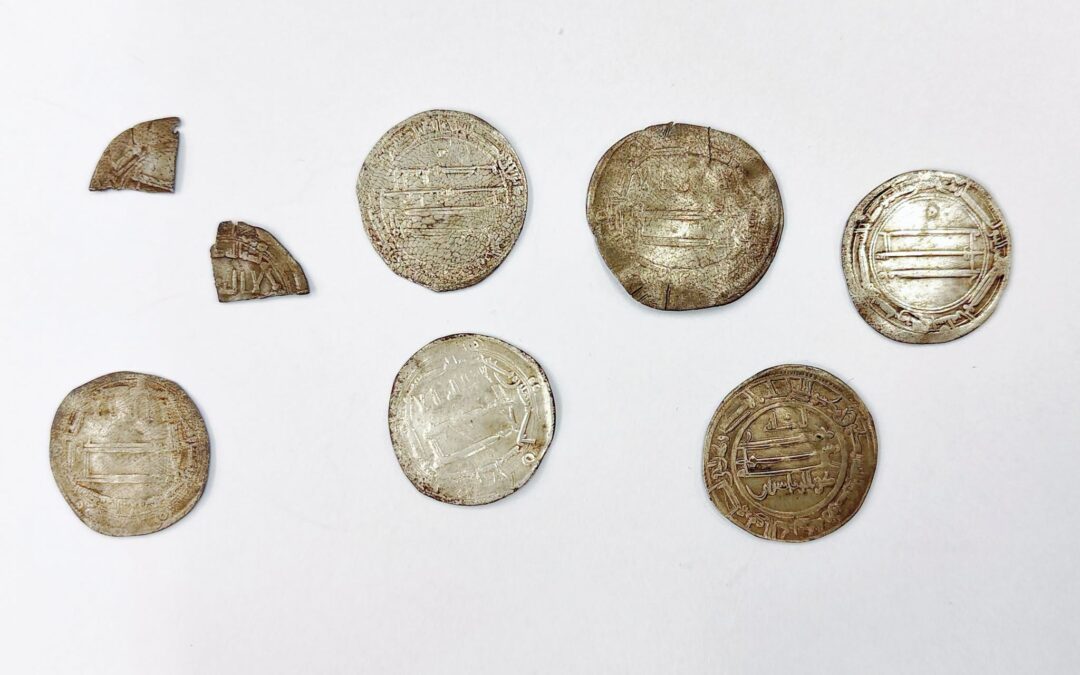
Several early medieval Arabic silver coins have been found in a forest near Elbląg in northern Poland. Experts believe they may have belonged to merchants travelling to or from the Viking Age port of Truso, which was situated nearby.
The silver dirhams date back around 1,200 years, to the first half of the ninth century, before the founding of the Polish state. They may have remained in circulation until the turn of the 10th/11th century, the time of the settlement’s collapse.
The discovery of the “new treasure” was announced last week by the Archaeological and Historical Museum in Elbląg. It did not reveal who had unearthed them, but said that the find had taken place during a legal search in a forest near the town of Młynary, just east of Elbląg.
After conservation and processing work, the coins will be included in the collection of the museum, whose archaeologists will also visit the site hoping for further finds.
The museum’s Jakub Jagodziński told the Polish Press Agency (PAP) that the find consists of “six early medieval Arabic dirhams and two fragments of these silver coins”. He said that they are provisionally dated to the first half of the 9th century, but a more precise estimate will be possible after they are processed.
The coins could have belonged to merchants travelling along the routes leading to or from Truso or to Prussian guards who later collected tolls on these routes, Jagodziński explained.
Truso was a Viking Age port of trade set up by the Scandinavians on the shores of lake Druzno near the Vistula river delta. Established by the late 7th century and active until the early 11th century, its location enabled trade extending towards Kyivan Rus, Byzantium and the Islamic world.
Historians knew of Truso’s existence because of the account of the Anglo-Saxon traveller Wulfstan of Hedeby. Centuries-long efforts to find the precise site proved fruitless until it was finally discovered in the early 1980s by the young archaeologist Marek Jagodziński, Jakub’s father.
Finds of Arab coins in Poland are not unprecedented. A silver deposit was discovered in 1986 on the site of Truso itself, consisting of 11 complete coins and five fragments. Coins found there were minted in places including Baghdad and Damascus, according to the Medievalists.net website.
More recently, in 2024, a fragment of an early medieval Arabic dirham was found during renovations of an old manor house on the Baltic coast in northwestern Poland.
In transactions involving dirhams, it was the value of the silver that mattered, so the coins were often broken into pieces, archaeologist Grzegorz Kurka told PAP.
“Therefore, when hoards of Arab coins are discovered in Poland, they are divided into several pieces. Whole coins are also found, but much less frequently,” he explained.
Notes from Poland is run by a small editorial team and published by an independent, non-profit foundation that is funded through donations from our readers. We cannot do what we do without your support.
Main image credit: Facebook/Muzeum Archeologiczno-Historyczne w Elblągu
Ben Koschalka is a translator, lecturer, and senior editor at Notes from Poland. Originally from Britain, he has lived in Kraków since 2005.