Keep our news free from ads and paywalls by making a donation to support our work!

Notes from Poland is run by a small editorial team and is published by an independent, non-profit foundation that is funded through donations from our readers. We cannot do what we do without your support.
Prosecutors have ended a decade-long case in which former president and Nobel Peace Prize winner Lech Wałęsa was accused of falsely claiming not to have authored documents relating to his alleged cooperation with the communist authorities.
Wałęsa, who led the Solidarity movement that helped bring down the communist regime in the 1980s, has always denied longstanding claims that, in the 1970s, he acted as an informant to the communist security services.
The case has become highly politicised, with right-wing figures – especially from the Law and Justice (PiS) party that ruled Poland from 2015 to 2023 – critical of Wałęsa. By contrast, the former president, who turns 83 next week, enjoys good relations with the current ruling coalition of Prime Minister Donald Tusk.
Waldemar Żurek, Tusk’s justice minister and prosecutor general, welcomed the decision to drop the case against Wałęsa, saying that, under PiS, “a politicised state apparatus hounded the legend of Solidarity, deliberately ignoring facts and basic logic”. Now, “truth has triumphed over an attempt to rewrite history”.
Prokuratura ostatecznie umorzyła śledztwo przeciwko Lechowi Wałęsie.
Przez lata upolityczniony aparat państwa ścigał legendę „Solidarności”, celowo ignorując fakty i elementarną logikę. Zignorowano bezsporny fakt historyczny – SB masowo fałszowała dokumenty i podpisy Wałęsy w…
— Waldemar Żurek (@w_zurek) September 24, 2026
The case in question stems from statements made by Wałęsa in 2016 during an investigation by the Institute of National Remembrance (IPN), a state historical body that also has prosecutorial powers.
Those proceedings, in which the former Polish president testified as a witness, were launched after documents apparently carrying his signature were found in the home archives of former communist interior minister Czesław Kiszczak.
The files indicated that Wałęsa, working under the code name TW Bolek, signed a commitment to collaborate with the communist Security Service (SB). They also included payslips and informant’s notes.
The former president had told the media at the time when the documents were discovered that they had been forged. When speaking to IPN investigators, he also denied having drafted or signed all but one of the documents.
However, prosecutors subsequently claimed that – after comparing the documents from Kiszczak’s file with others they said had been written and signed by Wałęsa, as well as consulting forensic handwriting experts – Wałęsa’s testimony was false in the case of over 50 of the documents.
In 2021, the former president was charged with giving false testimony. Then, in 2023, he was indicted, meaning the case was sent to court. However, in 2024, after Tusk’s government had taken power from PiS, prosecutors asked that the case be returned to them by the court, which agreed to the request.
Now, the district prosecutor’s office in Warsaw has announced that it is discontinuing the case entirely, after finding that there are no grounds for Wałęsa to be prosecuted.
Lech Wałęsa will face trial accused of falsely testifying not to have signed documents of cooperation with the communist authorities. If convicted, he can be jailed for up to 3 years.
He calls the claims against him "terrible insults and monstrous lies" https://t.co/X0eb4e5ahm
— Notes from Poland 🇵🇱 (@notesfrompoland) November 30, 2023
In a statement explaining the decision, prosecutors claimed that there had been significant “methodological errors” made previously in attributing handwritten texts to Wałęsa and in handwriting comparisons between them.
“There was no evidence to assume with 100% certainty that the comparative material actually came from Lech Wałęsa,” they wrote. In fact, “the evidence collected clearly indicated that Lech Wałęsa did not write long manuscripts during his life, and especially not in the 1970s”.
“Some witnesses explicitly stated that, at that time, he was a secondary illiterate,” meaning someone who has lost their ability to read and write, said the prosecutors. “He was not able to write and could barely read.”
This, along with other concerns over how the case was previously conducted, “led to the conclusion that there was no certain basis to assume that Lech Wałęsa was the author of the documents disclosed in the ‘Kiszczak files’, and therefore there was no evidence that he lied during the interrogation”.
Hit!
Ekipa Tuska ogłosiła Wałęsę analfabetą by wybronić go przed Bolkiem!
To się nie dzieje! To niemożliwe! pic.twitter.com/PQnOn5XDb0
— Sławomir Cenckiewicz (@Cenckiewicz) September 24, 2026
Prosecutors also said that “the testimony of numerous witnesses proves that the files of TW Bolek, discovered in the possession of General Kiszczak’s widow, were most likely fabricated.
Finally, they argued that, even if Wałęsa had given false testimony, he was protected by the constitutional right against self-incrimination while being interviewed as a witness.
“The prosecution found that Lech Wałęsa could have feared that if he admitted to having prepared or signed the documents from the ‘Kiszczak files’…all his testimonies in which he denied being secret collaborator “Bolek” in previous proceedings…would be deemed false and would lead to his being held criminally liable.”
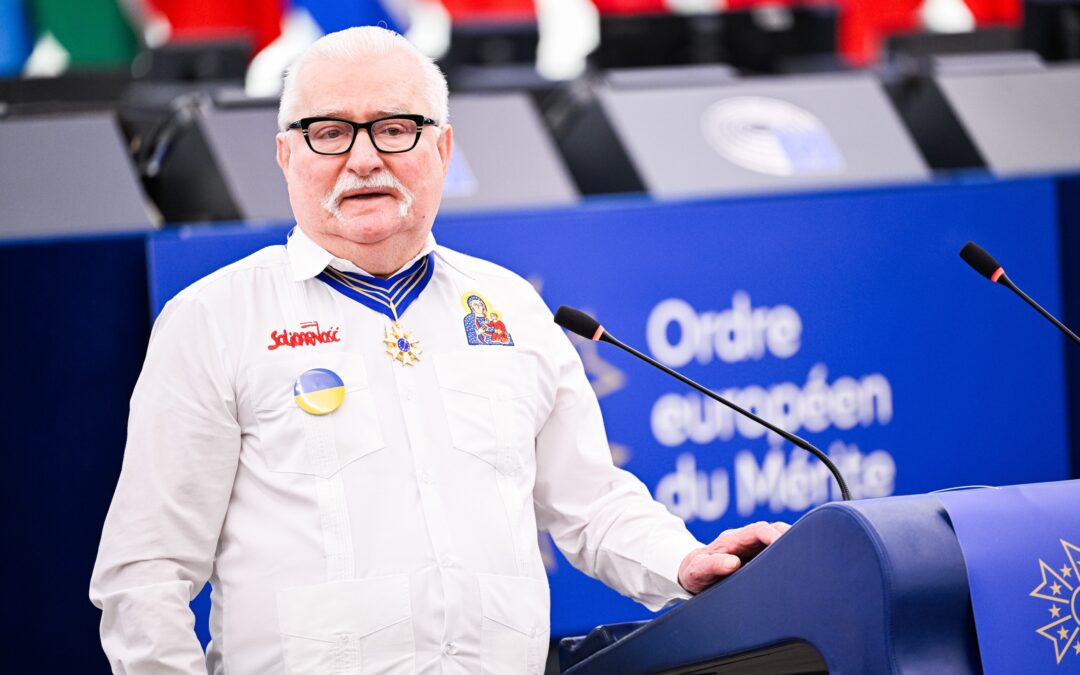
Lech Wałęsa, Angela Merkel and Volodymyr Zelensky have been named the first distinguished members of the European Order of Merit.
The award was created by the European Parliament to "honour those who did not simply believe in Europe, but helped build it" https://t.co/inosiiRQkW
— Notes from Poland 🇵🇱 (@notesfrompoland) March 11, 2026
In response to the announcement, Wałęsa shared on his Facebook page the post by Żurek praising the prosecutors’ decision. Wałęsa then added a comment claiming that Jarosław and Lech Kaczyński, the founders of PiS, had ordered a right-wing historian, Sławomir Cenckiewicz, to fake the Kiszczak files.
Cenckiewicz has written extensively about Wałęsa, including about his alleged collaboration with the communist security services. He also recently served as national security advisor to current Polish President Karol Nawrocki, who was elected last year with the support of PiS.
In a series of social media posts on Thursday, Cenkiewicz said that he had “never read a bigger lie” than the prosecutors’ statement justifying dropping the case. He also ridiculed the idea that Wałęsa could have led the Solidarity movement in the 1980s and served as president in the 1990s if he was a “secondary illiterate”.
Większego kłamstwa przebranego w wymiar sprawiedliwości RP nigdy nie czytałem! To większe kłamstwo niż skandaliczny wyrok Kapińskiego i spółki z 2000 r.!
Reżim Tuska uznał, że Wałęsa nie był Bolkiem, a Instytut Sehna niczego kategorycznie nie ustalił!
I powtórzyli brednie…
— Sławomir Cenckiewicz (@Cenckiewicz) September 24, 2026
The accusations of communist collaboration have tarnished Wałęsa’s reputation among some Poles. In 2017, shortly after the Kiszczak files were uncovered, a poll by IBRiS for the Rzeczpospolita daily found that 28% believed Wałęsa was not a national hero. However, 62% said that he was.
Earlier this year, Wałęsa was named as one of the first three distinguished members of the European Order of Merit, a new initiative launched by the European Parliament, alongside Ukrainian President Volodymyr Zelensky and former German Chancellor Angela Merkel.

Notes from Poland is run by a small editorial team and published by an independent, non-profit foundation that is funded through donations from our readers. We cannot do what we do without your support.
Main image credit: Laurie DIEFFEMBACQ © European Union 2026 – Source : EP

Daniel Tilles is editor-in-chief of Notes from Poland. He has written on Polish affairs for a wide range of publications, including Foreign Policy, POLITICO Europe, EUobserver and Dziennik Gazeta Prawna.