Keep our news free from ads and paywalls by making a donation to support our work!

Notes from Poland is run by a small editorial team and is published by an independent, non-profit foundation that is funded through donations from our readers. We cannot do what we do without your support.
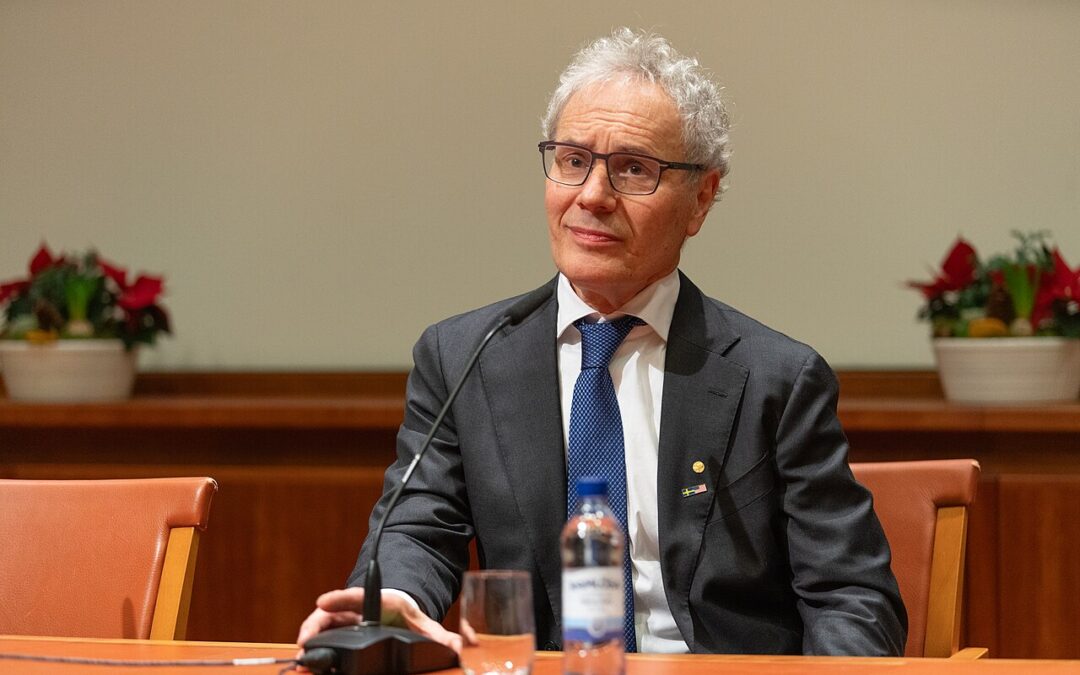
American Nobel laureate Victor Ambros, whose father emigrated from Poland after World War Two, has received Polish citizenship. Prime Minister Donald Tusk called him to give him the good news personally.
Ambros, who won the 2024 Nobel Prize in Medicine for his research on microRNA, revealed earlier this year during a visit to Warsaw that he was seeking Polish citizenship and hoped to help strengthen Poland’s scientific standing worldwide.
Jesteś obywatelem najlepszego państwa na świecie!🇵🇱❤️ pic.twitter.com/cBDfMDS3Ax
— Donald Tusk (@donaldtusk) September 16, 2026
“I have great news for you: you are a Pole, you have a Polish passport,” Tusk told Ambros during the call. “You are a citizen of the country that is the best place on Earth – at least I believe that.”
Ambros told Tusk that he was “honoured” to receive the news. Speaking later to the Polish Press Agency (PAP), the scientist said that he was “very grateful to Prime Minister Tusk and to Poles for awarding me Polish citizenship”.
“I hope that my having dual citizenship – American and Polish – will honour both my father’s Polish roots and the opportunities that America created for him and me.”
Ambros, who is already chair of the scientific council of the International Institute of Molecular Mechanisms and Machines of the Polish Academy of Sciences, also expressed hope that there would be “additional opportunities to help improve the international position of Polish science, especially in the field of biomedical research”.
Ambros’s father, Longin, was born in 1923 in what was then the village of Dordziszki in Poland but which, after postwar border changes, is now Dordishki in Belarus. He later attended high school in the city then known as Wilno, and which was part of Poland, but is now Vilnius, the capital of Lithuania.
During World War Two, Longin Ambros was deported to Nazi Germany and used as forced labour, before being liberated at the end of the war by American forces, who then employed him as an interpreter.
In 1946, Longin emigrated to the United States, where he settled on a farm and raised a family. Victor was one of eight children and the first scientist in the family.
American Nobel laureate Victor Ambros has announced that he is seeking Polish citizenship in order to honour his family “and all those who fought and survived so that I could exist today”
He also wants to contribute to the development of science in Poland https://t.co/70uXhh1fj6
— Notes from Poland 🇵🇱 (@notesfrompoland) March 10, 2026
There has been a growing trend in recent years for foreigners to seek Polish citizenship. There are three paths for those wishing to obtain it.
The first is through Polish ancestry. People with a Polish parent, grandparent or great-grandparent who lived in Poland after 1920 and never lost their citizenship can apply to have their status as a Polish citizen officially confirmed.
Last year, Hollywood star Jesse Eisenberg, whose ancestors were Jews from Poland, received Polish citizenship, describing it as the “honour of a lifetime”. His Oscar-nominated 2024 film A Real Pain was set entirely in Poland.
Eisenberg is currently starring in a new state campaign promoting Poland abroad, along with football star Robert Lewandowski and supermodel Anja Rubik.
Poland has launched a new advertising campaign to attract tourists from Europe and the US.
The first video, under the slogan "Poland. More than you expected", features footballer Robert Lewandowski, Hollywood star Jesse Eisenberg and supermodel Anja Rubik https://t.co/3jtqyUWQyy
— Notes from Poland 🇵🇱 (@notesfrompoland) August 19, 2026
The second route is for foreign residents in Poland who meet requirements relating to their length of residency, language skills and personal situation to apply to the governor of the province where they live.
The third is by applying directly to the president, who has discretion to grant citizenship without any specific legal requirements being met. Applicants are expected to show personal ties to Poland and explain their reasons for seeking citizenship.
One recent example was Russian-born speed skater Vladimir Semirunniy, who fled to Poland and was granted citizenship last year by President Karol Nawrocki. This allowed him to win a medal for Poland at the recent Winter Olympics.
Poland granted citizenship to a record 19,135 foreigners in 2025, up 17% from the previous year and almost five times higher than a decade ago.
Over half of recipients were Ukrainians, followed by Belarusians, Russians, Vietnamese and Turks https://t.co/FoyWd5UPJx
— Notes from Poland 🇵🇱 (@notesfrompoland) May 15, 2026
Last year, Poland granted citizenship – either through provincial governors or directly from the president – to a record 19,135 people. Over half of the recipients were Ukrainians, who constuitute by far Poland’s largest immigrant group. In 2024, the figure stood at 16,342.
However, the Polish government is currently working on measures to make it tougher for foreigners to obtain citizenship, including increasing the minimum residency period and requiring applicants to take a test proving they are integrated. They would also have to sign a declaration of loyalty.
Applications to confirm citizenship through descent have also risen sharply, in particular among Israelis, many of whom have roots in Poland.
Last month, rising US sprint star Sam Blaskowski announced that he was also applying for Polish citizenship with a view to representing and winning medals for the land of his ancestors on the international stage.
Rising US sprint star Sam Blaskowski has announced he wants to represent Poland, the country of his ancestors.
His best 100m time of 9.89 seconds is the 9th fastest in the world this year and over a tenth of a second faster than Poland's national record https://t.co/S2tZsiSAhh
— Notes from Poland 🇵🇱 (@notesfrompoland) August 24, 2026
Notes from Poland is run by a small editorial team and published by an independent, non-profit foundation that is funded through donations from our readers. We cannot do what we do without your support.
Main image credit: John Sears/Wikimedia Commons (under CC BY-SA 4.0)
Ben Koschalka is a translator, lecturer, and senior editor at Notes from Poland. Originally from Britain, he has lived in Kraków since 2005.