Why are you now seeing adverts on our website for the first time? Click here to learn more.
Keep our news free from paywalls by making a donation to support our work!

Notes from Poland is run by a small editorial team and is published by an independent, non-profit foundation that is funded through donations from our readers. We cannot do what we do without your support.
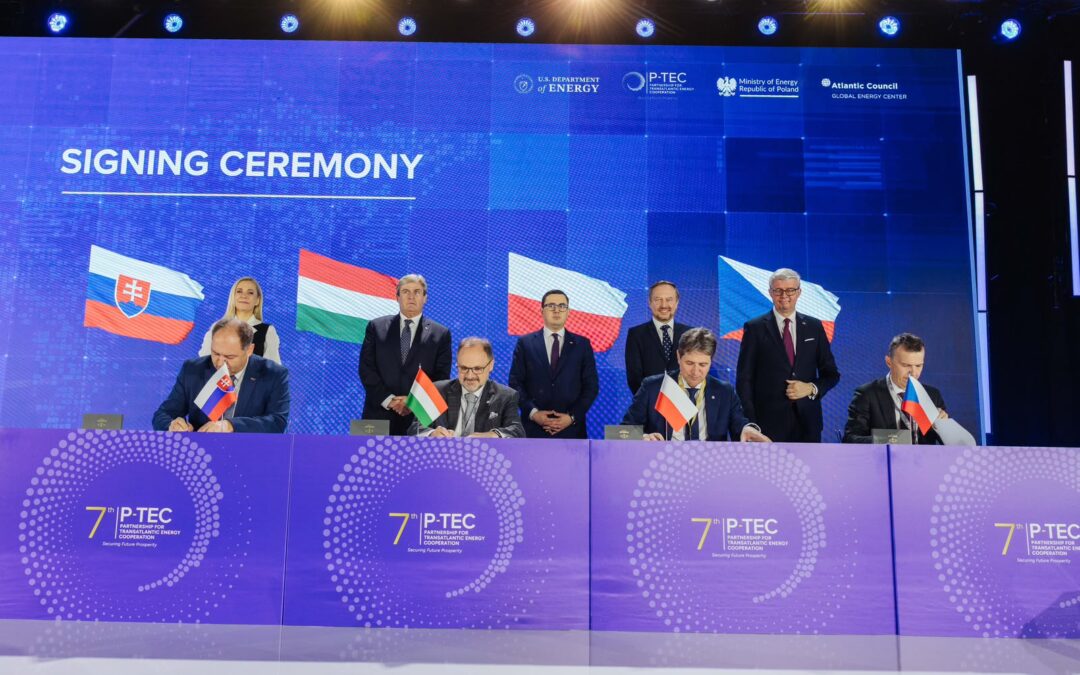
Poland has signed memorandums with four of its neighbouring countries – Hungary, the Czech Republic, Slovakia and Lithuania – pledging to strengthen regional cooperation on natural gas supplies and the security of infrastructure.
The initiative comes amid Poland’s efforts to use its liquefied natural gas (LNG) capacity and transmission links to establish itself as a regional energy hub, helping its neighbours, especially landlocked countries to the south, diversify supplies and reduce their reliance on Russia.
The two memorandums of understanding were signed in Warsaw during a ministerial meeting at the Partnership for Transatlantic Energy Cooperation (P-TEC), co-organised by the US Department of Energy, Poland’s energy ministry and the Global Energy Centre run by the Atlantic Council.
Rozpoczęliśmy 7. edycję Partnership for Transatlantic Energy Cooperation (P-TEC) – jednego z kluczowych forów współpracy energetycznej Stanów Zjednoczonych oraz krajów Europy Środkowo-Wschodniej. ⚡️
W Warszawie spotkali się przedstawiciele rządu Stanów Zjednoczonych, państw… pic.twitter.com/7t8kLluubF
— GAZ-SYSTEM (@GAZ_SYSTEM) November 18, 2026
One of them, signed by Poland, Slovakia, Hungary and the Czech Republic – who collectively form the Visegrad Group – establishes a framework for closer collaboration between their gas transmission system operators and more effective use of existing infrastructure.
In late 2022, for example, a new gas interconnector opened between Poland and Slovakia. However, since then, the pipeline has seen very little use, as Bratislava has continued to rely on Russian gas supplies. Hungary has also remained reliant on Russian gas.
By contrast, Poland quickly phased out its imports of Russian energy after the full-scale invasion of Ukraine in 2022. It now receives most of its gas via a pipeline that runs from Norway through Denmark and through LNG that arrives by sea, sourced mainly from the US and Qatar.
From autumn 2027, the EU will ban its member states from importing Russian gas. In September, Hungary’s energy minister said that his country will be ready to meet that deadline. Slovakia, however, is challenging the import ban at the European Court of Justice.
As part of the new memorandum signed this week, the four Visegrad countries will assess the impact of phasing out Russian supplies on regional energy security.
The second memorandum, signed between Poland’s Gaz-System and Lithuania’s Amber Grid and KN Energies – which operate gas and LNG infrastructure in the two countries – focuses on strengthening the resilience and security of energy infrastructure around the Baltic Sea.
It provides for closer coordination between the companies, including information-sharing on threats and incidents, joint risk assessments, exchanges of expertise on infrastructure protection and crisis response, and joint training sessions and exercises.
“The LNG terminals in Poland and Lithuania serve as critical supply hubs for…Central and Eastern Europe, significantly enhancing energy security and bolstering regional resilience,” said Sławomir Hinc, CEO of Gaz-System.
But that “security depends on the resilience of every link in the chain”, added his counterpart at Amber Grid, Nemunas Biknius. “This regional agreement will enable us to strengthen that chain in a structured and coordinated way.”
Poland has declared its ambition to become a hub for supplying gas to the CEE region, including Ukraine, in particular by expanding imports of LNG from the United States.
In addition to its existing LNG terminal in Świnojście, which opened a decade ago, it is planning to build two further floating storage and regasification units that will be located in the Bay of Gdańsk. The first of those, under construction in South Korea, is due to open in 2028.
Last year, a record amount of natural gas was traded in Poland, surpassing the levels seen before Russia’s full-scale invasion of Ukraine and the energy crisis that followed.
Notes from Poland is run by a small editorial team and published by an independent, non-profit foundation that is funded through donations from our readers. We cannot do what we do without your support.
Main image credit: Ministerstwo Energii (under CC BY-NC-ND 4.0)

Alicja Ptak is deputy editor-in-chief of Notes from Poland and a multimedia journalist. She has written for Clean Energy Wire and The Times, and she hosts her own podcast, The Warsaw Wire, on Poland’s economy and energy sector. She previously worked for Reuters.