Keep our news free from paywalls by making a donation to support our work!

Notes from Poland is run by a small editorial team and is published by an independent, non-profit foundation that is funded through donations from our readers. We cannot do what we do without your support.
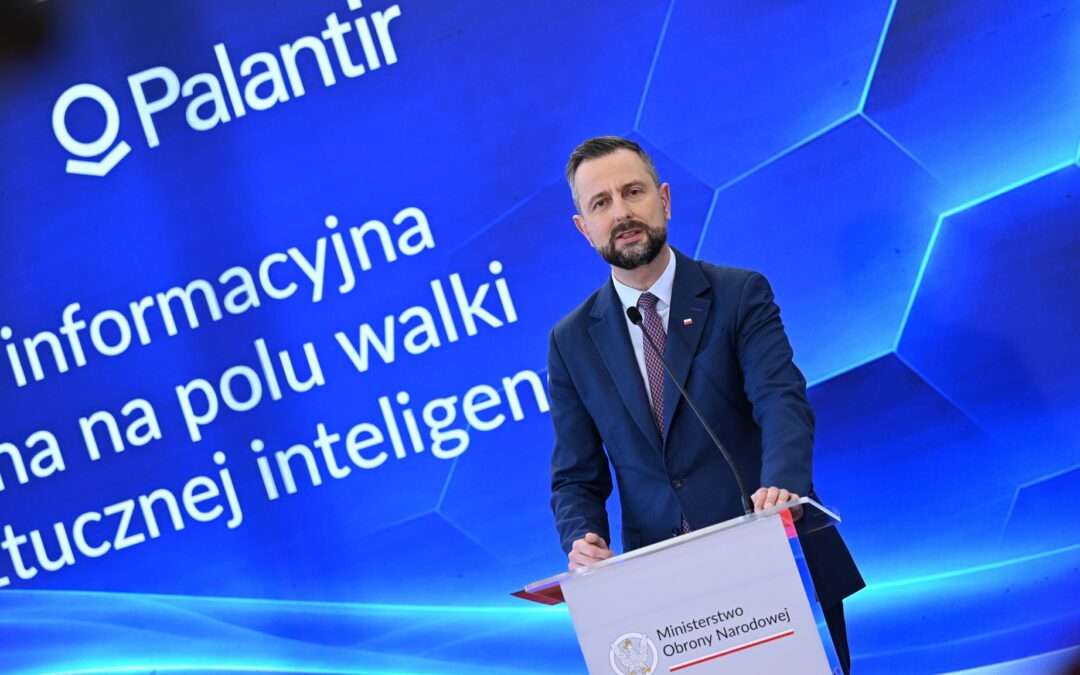
Poland’s defence ministry has signed a $300 million (1.2 billion zloty) deal with US data integration and analytics firm Palantir for use of its Maven Smart System, an AI-powered software platform for battlefield analysis and decision-making
Defence minister Władysław Kosiniak-Kamysz says that the system will help Poland “build a modern army, ready for the challenges of the future”. He has also confirmed all servers and data will remain in the possession of the Polish armed forces.
We are extremely proud to stand with Poland and support its undisputed leadership in defending a free, safe, and sovereign Europe.
Maven Smart System is universally recognized as the vanguard of next-generation AI warfare.
And we are honored that Poland is adopting Maven Smart… https://t.co/b8MCLypIea
— Palantir (@PalantirTech) November 27, 2026
Poland has signed a five-year contract for Maven, whose other users include the US military and NATO’s Allied Command Operations. Ukraine has also developed its own equivalent of the system and has collaborated with Palantir.
The system, which grew out of Project Maven, a programme initiated by the US Department of Defence in 2017, uses machine learning to integrate and analyse various sources of data for military operations.
The software is advertised as supporting military “command and control” functions, aiding in identifying military targets and helping manage battlefield information.
“This is one of the biggest steps in the transformation of our armed forces,” declared Kosiniak-Kamysz. He said that Maven would benefit all branches of the armed forces and help “build the best capabilities”, adding that “it is impossible to build the Polish army today without artificial intelligence”.
Palantir has faced criticism from some quarters due to concerns over its role in expanding governments’ use of sensitive data, as well as over its work relating to immigration enforcement in the United States and Israel’s military operations in Gaza.
However, Kosiniak-Kamysz assured that Poland would “hold all the tools and all the keys in our hands”, including maintaining possession of servers and data.
He added that he believed there had “never been a more thoroughly analysed agreement” signed by the defence ministry and said that no European providers were able to offer the same capabilities.
Kosiniak-Kamysz also emphasised that NATO has already integrated Maven into its military exercises, so the new agreement with Palantir would “bring us closer to NATO and improve our position in the alliance”.
Palantir CEO Alex Karp, who was present at today’s signing, also addressed potential opposition to the contract.
“There will always be someone who opposes Palantir,” he said, according to a Polish translation of his remarks. “But it is Poland’s enemies who shout loudest against Palantir…They spend a lot on propaganda, persuading useful idiots that good solutions are unnecessary and that bad ones are good.”
Palantir registered a Polish subsidiary a decade ago and has since grown its Warsaw office. Last year, the defence ministry signed a letter of intent with the firm on strengthening cooperation on AI, cybersecurity and information technology.
Poland and the US have signed an agreement on defence research, development, testing and evaluation, concluding 17 years of negotiations and opening the way for deeper cooperation on military technology https://t.co/rCHzK00Pwa
— Notes from Poland 🇵🇱 (@notesfrompoland) November 24, 2026
Since Russia’s full-scale invasion of Ukraine, Poland has rapidly and significantly ramped up defence spending to some of the highest relative levels in NATO. It was the alliance’s biggest importer of arms between 2021 and 2025, with 44% of that equipment coming from the US.
Last week, Poland and the US signed an agreement on defence research, development, testing and evaluation, opening the way for deeper technological cooperation.
Earlier this month, Polish defence minister Władysław Kosiniak-Kamysz and Secretary of War Pete Hegseth signed a declaration on expanding bilateral defence-industrial cooperation
Notes from Poland is run by a small editorial team and published by an independent, non-profit foundation that is funded through donations from our readers. We cannot do what we do without your support.
Main image credit: MON (under CC BY-SA 4.0)

Leo Greenberg is an assistant editor at Notes from Poland. Based in Kyiv, he writes about global politics, Europe and America, and the war in Ukraine.