Keep our news free from ads and paywalls by making a donation to support our work!

Notes from Poland is run by a small editorial team and is published by an independent, non-profit foundation that is funded through donations from our readers. We cannot do what we do without your support.
This is a breaking news story and will be updated as further information becomes available.
The man who carried out Saturday’s deadly terrorist attack in the Polish city of Kraków – and who can now be named as 24-year-old Michał Oksiński – has died in hospital.
Oksiński suffered serious injuries in a firefight with two police officers, who heroically brought his rampage to an end. On Sunday, Krzysztof Klęczar, the governor of the Małopolska province in which Kraków is located, revealed that Oksiński remained in critical condition.
On Monday morning, provincial police announced that “the perpetrator of the tragic events [in Kraków] died this morning in hospital”.
“There was a constant struggle to save this man’s life, despite the evil he had committed,” Klęczar told broadcaster TVN after the death was confirmed. “He underwent at least three surgeries.”
Informujemy, że sprawca tragicznych wydarzeń zmarł dzisiaj nad ranem w szpitalu.
— Małopolska Policja (@kwpkrakow) November 9, 2026
The two police officers, Jakub Kulik and Artur Morański, who engaged Oksiński also suffered serious injuries, with Kulik’s condition the more critical of the two.
The situation would have been much worse were it not for the fact that two leading local surgeons had, by pure chance, been eating a meal with their families in a restaurant near where the shootout took place, and provided emergency aid to the officers.
There was also a huge public response to appeals for people to donate blood for Kulik, who underwent a series of surgeries.
On Sunday, it was announced that both Kulik and Morański had come out of the comas they had previously been placed in. Kulik’s condition was described as “serious but stable” by Karolina Gałecka, spokeswoman for the interior ministry.
CCTV footage shows the moment two police officers confront the Krakow shooter. pic.twitter.com/vcQ0Xvi1nX
— WarMonitor🇺🇦🇬🇧 (@WarMonitor3) November 7, 2026
Just after 3 p.m. local time on Saturday afternoon, Oksiński drove through the historic city centre of Kraków, Poland’s second-largest city, including its famous market square, which was packed with tourists and locals.
He fired at random from the car, killing six people. Four of those victims have been identified as Polish women, aged 47, 53 and 61, and a Polish man in his 50s. The other two were foreign nationals: a 32-year-old British man and a 51-year-old Austrian woman.
A further 16 people were injured in the attack, 11 of them Polish. The interior ministry has said that, among the dead and injured are citizens of the UK, Austria, Germany, Russia and Portugal.
On Saturday evening, it was announced that a search of the perpetrator’s home in the small town of Ostrowiec Świętokrzyski in southeast Poland, around 160 km from Krakow, had revealed three further dead bodies.
They were later confirmed to belong to Oksiński’s parents, aged 53 and 52, and 21-year-old sister. Prosecutors believe Oksiński murdered them before launching his rampage in Kraków.
Oksiński’s motive remains unknown. On Saturday evening, in the wake of the attacks, interior minister Marcin Kierwiński announced at a press conference that the information obtained so far indicated that the suspect had “very, very radical views” and “may have been fascinated by far-right ideologies”.
However, when pressed on this claim during an interview with TVN on Sunday evening, Kierwiński refused to provide evidence, said that his remarks had referred to “initial hypotheses”, and confirmed that the potential motive was still being investigated.
Poland's interior minister refuses to reveal on what basis he said the Kraków terrorist had "very radical views" and was "fascinated by the far right".
"In cases like this, there are always first hypotheses, first clues. That's why I made this statement" pic.twitter.com/Wpud1FrAYM
— Daniel Tilles (@danieltilles1) November 8, 2026
The incident has caused shock in Poland, where gun crime is exceedingly rare. The country has one of the lowest levels of gun ownership in Europe and has never previously suffered a mass public shooting of this kind.
In response to the tragedy, a period of two days of official public mourning has been declared, with a decree to that effect signed by President Karol Nawrocki and Prime Minister Donald Tusk. On Monday evening, a silent march will be held in Kraków at 8 p.m. to pay tribute to the victims.
Notes from Poland is run by a small editorial team and published by an independent, non-profit foundation that is funded through donations from our readers. We cannot do what we do without your support.
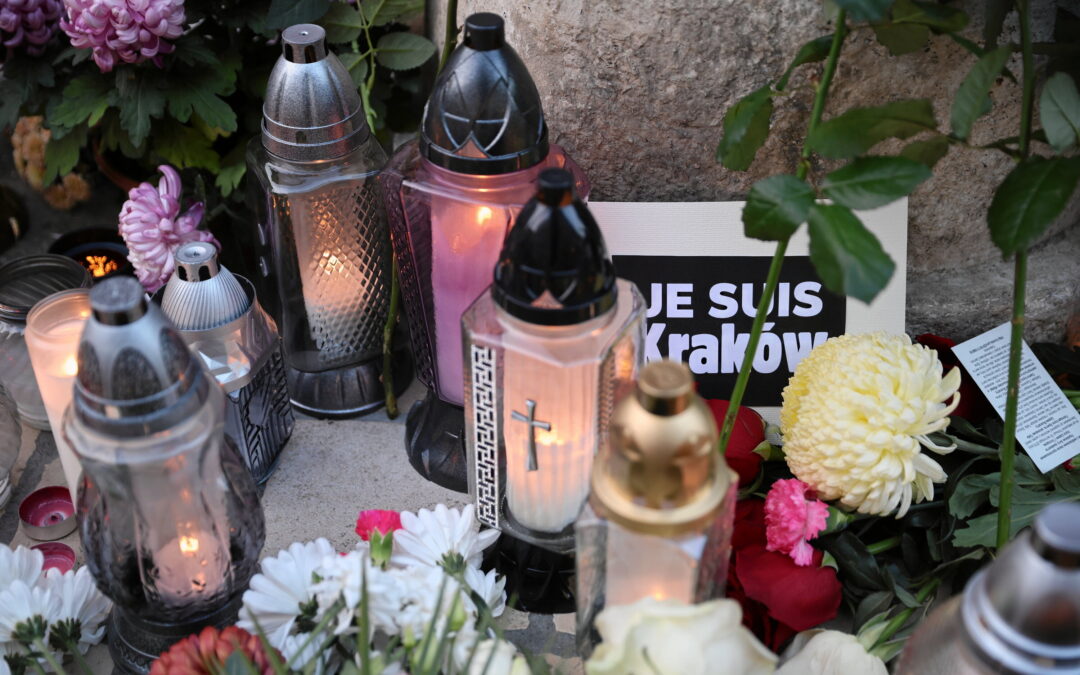
Main image credit: Jakub Wlodek / Agencja Wyborcza.pl

Daniel Tilles is editor-in-chief of Notes from Poland. He has written on Polish affairs for a wide range of publications, including Foreign Policy, POLITICO Europe, EUobserver and Dziennik Gazeta Prawna.