
Keep our news free from ads and paywalls by making a donation to support our work!

Notes from Poland is run by a small editorial team and is published by an independent, non-profit foundation that is funded through donations from our readers. We cannot do what we do without your support.
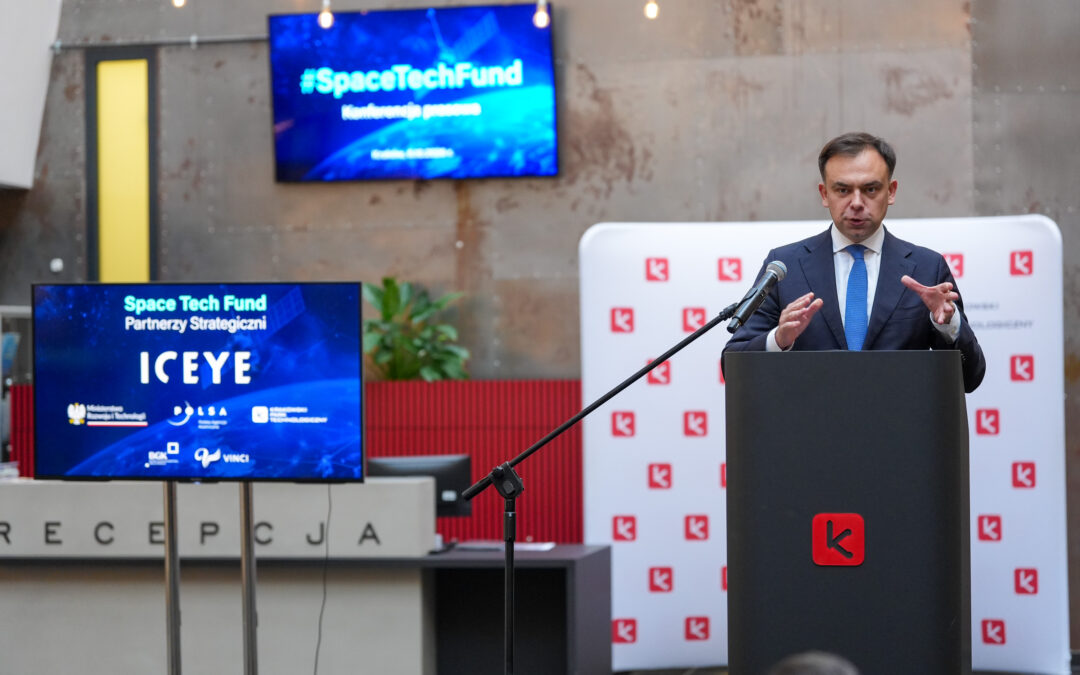
Poland’s state-owned National Development Bank (BGK) has announced the launch of the country’s first fund to support companies developing space technologies. Vinci Space Tech Fund will be worth 500 million zloty (€114 million), investing up to 100 million zloty each in 15-20 firms in the sector.
The brainchild of finance minister Andrzej Domański, the fund aims to foster the growth of Polish space technologies and bolster the country’s technological independence.
Kosmos to nie tylko gospodarka i innowacje. Kosmos to także bezpieczeństwo Polski. 🇵🇱
Dziś w Krakowie uruchamiamy pierwszy w Polsce fundusz dla sektora kosmicznego – Vinci Space Tech Fund. 500 mln zł na rozwój sektora @BGK_pl Vinci.
Mamy ambitne spółki, znakomitych naukowców i… pic.twitter.com/NQBy8HYOcY
— Andrzej Domański (@Domanski_Andrz) October 6, 2026
According to the growth and technology ministry, one of the fund’s strategic partners, BGK will invest between 10 and 100 million zloty in companies with a potential for rapid growth and expansion into international markets through its Vinci investment vehicle.
The fund’s other partners are the Polish Space Agency and Kraków Technology Park (KTP), where the launch took place, along with ICEYE, a world-leading Finnish microsatellite manufacturer and operator co-founded by Pole Rafał Modrzewski.
Announcing the fund, Domański highlighted the space sector’s role in responding to threats, protecting critical infrastructure, strengthening energy security and monitoring Poland and its surroundings.
“The money from the Vinci fund is an investment in Poland’s capacity to build its own strong companies and develop competences that will be strategically significant for our economy and security,” he said.
Warsaw has been chosen as the location for a new European Space Agency security centre, as Poland takes another step in its ambitions to become a bigger player in the space sector
The facility will be the @esa's first outside its 11 founding member states https://t.co/WnHIbrW3ze
— Notes from Poland 🇵🇱 (@notesfrompoland) July 13, 2026
Mirosław Czekaj, president of the BGK management board, also noted that the development of the space industry would help “to build Poland’s technological sovereignty”, as one of the projects that are “vital to the Polish economy”.
The fund is expected to invest in 15 to 20 companies, mainly Polish, although companies from elsewhere in Europe may also qualify if they have their main business operations in Poland, the ministry said.
Its key investment areas include satellites, optics and Earth observation, satellite communications, electronics and photonics, rockets and propulsion systems, and artificial intelligence.
In addition to funding, companies will benefit from advice and support from the fund’s partners.
KPT, the city of Kraków and the Faculty of Space Technologies at AGH University are expected to provide much of the initiative’s academic, research and technical expertise. ICEYE, meanwhile, will share its experience of growing a space company and expanding into global markets.
Last month, the company opened a satellite technology centre in Warsaw, and it plans to invest more than 120 million zloty in Poland by 2028, reports industry website Space News.
Modrzewski said that raising capital in Poland was difficult when the company was founded 12 years ago, but that it has become easier as space has emerged as one of the country’s “strategic domains”.
“The availability of capital in Poland will allow our companies to build their position on the global market without needing to leave the country at an early stage,” Modrzewski said, quoted by financial news site Bankier.pl.
Vinci has previously invested in ICEYE as part of its private equity fund.
Astronaut @astro_slawosz's recent trip to the International Space Station highlighted the Polish space industry's growing importance.
Once limited to making components for others, Poland is now building its own spacecraft and participating in missions https://t.co/TmQiD91IzZ
— Notes from Poland 🇵🇱 (@notesfrompoland) October 6, 2025
Poland’s space sector has expanded rapidly since the country joined the European Space Agency in 2012, moving from supplying components for foreign missions to developing its own satellites and space systems.
A key milestone came in 2024 with the launch of EagleEye, Poland’s largest satellite, which was designed and built by a consortium of Polish companies and research institutions. In 2025, a Pole went to space for the second time in history, 50 years after the first Polish astronaut’s flight.
The sector is now taking on larger international projects, while Russia’s war in Ukraine has highlighted the importance of domestic space capabilities for national security.
In July this year, Warsaw was chosen as the location for a new European Space Agency centre focusing on civil security and resilience.

Notes from Poland is run by a small editorial team and published by an independent, non-profit foundation that is funded through donations from our readers. We cannot do what we do without your support.
Main image credit: MRiT (under CC BY-NC-ND 4.0)

Ben Koschalka is a translator, lecturer, and senior editor at Notes from Poland. Originally from Britain, he has lived in Kraków since 2005.