Keep our news free from ads and paywalls by making a donation to support our work!

Notes from Poland is run by a small editorial team and is published by an independent, non-profit foundation that is funded through donations from our readers. We cannot do what we do without your support.
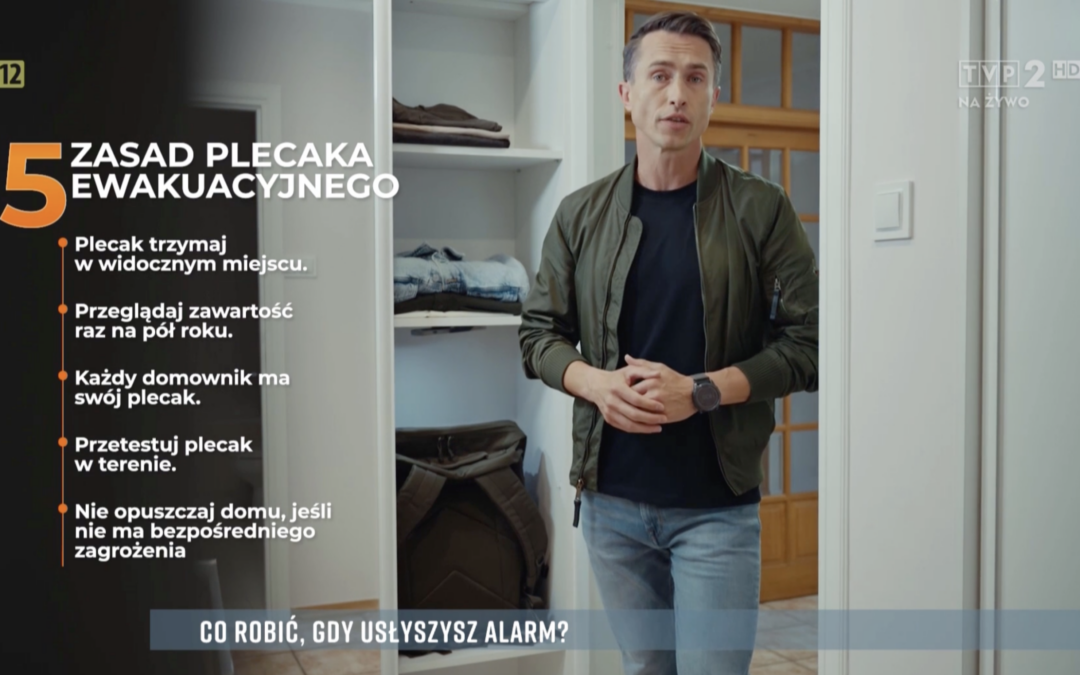
Poland’s interior ministry has launched a TV campaign, including spots on public broadcaster TVP’s flagship morning show, aimed at educating the public about how to respond to emergency situations such as natural disasters and security threats.
The initiative comes as Poland has faced growing threats from Russia, including acts of sabotage and the entry of missiles and drones into Polish airspace. Prime Minister Donald Tusk warned this week that there may be an “escalation” of such actions in the coming weeks and months.
📺 Dzisiejsza wizyta w programie „Pytanie na Śniadanie” odbyła się w ramach naszej nowej kampanii „ Minuta dla twojego bezpieczeństwa”!
Rozmawialiśmy o sprawach fundamentalnych – o bezpieczeństwie. Mogliście sprawdzić, czy wiecie, co oznaczają sygnały alarmowe oraz krok po kroku… pic.twitter.com/ARta1Pqmlz
— MSWiA 🇵🇱 (@MSWiA_GOV_PL) September 8, 2026
The new campaign will include weekend segments on the TVP1 channel and a series of pieces aired during TVP2’s breakfast show, Pytanie na śniadanie, which had an average audience of 322,000 in August, according to Nielsen Media data.
The weekend programmes will introduce topics such as floods, fires, extreme weather, power outages, chemical contamination, evacuation, cybersecurity, disinformation and first aid. Specialists will then discuss the subjects in greater detail during the morning segments.
The ministry says the content is based on its official security handbook, which it sent to all 17 million Polish households earlier this year, and is intended to help people prepare for emergencies before they occur.
“We only find out whether we’re prepared for difficult situations when they actually arise,” said Mateusz Jarecki, who is presenting the segments. “That’s why, in collaboration with specialists, we’ve produced a series of short, easy-to-follow videos that will help you prepare for various life scenarios.”
The government is sending copies of a booklet advising how to prepare for and act in emergencies to all 17 million households in Poland.
The guide includes information on what to do in the event of military attacks, terrorist threats and natural disasters https://t.co/xIaRQ2ie5N
— Notes from Poland 🇵🇱 (@notesfrompoland) January 12, 2026
According to Presserwis, a newsletter by media industry magazine Press, the ministry will spend 5.4 million zloty (€1.3 million) on broadcasting the campaign during Pytanie na śniadanie.
The agreement with the public broadcaster, signed on 4 September, includes 16 short segments and seven commentary pieces, according to Presserwis.
Pytanie na śniadanie’s website so far shows two segments with material from the series. One explains what to do when an evacuation order is issued, while the other covers what should be included in an emergency kit.
The campaign comes following recent criticism from the opposition over how the government communicates with citizens during emergencies.
Amid Russian mass attacks on western Ukraine this week, including strikes on a train and a truck near the Polish border, residents of eastern Poland received mobile phone alerts from the Government Security Centre (RCB) warning of air strikes and urging them to seek shelter.
However, Beata Mazurek, a senior figure from the opposition Law and Justice (PiS) party, criticised the messages for “spreading panic without providing instructions” on where people should shelter.
“Where are we supposed to go? That seems to be the most basic piece of information. The threat is real, but the instructions are incomplete,” she wrote on X.
Pani poseł @beatamk zablokowała komentarze, więc odpowiadamy tutaj.
Jeśli nie wie Pani, co zrobić, gdy wyją syreny – zapraszamy na nasze szkolenia. Uczymy tam https://t.co/yklFDaNeI3., jak zachować się w sytuacji zagrożenia i przygotować plecak ewakuacyjny. To wiedza, która… pic.twitter.com/V6je9VOUda
— Karolina Gałecka (@K_Galecka) September 13, 2026
In response, interior ministry spokeswoman Karolina Gałecka invited Mazurek to attend training sessions provided by the ministry.
“There, we teach, amongst other things, how to behave in an emergency and how to pack an evacuation rucksack. This is knowledge that comes in handy precisely in such situations,” wrote Gałecka.
Last December, the interior ministry launched a mobile application and website that helps people to find their nearest shelter.
In July this year, opposition figures also criticised the government when a Russian missile entered Polish airspace and landed in a field. They claimed that local residents were not provided with clear warnings and information about the threat and how to respond.
The object that crashed in the Lublin region on Thursday was a Russian Kh-101 cruise missile carrying a "significant amount" of explosive material.
The missile was "potentially very dangerous,” Poland's defence ministry confirmedhttps://t.co/NoqZwIcaWp
— Notes from Poland 🇵🇱 (@notesfrompoland) July 31, 2026
After this week’s Russian attacks on western Ukraine, Tusk warned that “we can expect the coming weeks and months will be a period of very intensified Russian actions”, and that “we cannot rule out that this escalation will also affect our territory”.
Earlier this month, after an arson attack on a drone plant in Poland likely carried out by agents working on behalf of Russia, interior minister Marcin Kierwiński warned that “society must be prepared for the possibility of an increase in Russian acts of sabotage”.
A report published earlier this year by the International Centre for Counter-Terrorism found that Poland is the “primary focus” of Russia’s growing campaign of sabotage in Europe.
A drone has struck a passenger train travelling between Kyiv and Warsaw, around 2 km from the Polish border, amid the latest mass Russian attacks on Ukraine.
Separately, a truck around 800 metres from a border crossing with Poland was also hit last night https://t.co/ZbfE2iDLOk
— Notes from Poland 🇵🇱 (@notesfrompoland) September 13, 2026
Notes from Poland is run by a small editorial team and published by an independent, non-profit foundation that is funded through donations from our readers. We cannot do what we do without your support.
Main image credit: TVP (screen shot)

Alicja Ptak is deputy editor-in-chief of Notes from Poland and a multimedia journalist. She has written for Clean Energy Wire and The Times, and she hosts her own podcast, The Warsaw Wire, on Poland’s economy and energy sector. She previously worked for Reuters.