Keep our news free from ads and paywalls by making a donation to support our work!

Notes from Poland is run by a small editorial team and is published by an independent, non-profit foundation that is funded through donations from our readers. We cannot do what we do without your support.
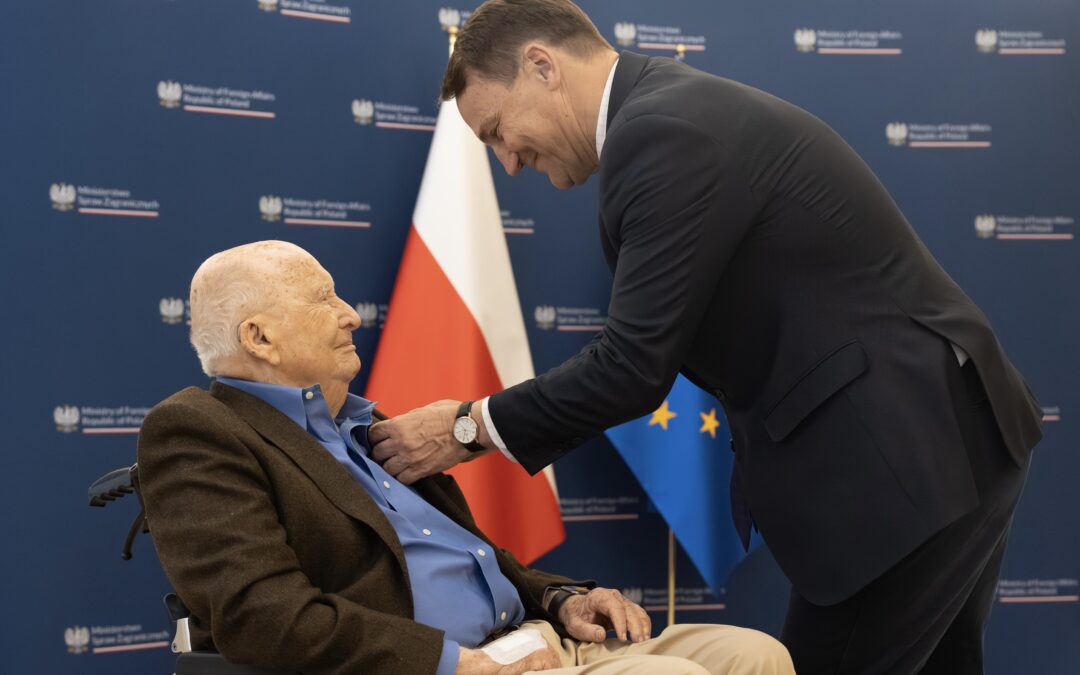
Poland’s foreign ministry has awarded the Bene Merito, a civilian decoration, to Stanisław Aronson, a 101-year-old veteran of Poland’s wartime underground resistance. After the war, Aronson moved to what was then Palestine and fought in the war to establish an Israeli state.
He was honoured for his “outstanding contributions to building historical memory and longstanding efforts to promote Poland’s good name, understanding, and reconciliation in Polish-Jewish relations”, said the ministry.
🇵🇱🫱🏼🫲🏽🇮🇱 Z najserdeczniejszymi gratulacjami i wyrazami najwyższego uznania oddajemy hołd pułkownikowi Stanisławowi Aronsonowi „Ryśkowi” — polsko-izraelskiemu bohaterowi, weteranowi Armii Krajowej i uczestnikowi Powstania Warszawskiego, który po wojnie służył również jako oficer Sił… https://t.co/xwMXa3C3tF
— Ambasada Izraela (@IsraelinPoland) May 11, 2026
Aronson, who celebrated his 101st birthday last week, collected the honour in person from Radosław Sikorski, Poland’s foreign minister. The Bene Merito distinction is awarded by the ministry to both Polish citizens and foreign nationals in recognition of merits in promoting Poland abroad.
“Colonel Stanisław Aronson is one of those truly remarkable people whose lives became symbols of courage, commitment to values, and service to Poland despite the most tragic experiences,” said Sikorski.
Sharing news of the award, the Israeli embassy described Aronson as a “Polish-Jewish hero” and “powerful symbol of the enduring bonds uniting Poland and Israel”.
Aronson was born in Warsaw in 1925. When Nazi Germany invaded Poland from the west in 1939, he and his family tried to flee eastwards, ending up in the city of Lwów (now Lviv in Ukraine), which had been occupied by the Soviets, who had invaded Poland from the east.
After Germany attacked the Soviet Union in 1941, Lwów fell under German occupation and the Aronsons ended up back in Warsaw, in the ghetto that the Nazis had forced Jews to live in there.
The following year, as the Germans began to liquidate the ghetto, sending the Jews to their death in extermination camps, Stanisław Aronson became separated from his family, whom he never saw again.
He himself was put on a transport to the Treblinka death camp but managed to escape when the train made a stop outside Warsaw. Aronson made his way back to the city, where he obtained fake identity papers and joined the Home Army (AK), Poland’s main underground resistance force.
He served in Kedyw, an AK unit that carried out sabotage operations and also executed Nazi-German officers as well as Poles or others who collaborated with the occupiers.
In 1944, Aronson fought in the Warsaw Uprising, the largest single act of armed resistance in German-occupied Europe. During the fighting, he was seriously wounded.
“A mortar shell shattered my leg, and shrapnel lodged in my lungs. That was the end of the uprising for me,” he told the Rzeczpospolita newspaper in a 2009 interview.
After the uprising was defeated, Aronson again managed to escape from a transit camp he had been sent to as the Germans expelled Warsaw’s population.
In the final stages of the war, he joined Polish resistance forces seeking to prevent Poland from falling under Soviet-backed communist rule. He was captured by the communist authorities, but once again managed to escape.
Aronson then fled Poland, making his way through Czechoslovakia, Hungary, Austria and on to Italy before deciding to travel to what was then British-controlled Palestine in 1947.
When war broke out there between Arabs and Jews, he joined the nascent Israeli army and fought in the struggle to establish an Israeli state.
He continued to live in Israel and serve in the Israel Defence Forces, earning medals for his participation in the 1973 Yom Kippur War and the 1982 Lebanon War. Aronson rose to the level of lieutenant colonel in the IDF, the same rank he had held in the AK.
The last survivor fighter from the Warsaw Ghetto Uprising, the largest single act of Jewish resistance in WWII, has died.
Michael Smuss passed away aged 99 on Thursday. He had continued to educate about his wartime experiences right to the end of his life https://t.co/A8J3xl840P
— Notes from Poland 🇵🇱 (@notesfrompoland) October 24, 2025
Throughout his time in Israel, Aronson continued to hold a close personal attachment to Poland, though he was unable to return there for decades while the country remained under communist rule.
“I was a Polish boy,” Aronson told Rzeczpospolita. “Today, when I tell this to people in Israel, it’s hard for them to understand. I was raised in the spirit of Polish patriotism…My homeland was Poland. This was obvious to me, and that’s why I joined the underground without hesitation.”
In 1988, he was finally able to visit Poland, and since then has devoted himself to improving Polish-Jewish relations and promoting the history of the Home Army and of the Poles who sought to save Jews from the Holocaust.
Aronson has been awarded numerous Polish military and civilian honours, including, in 2013, the Order of Polonia Restituta for “outstanding achievements in activities aimed at bringing together the Polish and Jewish states and nations”.
Urszula Tauer, a veteran of Poland’s wartime resistance who participated in the Warsaw Uprising, has been promoted to the rank of colonel by the defence minister to mark her 105th birthday https://t.co/gbVfWBIvWb
— Notes from Poland 🇵🇱 (@notesfrompoland) April 27, 2026
Notes from Poland is run by a small editorial team and published by an independent, non-profit foundation that is funded through donations from our readers. We cannot do what we do without your support.
Main image credit: MSZ/X

Daniel Tilles is editor-in-chief of Notes from Poland. He has written on Polish affairs for a wide range of publications, including Foreign Policy, POLITICO Europe, EUobserver and Dziennik Gazeta Prawna.