Keep our news free from ads and paywalls by making a donation to support our work!

Notes from Poland is run by a small editorial team and is published by an independent, non-profit foundation that is funded through donations from our readers. We cannot do what we do without your support.
President Karol Nawrocki has established a council tasked with preparing a potential new national constitution, something he pledged to pursue when he came to office last year.
However, constitutional change requires a two-thirds supermajority in parliament, which the opposition-aligned president cannot count on at the moment. Prime Minister Donald Tusk called Nawrocki’s plans “a political game” and made clear that the government will not support them.
Prezydent RP @NawrockiKn: Powołałem dziś korpus — fundament Rady ds. Nowej Konstytucji. Zaczynamy pracę nad konstytucją nowej generacji roku 2030.
Bardzo dziękuję profesjonalistom, dziękuję ludziom odważnym, dziękuję tym, którzy mają różne poglądy — nawet wobec tez, które… pic.twitter.com/pj1SbIPdyN
— Kancelaria Prezydenta RP (@prezydentpl) May 3, 2026
The president created his new body on Poland’s annual Constitution Day, which marks the anniversary of the constitution adopted by the Polish-Lithuanian Commonwealth on 3 May 1791. It was the world’s second modern constitution, after that of the United States, which was adopted two years earlier.
However, the Polish-Lithuanian constitution was in force for less than two years, as the state fell under foreign control. Poland’s current constitution was adopted in 1997, as the country emerged from decades of communist rule.
But many in Poland, especially on the political right, have been critical of the 1997 constitution. The national-conservative Law and Justice (PiS) party, which ruled Poland from 2015 to 2023 and is now the main opposition, has regularly called for a new constitution to be adopted.
Last year, after Nawrocki won the presidency as an independent with PiS backing, he used his inauguration speech to declare that the “political class must begin working on solutions for a new constitution, which will be ready for adoption, I hope, in 2030”, at the end of his term.
On Sunday, Nawrocki called on Poland to learn the “lesson” of the 1791 constitution, which showed “Poles’ profound capacity for self-correction” and “was meant to give the republic a chance of survival”.
“I am convinced that today’s problems in the republic are no longer merely political; they are systemic problems,” declared the president. “It cannot go on like this, with power in Poland split between two centres.”
“State institutions, which should be enduring, should be strong, are being drawn into political and partisan battles, and the system of rule of law…is producing further chaos and further social conflicts,” he added.
Since coming to power, Nawrocki has vetoed an unprecedented number of bills passed by the ruling majority in parliament, resulting in gridlock over a number of key issues, including judicial reform, defence spending and financial regulation.
Many state institutions, such as the Constitutional Tribunal (TK) and Supreme Court, have also been drawn into the crisis, with judges and other officials aligned with PiS blocking government policies.
The chief justice of the constitutional court has refused to accept four new judges appointed by parliament but whom the opposition-aligned president has refused to swear in.
The decision deepens an unprecedented standoff over Poland's top court https://t.co/B02DKA3uBL
— Notes from Poland 🇵🇱 (@notesfrompoland) April 9, 2026
In his speech on Sunday, Nawrocki said that, while he “respects the 1997 constitution and will remain its guardian until the very end”, it was “a necessary compromise in times of systemic transformation, in an entirely different reality” from today.
“Now we need a new-generation constitution” that is “modernised and adapted” to current conditions, he argued.
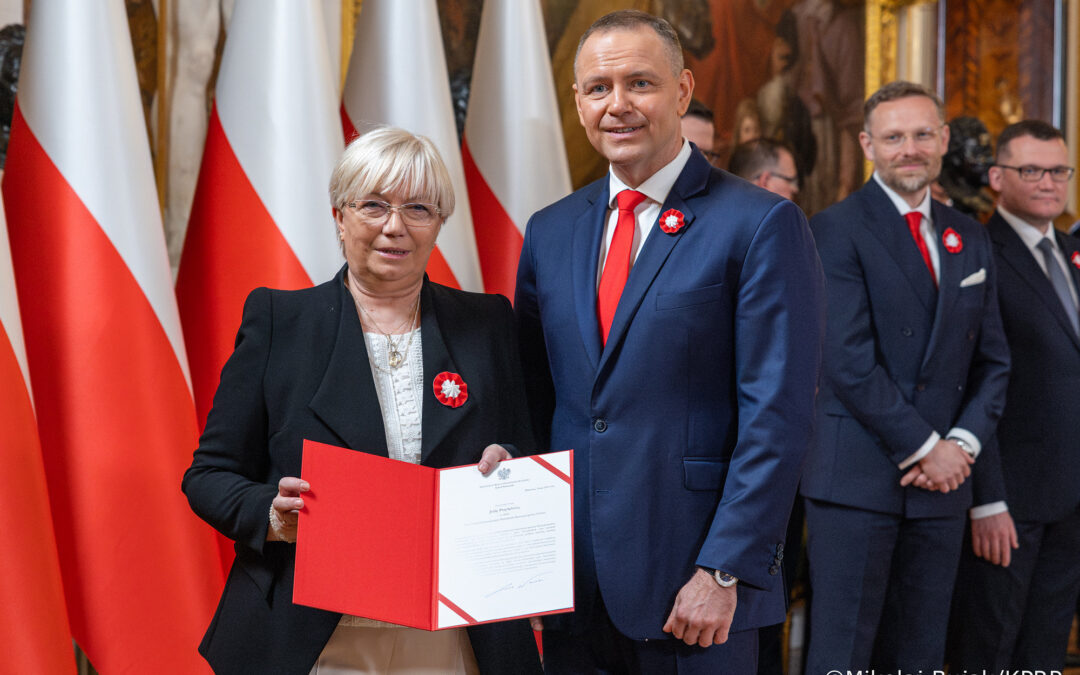
To that end, the president announced the formation of a council to begin working on that project and appointed its first ten members. They are a mix of legal scholars and politicians, including four former lawmakers associated with PiS.
Another member, Julia Przyłębska, was chief justice of the TK during PiS’s time in power. She is a close associate of PiS leader Jarosław Kaczyński and, under her leadership, the court was seen as being under the influence of the party and contained illegitimately appointed judges.
The EU's top court has ruled that Poland's Constitutional Tribunal violated EU law when it rejected the primacy of EU law and the validity of EU court judgments
It also found that the tribunal isn't a valid court as it contains unlawfully appointed judges https://t.co/wOlRLh0iUP
— Notes from Poland 🇵🇱 (@notesfrompoland) December 18, 2025
At Sunday’s ceremony, Nawrocki insisted that he “invites everyone” to discuss the new constitution and will be appointing further members of the council in the near future.
Earlier, on Friday, the president’s spokesman, Rafał Leśkiewicz, told Polsat News that the council would “brainstorm” ideas which would then be processed by parliament before being put to a national referendum.
However, changing the constitution requires a two-thirds majority in the Sejm, the lower house of parliament, something that Nawrocki is currently certain not to be able to obtain. The ruling coalition, which ranges from left to centre right and regularly clashes with the president, has a majority in the Sejm.
“The president knows full well that there will not be a constitutional majority in favour of his ideas,” said Tusk on Sunday. He called Nawrocki’s announcement “a political game” that will simply create “more confusion [when] Poland needs stability above all else”.
Pan @NawrockiKn ogłosił, że będzie pracował nad nową konstytucją. Proponuję zacząć od przestrzegania aktualnej.
— Donald Tusk (@donaldtusk) May 1, 2026
“PiS has done everything to undermine the constitutional order”, added Tusk, quoted by Polsat. “It is hard for me to imagine that those who were destroying the system in Poland would suddenly want to repair it…[and] that this initiative aims at anything more than the political interests of Karol Nawrocki.”
Deputy prime minister Władysław Kosiniak-Kamysz declared that, rather than changing the constitution, “people need to be responsible enough” to adhere to the current law. This “requires maturity, preparation, and a willingness to cooperate”, he added, quoted by Gazeta Wyborcza.
Poland will hold parliamentary elections next year, at which PiS and other opposition parties will seek to unseat Tusk’s government. However, current polling indicates that, even if they managed to win a majority, it would fall far short of the two thirds required for constitutional change.
Karol Nawrocki has sought to redefine Poland's presidency and become the figurehead of the right-wing opposition.
So far, it is working, but questions remain over what his end goal is and whether these tactics will get him there, writes @danieltilles1 https://t.co/TNDRGGv2QT
— Notes from Poland 🇵🇱 (@notesfrompoland) December 22, 2025
Notes from Poland is run by a small editorial team and published by an independent, non-profit foundation that is funded through donations from our readers. We cannot do what we do without your support.
Main image credit: Mikołaj Bujak/KPRP

Daniel Tilles is editor-in-chief of Notes from Poland. He has written on Polish affairs for a wide range of publications, including Foreign Policy, POLITICO Europe, EUobserver and Dziennik Gazeta Prawna.