Keep our news free from ads and paywalls by making a donation to support our work!

Notes from Poland is run by a small editorial team and is published by an independent, non-profit foundation that is funded through donations from our readers. We cannot do what we do without your support.
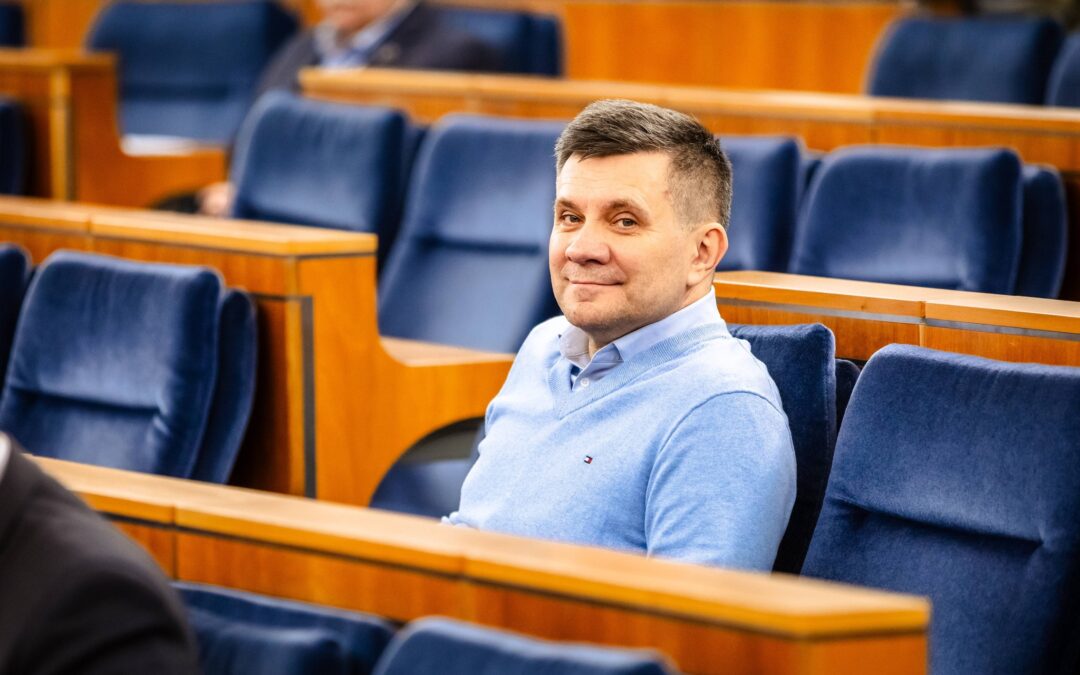
Poland’s main opposition, the national-conservative Law and Justice (PiS), has expelled one of its senators, Jacek Włosowicz, after he criticised the party for moving in a “nationalist” direction and seeking to block €44 billion in EU loans for defence spending.
In an announcement on Wednesday evening, PiS spokesman Rafał Bochenek accused Włosowicz of being “on [Prime Minister Donald] Tusk’s side”. Later, the party confirmed that he had been removed from its parliamentary caucus.
Senator Jacek Włosowicz od 2011 roku nie jest członkiem partii @pisorgpl. Jego dzisiejsze wypowiedzi wyraźnie pokazują, że od dawna mentalnie znajduje się po stronie Tuska. Rolą parlamentarzysty jest praca na rzecz polskich obywateli i reagowanie,wtedy gdy dzieje się im krzywda.…
— Rafał Bochenek (@RafalBochenek) March 18, 2026
The controversy began on Tuesday, when, in an appearance on liberal broadcaster TVN, Włosowicz made lengthy criticism of PiS, saying he was disappointed with its efforts to block Poland’s access to the EU’s SAFE programme, which provides loans on preferential terms for defence spending.
He contrasted that to how, when PiS was in power until 2023, the then-opposition was supportive of its defence spending.
When it was founded in 2001, PiS “was supposed to be a broad-based conservative party”, said Włosowicz. “But unfortunately in recent years…it is becoming a nationalist party.”
The SAFE programme is meant to provide Poland with €43.7 billion of loans to support defence spending. Nineteen other member states are also seeking funds from the scheme.
However, PiS has argued that SAFE is a threat because there is a lack of transparency over how the money will be spent and the terms of the loans. It also warns that the programme would give Brussels greater control over Poland because it could choose to withhold the money at any time.
Meanwhile, some in PiS have also expressed concern over the fact that the majority of SAFE funds must be spent in Europe, which they say may harm relations with the United States, a key ally and supplier of military hardware.
When a government bill on implementing the SAFE programme came before parliament earlier this month, Włosowicz was the only PiS senator to vote in favour of it.
Although the bill was approved by parliament, PiS-aligned President Karol Nawrocki vetoed it last week. He instead proposed his own “sovereign” alternative that would see the same level of money supplied by the Polish central bank.
However, the government and many financial experts have expressed doubt over the viability of Nawrocki’s plan. The day after the president’s veto, Tusk launched a “plan B” that would still allow Poland to receive the EU SAFE funds, though it remains unclear if it will be possible to spend them all.
Poland’s government has launched its “plan B” to obtain €44bn in loans for defence spending from the EU's SAFE programme, after opposition-aligned President Nawrocki yesterday vetoed a law intended to facilitate the funds https://t.co/NLVjLRift5
— Notes from Poland 🇵🇱 (@notesfrompoland) March 13, 2026
Włosowicz was a member of PiS from 2002 to 2011, serving during that time as a senator and a member of the European Parliament. However, in 2011 he left the party to join United Poland (Solidarna Polska), a breakaway right-wing group.
From 2015 to 2023, United Poland (which later changed its name to Sovereign Poland) was part of a PiS-led coalition government. However, in 2022, Włosowicz was expelled from United Poland amid a dispute over local leadership and the party’s programme.
Nevertheless, he continued to sit in the PiS caucus and, at the last parliamentary elections in 2023, he was re-elected to the Senate as a PiS candidate. In 2024, he unsuccessfully stood as a PiS candidate in the European elections.
Announcing PiS’s decision to suspend Włosowicz and begin the process of removing him from its caucus, Bochenek noted that the senator had not actually been a member of the party since 2011. “His recent statements clearly show that for a long time he has been mentally on Tusk’s side,” added the spokesman.
On Thursday morning, PiS senator Stanisław Karczewski confirmed that Włosowicz had been removed from the party’s caucus.
A ja przed chwilą zadzwoniłem do @JWlosowicz i poinformowałem go
o wykluczeni z Klubu @pisorgpl pic.twitter.com/VwqNzM2uYq— Stanisław Karczewski (@StKarczewski) March 19, 2026
Speaking to Onet Radio on Thursday morning, Włosowicz said that he stood by his earlier comments.
“I said that because I believe it. I think we can all see…[that] the right wing [of the party] had gained the main influence over its media message regarding its character. And this character…has started being changed towards a nationalist party.”
In recent months, PiS has seen its level of support in polls fall to around 24% – the party’s lowest figure since 2012. At the same time, two far-right opposition groups, Confederation (Konfederacja) and Confederation of the Polish Crown (KKP), have risen to a combined support of around 21%.
That has led to questions over whether PiS should itself move towards the right, in order to neutralise the challenge. However, such a move would risk ceding the centre ground.
Support for PiS has fallen to its lowest in 14 years, as the party grapples with internal division, the rise of far-right challengers, living in President Nawrocki's shadow, and the unpopularity in Poland of PiS ally Donald Trump, writes @danieltilles1 https://t.co/QRScBpEQQG
— Notes from Poland 🇵🇱 (@notesfrompoland) March 2, 2026
Earlier this month, PiS leader Jarosław Kaczyński signalled such a move, naming Przemysław Czarnek, a hardline conservative, as the party’s prime ministerial candidate for next year’s parliamentary elections.
Czarnek is seen as a figure who can appeal to parts of Confederation and KKP’s support, as well as someone who could potentially work with them to form a PiS-led administration after the elections.
That decision was, however, criticised by Włosowicz, who told news website Gazeta.pl on Wednesday (before his suspension was announced) that he “hopes the party will return to its mainstream programme, that it will not waste time on some tactical search for voters on the far right”.
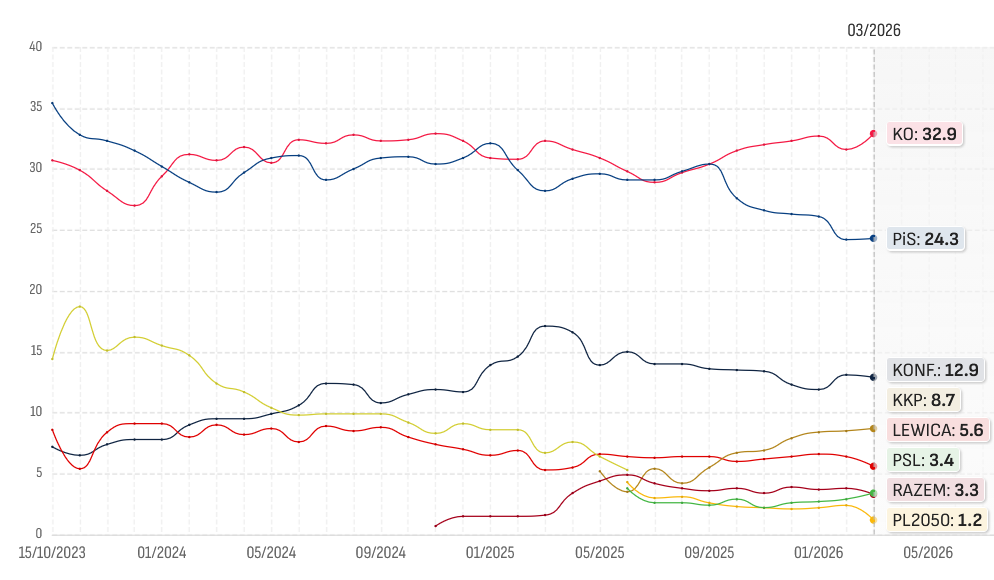
Monthly polling averages for Poland’s main political groups (source: ewybory.eu)
Notes from Poland is run by a small editorial team and published by an independent, non-profit foundation that is funded through donations from our readers. We cannot do what we do without your support.
Main image credit: Jacek Włosowicz/Facebook

Daniel Tilles is editor-in-chief of Notes from Poland. He has written on Polish affairs for a wide range of publications, including Foreign Policy, POLITICO Europe, EUobserver and Dziennik Gazeta Prawna.