Keep our news free from ads and paywalls by making a donation to support our work!

Notes from Poland is run by a small editorial team and is published by an independent, non-profit foundation that is funded through donations from our readers. We cannot do what we do without your support.
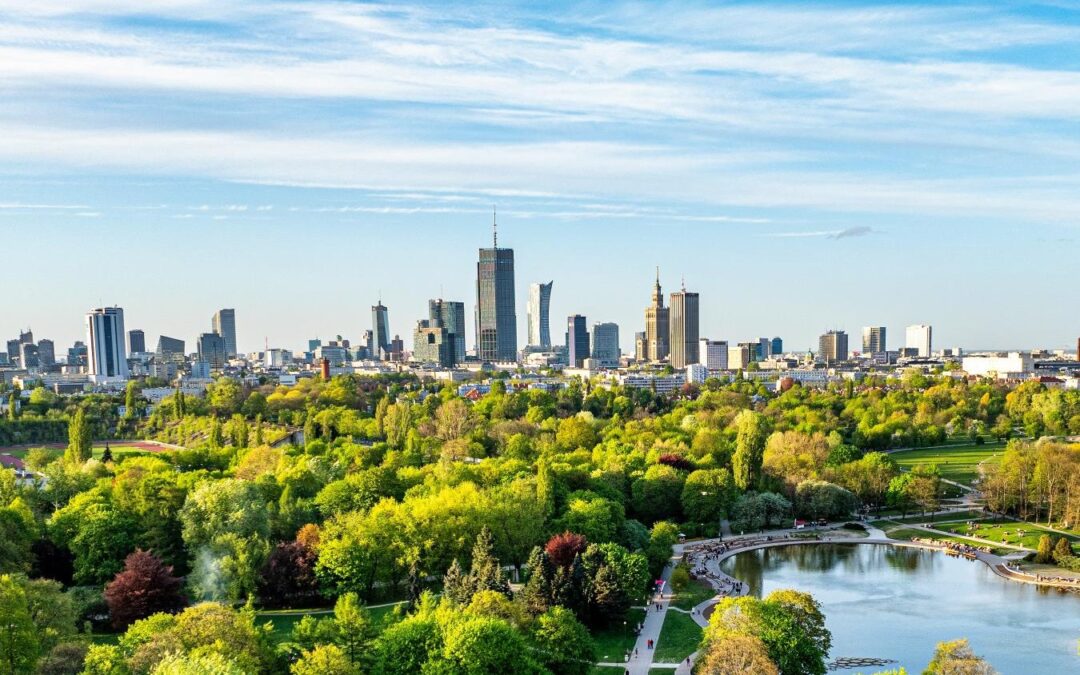
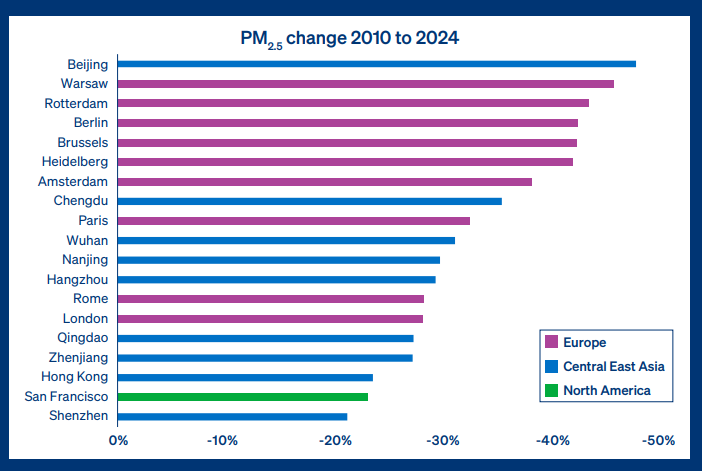
Warsaw reduced its level of fine particulate matter (PM2.5), a type of air pollution that causes a particular threat to health, by 46% between 2010 and 2024. That was the second biggest decrease among 19 global cities included in a new international report.
Poland has long had some of the worst air pollution in Europe, causing an estimated tens of thousands of premature deaths annually. However, national and local authorities, including in Warsaw, have taken steps over the last decade to address the issue.
“Warsaw’s focus on improving air quality has paid off,” write the authors of the new study, published by Breathe Cities, an initiative to improve air quality launched in 2023 by Bloomberg Philanthropies, the Clean Air Fund and C40 Cities.
Among the factors identified as being behind Warsaw’s success is the introduction of a ban on burning coal for heating households, supported by financial aid to help residents transition to cleaner fuels.
The report also pointed to Warsaw’s clean transport zone, which bans older, more polluting cars; the expansion of its bike path network from 275 km in 2010 to over 870 km in 2025; the opening of a new tram line and expansion of the metro system; and an increase of low- and zero-emission buses to 40% of its fleet
The authors also cited an increase in the availability of data on air quality and campaigns to increase public awareness of pollution.
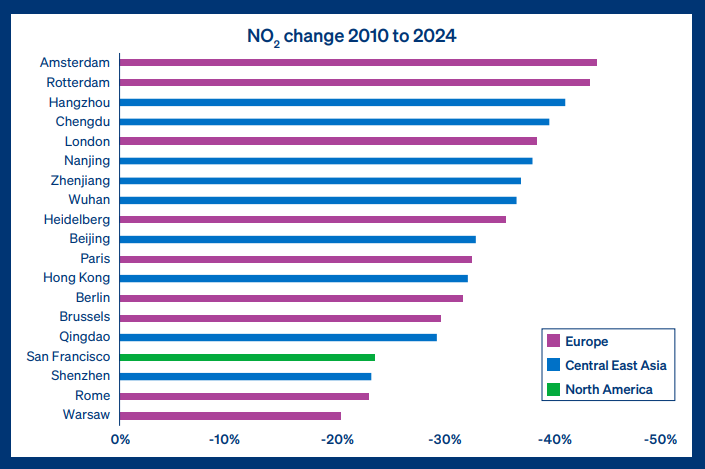
The new study analyses trends in levels of PM2.5 and nitrogen dioxide (NO2), another harmful substance produced by burning fossil fuels, between 2010 and 2024 in the 19 C40 cities that achieved a drop of at least 20% in both pollutants.
Only Beijing in China, which saw PM2.5 levels drop by 48%, had a larger reduction than Poland’s capital, while Rotterdam, Berlin, Brussels and Heidelberg also recorded decreases of over 40%.
Fine particulates, which result from human activities such as the burning of fossil fuels, are the most harmful form of air pollution. Polish cities sometimes record PM2.5 levels several times over the recommended norms, particularly during the colder months, when many homes are heated by burning coal.
The level of NO2 also dropped in Warsaw over the same period. However, its decrease of 20% was the lowest of the 19 cities that qualified for the study. The Dutch pair of Amsterdam and Rotterdam topped the list, with declines of 44% and 43% respectively.
Notes from Poland is run by a small editorial team and published by an independent, non-profit foundation that is funded through donations from our readers. We cannot do what we do without your support.
Main image credit: UM Warszawa
Ben Koschalka is a translator, lecturer, and senior editor at Notes from Poland. Originally from Britain, he has lived in Kraków since 2005.