Keep our news free from ads and paywalls by making a donation to support our work!

Notes from Poland is run by a small editorial team and is published by an independent, non-profit foundation that is funded through donations from our readers. We cannot do what we do without your support.
By Aleks Szczerbiak
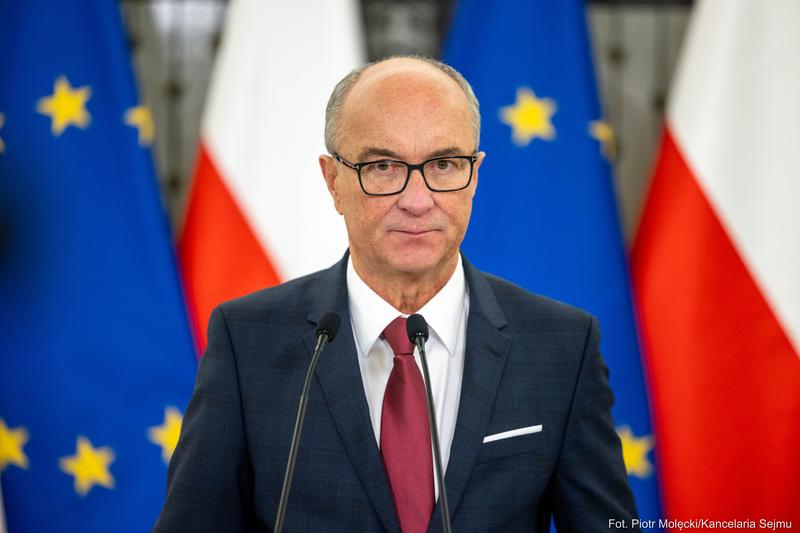
The new speaker has transformed the post into a forceful political weapon, using its powers to shield the government, sideline opponents and amplify the left’s influence. Controversial yet highly effective, he has become one of the liberal-centrist prime minister’s key strategic allies and the ruling coalition’s uncompromising enforcer.
A key strategic position
In December 2023, a coalition headed up by liberal-centrist Civic Coalition (KO) leader Donald Tusk took office following eight years’ rule by the right-wing Law and Justice (PiS) party, currently the main opposition grouping. The ruling coalition also includes the agrarian-centrist Polish People’s Party (PSL), liberal-centrist Poland 2050 (Polska 2050) party and breakaway Centre (Centrum) caucus, and the New Left (Nowa Lewica).
Last November, New Left leader Włodzimierz Czarzasty was elected speaker of the Sejm, Poland’s more powerful lower parliamentary chamber. Czarzasty took over from the then-Poland 2050 leader Szymon Hołownia as part of a formal coalition agreement to rotate the position after two years.
The new speaker of parliament has banned the sale of alcohol in parliamentary buildings.
He said that politicians need to "set an example", especially as they discuss a law potentially introducing tougher restrictions on the sale of alcohol in shops https://t.co/YjWyyQxKlR
— Notes from Poland 🇵🇱 (@notesfrompoland) November 19, 2025
He will now serve as Sejm speaker until the next parliamentary election, scheduled for autumn 2027. The speaker is a key strategic position within the Polish political system as the second-highest ranking state official and first in line to take over as acting president if PiS-backed incumbent Karol Nawrocki could no longer fulfil the office.
Czarzasty also wields vast legislative power with a range of procedural tools that give him near-total control of parliamentary debates, and can block any draft law by simply refusing to put it on the agenda.
Controversial but effective
Czarzasty is a highly controversial political figure. As a member of the former ruling communist Polish United Workers’ Party (PZPR) from 1983 until its dissolution in 1990, his critics accuse him of whitewashing the abuses of that regime and embodying a “post-communist” mentality.
Two leading left-wing politicians, both former members of the pre-1989 communist party, have sparked a row by saying that the Soviet Union "liberated Poland" at the end of WWII https://t.co/p4bRdB3VXO
— Notes from Poland 🇵🇱 (@notesfrompoland) December 2, 2019
They cite Czarzasty’s alleged central role in the so-called “Rywin scandal”, a landmark high-profile corruption case from the early 2000s involving allegations of high-level bribery and influence-peddling in the Polish media sector at a time when he was secretary of the national broadcasting council (KRRiT).
Film producer Lew Rywin solicited a bribe in exchange for legislative changes that would allow the Agora media group (publisher of the influential liberal-left Gazeta Wyborcza newspaper) to buy a TV station. A parliamentary investigative commission identified Czarzasty as a key member of the so-called “group in power” that Rywin claimed he was acting on behalf of.
For his part, Czarzasty dismissed the scandal as politically motivated and highlighted the fact that he was never formally charged with any crime.
Czarzasty took over the leadership of the communist successor Democratic Left Alliance (SLD) in 2016. Although the Alliance was the most powerful political and electoral force on the left for most of the post-communist period, and governed the country in 1993-1997 and 2001-2005, the Rywin scandal and a series of others destroyed its popularity and the party’s support collapsed in the 2005 parliamentary election.
After the 2015 election, for first time in post-communist Poland there were no left-wing parties represented in the Sejm. At this stage, the Alliance appeared to be in a downward spiral, with many commentators writing it off as a cynical and corrupt political grouping whose ageing, communist-nostalgic electorate was literally dying off.
However, through brokering a strategic alliance with the socially liberal Spring (Wiosna) and radical left Together (Razem) parties, Czarzasty reversed the Alliance’s fortunes and was the architect of the left’s return to parliament in 2019, and then government as a junior partner in 2023.
The opposition groups likely to form the next government have signed a coalition agreement
They pledged to:
– restore rule of law
– annul the near-total abortion ban
– depoliticise public media
– prosecute anti-LGBT hate speech
– separate church and state https://t.co/lwQvGGok8s— Notes from Poland 🇵🇱 (@notesfrompoland) November 10, 2023
In 2021, the Alliance relaunched itself as the New Left following a merger with Spring, with Czarzasty one of the two joint leaders. Last December, Czarzasty was elected as the party’s sole leader, having spent months touring the country to ensure his allies won regional leadership elections so that other potential challengers withdrew from the race.
Czarzasty’s elevation to the Sejm speakership was thus seen as the crowning moment of his political career.
Alleged Russian links
During the last few weeks, however, Czarzasty has faced intense criticism for his reported Russian-linked social and business associations.
In January, the right-wing media reported that, even though he has access to classified information by virtue of his position as Sejm speaker, Czarzasty has not completed a personal security questionnaire required for extended verification by the Polish internal security agency (ABW).
This became a major political flashpoint, with critics arguing that he was deliberately avoiding the vetting process to hide the uncovering of suspicious relations during a deep background check.
In particular, investigative reports claimed that Svetlana Chestnykh, a Russian author and businesswoman with alleged Kremlin ties, co-authored books published by Muza, Czarzasty’s former publishing house, and purchased a shareholding in the company managing a hotel where Czarzasty’s wife Małgorzata serves as vice-president.
Last month, at a meeting of Poland’s National Security Council (RBN), a presidential advisory body, Nawrocki called upon Czarzasty to account for his reported Russian connections and lack of security credentials.
President Nawrocki has called a meeting of the National Security Council to discuss Poland's proposed EU defence loans, its invitation to join Donald Trump's Board of Peace, and the alleged "eastern contacts" (meaning Russian) of the speaker of parliament https://t.co/hbJ5D3aIVS
— Notes from Poland 🇵🇱 (@notesfrompoland) February 4, 2026
During the meeting, the president questioned Czarzasty’s fitness for public office, saying that it was a potential national security risk for his first successor to have not passed a formal, extended personal verification, linking the allegations to Russia’s intensified ongoing hybrid war actions against Poland.
Czarzasty rejected these accusations as orchestrated by the right-wing opposition to destabilise the governing coalition. His supporters argued that he has access to top-secret information because the intelligence services checked his contacts and had no concerns of any security threat.
Czarzasty also demanded that Nawrocki explain his own past, specifically his contact with individuals connected to organised crime through his work as a hotel security officer, and alleged ties to football hooligan “pseudo-fan” groups.
Nawrocki‘s supporters, in turn, said that the president had undergone extended vetting procedures on a number of occasions and not hidden his ties to the Lechia Gdańsk fan community, pointing out that Tusk had himself reminisced about being a football hooligan during his youth.
An uncompromising enforcer
Czarzasty’s modus operandi as speaker marks a sharp contrast with his predecessor. While Hołownia focused on public engagement and parliamentary showmanship, Czarzasty maintains a much more formal and stoic demeanour.
Although Hołownia was criticised for alleged unlawful acts against opposition parliamentarians, he tried to operate in a more consensual and non-partisan way, particularly towards the end of his term when he resisted pressure from government supporters to prevent Nawrocki being sworn in as president.
On the other hand, Czarzasty views the speaker’s role as an uncompromising enforcer of the government’s programme and his relationship with the opposition and president are much more antagonistic.
The Polish speaker of parliament’s announcement in Kyiv that Poland would help Ukraine join the EU “as soon as possible” has prompted a backlash back at home, including from some allies within the ruling coalition as well as the president's chief of staff https://t.co/ziy9k2B687
— Notes from Poland 🇵🇱 (@notesfrompoland) February 25, 2026
For example, shortly after he was elected speaker, Czarzasty pledged explicitly to shield the government from opposition tactics by using the so-called “speaker’s veto”: blocking presidential legislative initiatives unilaterally if he deemed them harmful.
The concept was controversial because no such formal institution exists in Polish law. Czarzasty used the term more as a statement of political will and reference to the fact that because he controls the parliamentary agenda the speaker can “freeze” legislation indefinitely.
Interestingly, Czarzasty and Tusk clearly have one of the closest and strongest working relationships among coalition leaders, with the New Left a loyal and generally uncritical member of the ruling alliance.
Indeed, they appear to have agreed an unofficial but co-ordinated strategic division of labour effectively partitioning their appeal to different segments of the coalition’s electorate. Tusk pivots to the right on issues such as migration and security, while Czarzasty acts as the more radical voice shoring up the government’s liberal-left flank.
Countering the radical left
Czarzasty’s election as speaker also offers the New Left a high-profile platform to improve its government bargaining power and voter mobilisation potential. The party is particularly keen to counter the challenge from Together which, although elected to parliament on a joint ticket with the New Left, chose to maintain its independence from the government and distinct ideological identity.
In last year’s presidential candidate, Together leader Adrian Zandberg actually secured more votes than the New Left-backed candidate Magdalena Biejat.
Czarzasty’s strategy to counter the Together challenge is based on arguing that being in government yields results and thereby presenting his formation as the only effective left-wing political force. While policy gains may be relatively small and incremental, he dismisses Together as purists sniping from the sidelines who talk about radical change but lack the power and agency to actually deliver.
A small left-wing party, Together (Razem), has decided to cut ties with the ruling coalition and form a separate parliamentary group.
It accuses the government of failing to fulfil its promises and says it will vote against the proposed 2025 state budget https://t.co/AiA1QYErQs
— Notes from Poland 🇵🇱 (@notesfrompoland) October 28, 2024
Czarzasty has also used the speaker’s procedural powers to marginalise Together’s parliamentary influence by excluding smaller groupings from the so-called “seniors’ convention” that manages Sejm business.
Nonetheless, although the New Left is currently the only governing party apart from Civic Coalition to cross the 5% parliamentary representation threshold – the Politico Europe opinion poll aggregator has it averaging 8% compared with 3% for Together – Czarzasty has left the door open for a future electoral alliance.
Diplomatic row
Czarzasty’s heavily ideologically driven political style, and Tusk’s buy-in for this approach, was exemplified by his recent diplomatic spat with US Ambassador Tom Rose. Last month, Rose announced that the US embassy had officially severed relations with the speaker following a major disagreement over his sharp criticisms of US President Donald Trump.
Czarzasty stated publicly that Trump did not deserve a Nobel Peace Prize nomination, describing his foreign policy as violating international norms and accusing him of disrespecting Poland as an ally by saying that the USA’s allies had not supported it adequately during the war in Afghanistan.
The US has cut all contact with the speaker of Poland's parliament because of his "outrageous insults" against President Trump.
In response, Polish Prime Minister @donaldtusk told the US ambassador that "allies should respect, not lecture, each other" https://t.co/h2gGH7iMkn
— Notes from Poland 🇵🇱 (@notesfrompoland) February 5, 2026
Rose described these comments as outrageous and unprovoked insults and a serious impediment to otherwise excellent relations between Poland and the USA.
Czarzasty, however, defended his position, stating that while he respected the USA as a key Polish ally, he would not change his stance on a fundamental issue regarding international law. In fact, while most Poles continue to believe that the USA remains Poland’s only credible military security guarantor, Trump is also a very divisive figure and disliked intensely by those who identify with the liberal-left.
So, if anything, Czarzasty is likely to have benefited politically from the row. Moreover, the fact that Tusk strongly defended Czarzasty, as he has on a number of occasions, illustrates how the prime minister views his arrangement with the Sejm speaker as crucial to maintaining coalition stability.
A majority in Poland believe the US is no longer a reliable ally, finds a new poll.
A number of recent surveys have indicated that Poles – normally among the most pro-American Europeans – have much more negative views of the US since Donald Trump's return https://t.co/KdfSuVP7rA
— Notes from Poland 🇵🇱 (@notesfrompoland) February 2, 2026
Not to be underestimated
Czarzasty is widely regarded among both allies and enemies as a highly effective backroom political operator who prioritises power and pragmatism over ideological purity. Surviving the Rywin scandal cemented his reputation as a man who can navigate the most dangerous of political waters.
After the left collapsed in the mid-2000s, Czarzasty meticulously rebuilt the movement not through public charisma but by merging different factions and often ruthlessly sidelining rivals to maintain control.
Although critics of his leadership style argue Czarzasty has turned the New Left into an extension of his personal will, his ability to secure and maintain control of the party is a masterclass in institutional hardball and back-room manoeuvring.
By securing the speaker rotation deal, Czarzasty ensured that, even as the smallest coalition partner, the New Left holds the second-most powerful state post, and has used Sejm procedural rules to neuter the opposition much more aggressively than his predecessor.
His unofficial deal with Tusk to target different electoral constituencies shows that Czarzasty is one of the few politicians that the prime minister treats as a serious partner.
In short, while he lacks the smoothness and easy charm of many modern politicians, Czarzasty has a deep understanding of how the political process and machinery of the Polish state actually work and is not to be underestimated.
Notes from Poland is run by a small editorial team and published by an independent, non-profit foundation that is funded through donations from our readers. We cannot do what we do without your support.
Main image credit: Piotr Molęcki/Kancelaria Sejmu (under CC BY-SA 4.0)