Keep our news free from ads and paywalls by making a donation to support our work!

Notes from Poland is run by a small editorial team and is published by an independent, non-profit foundation that is funded through donations from our readers. We cannot do what we do without your support.
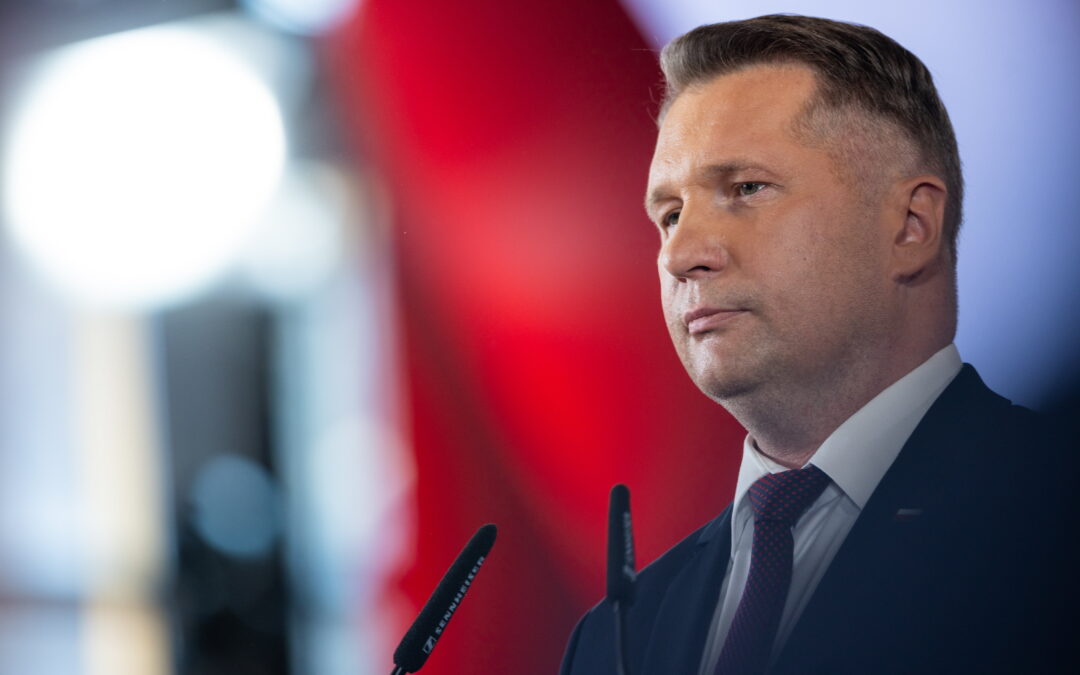
Przemysław Czarnek, the newly nominated prime ministerial candidate of the national-conservative Law and Justice (PiS), Poland’s main opposition party, has made overtures towards the far-right Confederation (Konfederacja), with which PiS would likely have to cooperate if it were to form a government after the next elections.
At the same time, Czarnek has ruled out the idea of Grzegorz Braun, an even more radical far-right figure, serving in a PiS-led government. However, he did not directly answer a question as to whether PiS could form a coalition with Braun’s Confederation of the Polish Crown (KKP) party.
The national-conservative opposition PiS party has named its candidate to be prime minister if it wins next year’s parliamentary elections.
Przemysław Czarnek is a hardline conservative who played a prominent role in PiS's campaign against "LGBT ideology" https://t.co/sSJLON00hW
— Notes from Poland 🇵🇱 (@notesfrompoland) March 7, 2026
Czarnek was announced on Saturday by PiS leader Jarosław Kaczyński as the party’s candidate to be prime minister if it wins parliamentary elections, which are due to take place in the autumn of 2027.
It is very unusual to name a candidate so early. The move was part of an effort by Kaczyński to reverse his party’s falling support in the polls, which now stands at around 24%, its lowest level since 2012.
That drop has coincided with rises for both of its far-right rivals, with Confederation now averaging support of around 13% in polls and KKP 8%.
The decision to name Czarnek, who is a hardline conservative figure, as PiS’s prime ministerial candidate is widely seen as a way to win back voters from the far right and potentially to make it easier to form a coalition government after the elections.
After Czarnek was unveiled, one of Confederation’s two main leaders, Sławomir Mentzen, issued a set of nine questions asking for Czarnek’s views on the record of the former PiS government, which ruled Poland from 2015 to 2023, in areas often criticised by Confederation.
They included its response to the Covid pandemic, relations with Ukraine, migration policy and EU climate rules.
In response, Czarnek did not answer Mentzen’s questions specifically, saying that he would do so later “privately and publicly”. But he added that he believes “you and I share the same opinion…that Poland needs a responsible right-wing government”.
However, speaking to Polsat News on Sunday, Confederation’s other main leader, Krzysztof Bosak, said that his group’s voters “do not want a return to the pathologies of the PiS government” and “remember perfectly well” Czarnek’s role serving in it as education minister from 2020 to 2023.
Drogi Sławku. Dziękuję Ci za szczere – jak mam nadzieję – gratulacje. Podyskutujmy. Odpowiem Ci kompleksowo na wszystkie Twoje wątpliwości i pytania. Prywatnie i publicznie. Bo i ja i Ty – jak wierzę – mamy to samo zdanie, które już kilka miesięcy temu Ci napisałem na X….… https://t.co/w5NibVcBrB
— Przemysław Czarnek (@CzarnekP) March 7, 2026
While many expect PiS to seek to work with Confederation to form a government, there have long been question marks over what it would do if Braun’s KKP was also needed in order to form a parliamentary majority after the elections.
This year, Kaczyński has twice publicly ruled out working with the vociferously antisemitic, anti-Ukrainian and anti-American Braun, whose rhetoric also often echoes Russia’s position. “There is no question of any alliances with Braun’s party,” said the PiS leader in February.
However, Czarnek last month refused to rule out the possibility of working with Braun, saying that “anything is possible”.
On Sunday, the day after his unveiling as PiS’s prime minister candidate, Czarnek was asked by Polsat News if he would consider having Braun in his government. “There is no such possibility,” he responded, saying he was “200%” certain of that.
However, when subsequently asked if Braun’s party could be part of a PiS-led coalition, Czarnek did not respond directly, instead reiterating only that Braun “is a man who is absolutely unfit for any government”.
PiS, which is closely aligned with Donald Trump, has reportedly been under pressure from Washington to rule out working with Braun.
On Sunday, the US ambassador to Poland, Tom Rose, shared Notes from Poland’s story about Braun last week visiting the Iranian embassy to sign a book of condolence for Supreme Leader Ali Khamenei, who was killed in the ongoing US and Israeli attacks on Iran.
“America and POTUS [the president of the United States] will not forget who are [sic] friends are; and more importantly, who are [sic] friends are NOT,” wrote Rose, who in a separate post also called Braun’s visit to the Iranian embassy “disgusting”.
America and @POTUS will not forget who are friends are; and more importantly, who are friends are NOT. https://t.co/9lTdaJ8983
— Tom Rose (@TomRoseIndy) March 8, 2026
Meanwhile, senior figures from Poland’s more liberal, pro-EU ruling coalition, which ranges from left to centre right, have sought to portray Czarnek’s selection by Kaczyński as a sign that PiS is moving towards the far right.
“So, [we now have] three Confederations against us,” wrote Tusk, suggesting that PiS has joined Confederation and Braun’s Confederation of the Polish Crown. “There’s nothing to fear, but they cannot be underestimated. One thing is certain: in 2027, everything is at stake for Poland.”
“In my opinion, Przemysław Czarnek is a very good candidate for prime minister…of Afghanistan,” wrote foreign minister Radosław Sikorski, referring to Czarnek’s hardline conservative views.
Czarnek once warned of the dangers of telling women they can “study, build a career first, and maybe [have] a child later”, because “saying to a woman that she doesn’t have to do what God has called her to do…leads to tragic consequences”.
A więc trzy Konfederacje przeciwko nam. Nie ma czego się bać, ale nie można ich lekceważyć. Jedno jest pewne: w 2027 Polskę czeka gra o wszystko.
— Donald Tusk (@donaldtusk) March 7, 2026
Notes from Poland is run by a small editorial team and published by an independent, non-profit foundation that is funded through donations from our readers. We cannot do what we do without your support.
Main image credit: Jakub Wlodek / Agencja Wyborcza.pl

Daniel Tilles is editor-in-chief of Notes from Poland. He has written on Polish affairs for a wide range of publications, including Foreign Policy, POLITICO Europe, EUobserver and Dziennik Gazeta Prawna.