Keep our news free from ads and paywalls by making a donation to support our work!

Notes from Poland is run by a small editorial team and is published by an independent, non-profit foundation that is funded through donations from our readers. We cannot do what we do without your support.
Poland’s president and central bank governor, both of whom are associated with the right-wing opposition, have proposed a “sovereign, Polish” alternative to the government’s plan to borrow €44 billion for defence spending through the European Union’s SAFE programme.
They claim that their plan, which President Karol Nawrocki dubbed “Polish SAFE 0%”, would involve no loans or interest payments, and is therefore more beneficial. However, they did not provide details of how it would work in practice, saying that those would be provided at a later stage.
Prezydent RP @NawrockiKn na temat polskiej alternatywy dla programu SAFE. pic.twitter.com/aSWJy5MmGd
— Kancelaria Prezydenta RP (@prezydentpl) March 4, 2026
In February, the European Commission approved Poland’s €44 billion (188 billion zloty) share of the SAFE programme. Later that month, the government’s majority in parliament approved a bill that would create a financial mechanism for Poland to receive the loans.
The legislation then passed to Nawrocki, who has 21 days to either sign it into law, veto it, or send it to the constitutional court for assessment.
The government urged the president to sign it, arguing that the funds were vital for strengthening Poland’s national security as well as boosting the domestic defence industry, where they claim almost 90% of the money would be spent.
However, the right-wing opposition wants Nawrocki to veto the bill. They claim that SAFE will bring Poland further under the control of Brussels and have also expressed concern about the fact that most funds need to be spent in Europe, whereas Poland buys much of its military hardware from the US and South Korea.
Nawrocki and his senior national-security and foreign-policy advisors have voiced similar concerns about SAFE, although the president has not yet announced whether he will veto the bill.
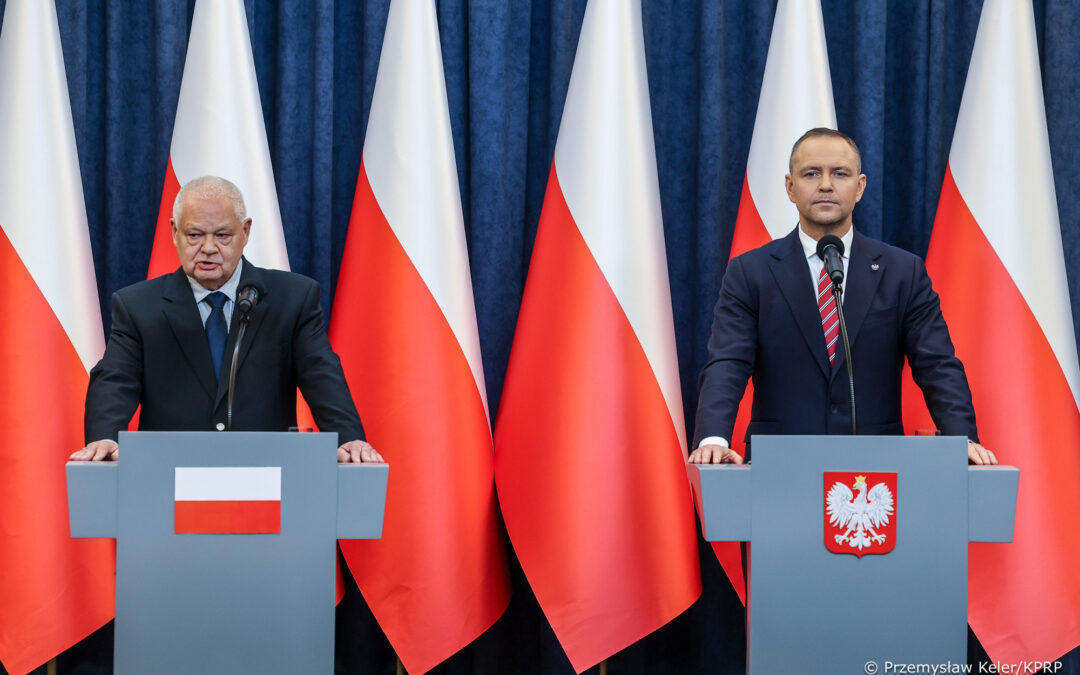
On Thursday, Nawrocki unexpectedly announced, alongside Adam Glapiński, the governor of the National Bank of Poland (NBP), that the pair had put together plans for “a Polish, effective and sovereign alternative to SAFE”.
Their proposal “will guarantee 185 billion zloty, interest-free and debt-free”, that can be used for defence spending, claimed the president. As the money is sourced domestically, it could also be spent more flexibly than the EU loans.
Parliament has approved a bill facilitating Poland’s receipt of €44bn in loans for defence spending from the EU's SAFE programme.
It remains unclear, however, whether President Nawrocki will sign the bill or veto it, as the opposition has urged him to do https://t.co/xIj15uKAIK
— Notes from Poland 🇵🇱 (@notesfrompoland) February 27, 2026
Neither Nawrocki nor Glapiński provided details of exactly where the money would come from or via what mechanism. “The time will come for details, and we’ll provide them,” said the central bank chief. “[For now] we are merely stating and calculating that such possibilities exist.”
There were, however, some hints of what they had in mind. Glapiński noted that the NBP “transfers most of our profits, 55%, to the government. They are used for a specific purpose. In this case, we expect it to be specifically to strengthen Polish defence”.
Nawrocki mentioned that the “Polish SAFE” plans are “helped by investments, of course, but also by the purchase and accumulation of Polish gold by the National Bank of Poland”.
Glapiński, who was appointed as NBP governor under the former Law and Justice (PiS) government and is a close associate of PiS chairman Jarosław Kaczyński, has rapidly expanded the central bank’s gold reserves during his tenure.
Poland is set to become the world’s tenth biggest holder of gold after its central bank announced plans to increase its reserves to 700 tonnes.
"This will place Poland among the elite," declared the bank's governor, Adam Glapiński https://t.co/x6SCOiyt4d
— Notes from Poland 🇵🇱 (@notesfrompoland) January 20, 2026
Both Nawrocki and Glapiński noted that their plan would require the cooperation of the government and its majority in parliament, given that new legislation would need to be passed.
Nawrocki said he would invite Prime Minister Donald Tusk and defence minister Władysław Kosiniak-Kamysz for talks on the idea. Glapiński said that discussions could also take place with finance minister Andrzej Domański.
In response to their announcement, Kosiniak-Kamysz wrote on social media that he was open to “additional instruments for financing the armed forces”. However, he added that these are “not an alternative to SAFE”, which “provides the fastest and most concrete measures for modernising the Polish army”.
Likewise, the government’s plenipotentiary for SAFE, Magdalena Sobkowiak-Czarnecka, told Polsat News that she “absolutely does not see this [Nawrocki’s proposal] as an alternative [to SAFE], but as a complement” to it.
Program SAFE daje najszybsze i konkretne środki na modernizację polskiej armii dlatego wojskowi, przemysł zbrojeniowy oraz wszyscy, którym na sercu leży wzmocnienie siły naszej armii apelują i liczą na podpis pod ustawą przez @prezydentpl.
Jeśli jednak pojawią się kolejne…
— Władysław Kosiniak-Kamysz (@KosiniakKamysz) March 4, 2026
Notes from Poland is run by a small editorial team and published by an independent, non-profit foundation that is funded through donations from our readers. We cannot do what we do without your support.
Main image credit: Przemysław Keler/KPRP

Daniel Tilles is editor-in-chief of Notes from Poland. He has written on Polish affairs for a wide range of publications, including Foreign Policy, POLITICO Europe, EUobserver and Dziennik Gazeta Prawna.