Keep our news free from ads and paywalls by making a donation to support our work!

Notes from Poland is run by a small editorial team and is published by an independent, non-profit foundation that is funded through donations from our readers. We cannot do what we do without your support.
Ukraine has granted permission for searches at another location on its territory for the remains of Polish victims of massacres carried out by Ukrainian nationalists during World War Two.
The legacy of the so-called Volhynia massacres, in which around 100,000 Polish civilians were killed, has long soured relations between Warsaw and Kyiv. However, a diplomatic breakthrough last year led to the resumption of exhumations, which had previously been banned by Ukraine.
🇵🇱🇺🇦
Ministerstwo Kultury Ukrainy wydało zgodę na prace poszukiwawcze w rejonie Huty Pieniackiej
__
Міністерство культури України надав дозвіл на пошукові роботи в районі Гути Пеняцької
Link/Покликання: https://t.co/YcIj1MV7fG— Ukraine in Poland (@UKRinPL) February 18, 2026
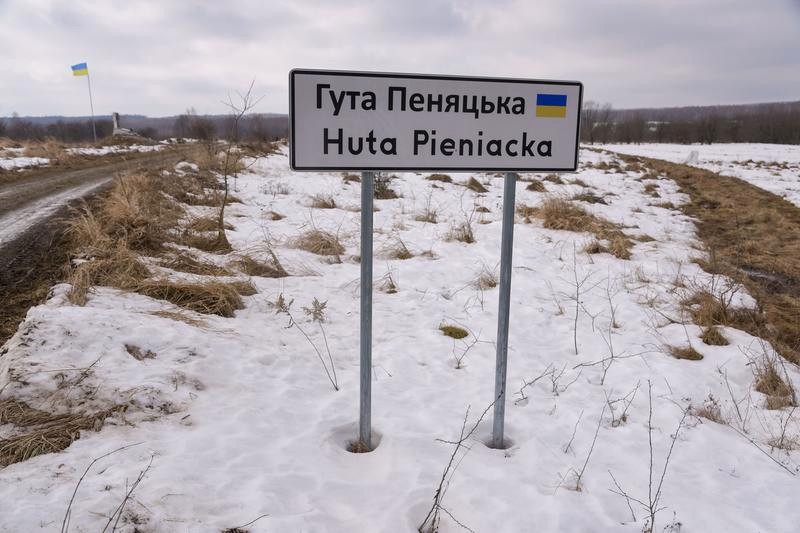
On Wednesday, Ukraine’s culture ministry and Poland’s state Institute of National Remembrance (IPN) announced that the Ukrainian authorities had approved a request from the IPN to search for burial sites in the depopulated former village of Huta Peniatska (Huta Pieniacka in Polish).
The village had been part of Poland before the war but is now in western Ukraine. According to the IPN, on 28 February 1944, Ukrainian members of the Nazi Waffen-SS together with a unit of the Ukrainian Insurgent Army (UPA) carried out a “pacification operation” there that resulted in the deaths of around 850 people.
The Ukrainian culture ministry says that a joint Polish-Ukrainian will search for burial sites. “If remains are discovered, the work will continue in the form of exhumation with subsequent reburial,” they added, saying that Ukraine “emphasises the importance of honouring the dead and preserving their memory”.
The news was welcomed by a spokesman for Polish President Karol Nawrocki, who said that the permission had granted thanks to Nawrocki raising the issue during a meeting with his Ukrainian counterpart, Volodymyr Zelensky, in December.
Wymierne efekty grudniowego spotkania Prezydenta RP Karola Nawrockiego z Prezydentem Ukrainy Wołodymyrem Zełenskim w Warszawie.
Sprawa wydania przez władze Ukrainy zgód na rozpoczęcie prac poszukiwawczych i ekshumacyjnych Ofiar Zbrodni Wołyńskiej była jednym z głównych tematów… https://t.co/lVeB0kmMEV— Rafał Leśkiewicz (@LeskiewiczRafa) February 18, 2026
After lifting its ban last year, Ukraine gave permission for the exhumation of victims in the depopulated former village of Puzhnyky (Puźniki in Polish). The remains of at least 42 people were subsequently discovered, and in September were reburied in a ceremony attended by the Polish and Ukrainian culture ministers.
In October, Ukraine granted permission for exhumation in the former Polish village of Ugły, and then in December for exhumations in three other locations.
In 2022, the IPN estimated that the remains of around 55,000 ethnic Polish victims and 10,000 Jewish ones “still lie in death pits in Volhynia, waiting to be found, exhumed, and buried”.
However, from 2017 until last year, Ukraine imposed a ban on searches for massacre victims on its territory in response to the dismantlement of a UPA monument in Poland.
Poland has criticised the fact that many in Ukraine still venerate the UPA and individuals seen as responsible for the Volhynia massacres. Meanwhile, Ukraine rejects Poland’s position that the massacres constituted a genocide.
Earlier this month, the IPN condemned the head of its Ukrainian counterpart after he called the Volhynia massacres part of a “Polish grand narrative” and said that, in Ukraine, they are regarded merely as a “local historical episode”. He also suggested they did not constitute genocide.
The dispute over the massacres is more than just symbolic. In 2024, a Polish deputy prime minister said that Poland would not allow Ukraine to be admitted to the European Union until the two countries “resolve” their differences over Volhynia.
That position was also expressed last year by Nawrocki, who, while campaigning for the presidency, said that he “currently does not envision Ukraine in either the EU or NATO until important civilisational issues for Poland are resolved”.
Poland's state historical institute has criticised remarks by the head of its Ukrainian counterpart about massacres of Poles by Ukrainians in WWII.
He said they are regarded in Ukraine as a "local episode" and suggested they do not constitute a genocide https://t.co/MAi6RhpRDL
— Notes from Poland 🇵🇱 (@notesfrompoland) February 11, 2026
Notes from Poland is run by a small editorial team and published by an independent, non-profit foundation that is funded through donations from our readers. We cannot do what we do without your support.
Main image credit: Witalij Hrabar/Konsulat Generalny RP we Lwowie (under CC BY-SA 4.0)
Olivier Sorgho is senior editor at Notes from Poland, covering politics, business and society. He previously worked for Reuters.